Ready when you are: First evidence that visual cues affect timing of sexual maturation
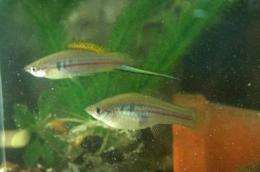
February 14, 2007 Male and female green swordtail fish

Male and female green swordtail fish. Credit: Copyright Craig Walling, University of Exeter

Scientists from the Universities of Exeter and Glasgow today reveal how some females become sexually mature more quickly if they see attractive males. Research published today in the Royal Society journal Biology Letters shows for the first time how the sight of physical ornamentation on another member of the group determines when an individual is ready to mate.

The researchers studied a captive population of green swordtail fish, a species native to Central America and popular in tropical aquariums. The green swordtail is named after the striking sword-like growth, which males develop on their tail-fin, so they appear larger and more attractive to females.

The females in the group that were shown males with long 'swords' reached sexual maturity earlier than those that were not by up to four months. Young males that were shown mature males with impressive 'swords' matured later than those that saw lower quality competitors. Both sexes are unconsciously using visual cues to increase their likely mating opportunities. For females, this means maximising the quality of potential mates and for males, this means delaying maturity until there is less competition from more attractive males.

'This is the first evidence that a species adjusts its rate of sexual maturation in response to visual cues. While our study focused on green swordtail fish, it seems unlikely that this attribute is limited to this one species,' said Dr Craig Walling of the University of Exeter's School of Biosciences.

Previous studies have shown that the timing of sexual maturation can be determined by chemical stimulus from other individuals in a variety of species, including some mammals like rats and sheep. In this study the fish were kept in separate tanks so while they could see members of the opposite sex through the glass, they could not use other senses to respond to one another.

Dr Walling continues: 'It's well established that sexual maturation in swordtails is highly variable, occurring anywhere between four and 20 months of age even though they rarely live longer than two years. We were really surprised to find that visual cues can have such an effect on sexual maturation, which is so important to an individual's reproductive success.'

Source: University of Exeter


print this article email this article download pdf blog this article bookmark this article     Stumble it Digg this share on Facebook retweet share on Reddit add to delicious
Rate this story - 4.2 /5 (11 votes)


February 14, 2007 all stories

Comments: 0

4.2 /5 (11 votes)
  • Stumble this up

  • Digg this

  • share this

  • hide
  • Related Stories

  • Why do animals, especially males, have so many different colors?
    created Oct 31, 2009 | popularity not rated yet | comments 0
  • Absent pheromones turn flies into lusty Lotharios
    created Oct 14, 2009 | popularity not rated yet | comments 0
  • When Being a Cuckold Makes Evolutionary Sense
    created Oct 09, 2009 | popularity not rated yet | comments 0
  • The story of X -- evolution of a sex chromosome
    created Apr 16, 2009 | popularity not rated yet | comments 0
  • Hormones and brain activity: Study sheds light on facial preferences
    created Nov 13, 2008 | popularity not rated yet | comments 0


Other News

Whiteflies sabotage alarm system of plant in distress

Whiteflies sabotage alarm system of plant in distress

Biology / Plants & Animals

created 1hour ago | popularity not rated yet | comments 0

(PhysOrg.com) -- When spider mites attack a bean plant, the plant responds by producing odours which attract predatory mites. These predatory mites then exterminate the spider mite population, thus acting ...


Knockouts in human cells point to pathogenic targets

Knockouts in human cells point to pathogenic targets

Biology / Cell & Microbiology

created 9 minutes ago | popularity not rated yet | comments 0

(PhysOrg.com) -- Whitehead researchers have developed a new approach for genetics in human cells and used this technique to identify specific genes and proteins required for pathogens.


RNA on the move

RNA on the move

Biology / Cell & Microbiology

created 1hour ago | popularity not rated yet | comments 0

In the fruit fly Drosophila, oskar mRNA, which is involved in defining the animal’s body axes, is produced in the nuclei of nurse cells neighbouring the oocyte, and must be transported to the oocyte and along ...


Variable Temperatures Leave Insects wtih a Frosty Reception

Biology / Plants & Animals

created 17 hours ago | popularity not rated yet | comments 0

(PhysOrg.com) -- For the first time, scientists at The University of Western Ontario have shown that insects exposed to repeated periods of cold will trade reproduction for immediate survival.


When camouflage is a plant's best protection

Rare woodland plant uses 'cryptic coloration' to hide from predators

Biology / Plants & Animals

created 20 hours ago | popularity 4.3 / 5 (3) | comments 0

It is well known that some animal species use camouflage to hide from predators. Individuals that are able to blend in to their surroundings and avoid being eaten are able to survive longer, reproduce, and ...