Shaky Ground

February 14, 2007 Shaky Ground

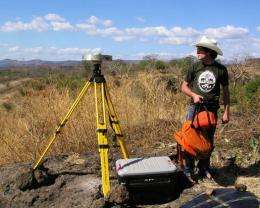
Graduate student Richard Styron makes a final visual check of a GPS antenna set-up over a newly installed geodetic benchmark near Laurel Galan, Nicaragua. This is one of several new sites installed near the boundary of the Nicaraguan Depression to investigate the transition from the seismically active forearc sliver to the stable Caribbean plate. Photo by Henry Turner.

University of Arkansas researchers have used measurements of tiny movements in the Earth's crust to gain a better understanding of earthquake dynamics in Nicaragua, where a large quake devastated the city of Managua in 1972. Their findings confirm a prediction of movement in the Earth's surface, but show little perpendicular strain associated with the movement, indicating a lack of coupling between the converging plates despite earthquake activity, a surprising finding.

University of Arkansas graduate student Henry L. Turner III, professors Pamela Jansma and Glen Mattioli of the University of Arkansas, Peter LaFemina of Penn State University, Armando Saballos of the Instituto Nicaragüense de Estudios Territoriales and Timothy Dixon of the University of Miami, Florida, reported their findings in the journal Geophysical Research Letters.

Nicaragua has a history of seismic activity, but little is known about the plate movements in the region and how they might be linked to earthquakes. Researchers know that the Earth's surface is broken into 12 major plates, with some minor plates. However, movement at the plate boundaries, where earthquake activity often occurs, varies, and in some places, like Nicaragua, the link between movement and earthquakes is poorly understood.

"We want to look at what the boundary is like," Turner said.

Using global positioning satellite technology, researchers have gathered data since 2000 that measure tiny movements of the Earth's surface at sites in Nicaragua. Researchers returned to the sites annually to collect data. Using the information gathered, Turner and his colleagues calculated the rate of movement along the Pacific coast of Nicaragua during that time frame.

They found that the region is moving to the northwest at a rate of about 15.1 millimeters per year relative to the Caribbean plate, a relatively fast clip in the world of plate movement. This movement corresponded well with a prediction made in 2001.

However, the researchers were surprised by a lack of perpendicular motion that would indicate the type of strain typical of earthquake-prone regions in subduction zones.

"There's definitely a large seismic hazard there," Turner said. "That makes you think that there's some coupling occurring on the plate interface." Coupling, or locking, happens when plate boundaries stick, then slip, creating the motion that causes earthquakes.

"It's possible that some of what we're seeing could be post-seismic relaxation," Turner said. Another possibility is that frequent, small events are releasing the energy that normally would build up, or the locked portion of the plate interface is too shallow and too far offshore for the arc-normal component of strain to be detected. Turner and his colleagues plan to develop more complex models to help determine the relationship between movement and earthquakes in the region.

"It's probably a combination of the three," Turner said.

Turner, Jansma and Mattioli are in the geosciences department of the J. William Fulbright College of Arts and Sciences. Turner is also a distinguished doctoral fellow in the Arkansas Center for Space and Planetary Sciences.

Source: University of Arkansas


print this article email this article download pdf blog this article bookmark this article     Stumble it Digg this share on Facebook retweet share on Reddit add to delicious
Rate this story - 4 /5 (4 votes)


February 14, 2007 all stories

Comments: 0

4 /5 (4 votes)
  • Stumble this up

  • Digg this

  • share this

  • hide
  • Related Stories

  • Not only the gene itself, its abnormal regulation can also trigger short stature
    created Aug 25, 2009 | popularity not rated yet | comments 0
  • Uncovering the secrets of ulcer-causing bacteria
    created Aug 12, 2009 | popularity not rated yet | comments 0
  • A ton of bitter melon produces sweet results for diabetes
    created Mar 27, 2008 | popularity not rated yet | comments 0
  • Raiding for women in the pre-Hispanic Southwest?
    created Nov 10, 2006 | popularity not rated yet | comments 0
  • Australian woman dies after 60 years in iron lung
    created Oct 31, 2009 | popularity not rated yet | comments 0


  • hide
  • Relevant PhysicsForums posts

Other News

Hawaii's famed white sandy beaches are shrinking (AP)

Hawaii's famed white sandy beaches are shrinking

Space & Earth / Environment

created 3 hours ago | popularity not rated yet | comments 1

(AP) -- Jenn Boneza remembers when the white sandy beach near the boat ramp in her hometown was wide enough for people to build sand castles.


Wu Chang Gong temple in Taiwan was partially levelled by a powerful earthquake ten years ago

Taiwan to boost quake warning system

Space & Earth / Earth Sciences

created 4 hours ago | popularity not rated yet | comments 0

Taiwan plans to build its first undersea seismic station, designed to improve the island's early warning system and save valuable seconds when earthquakes strike, officials said.


Commuters wait on the platform shrouded by fog in London

Climate change not man-made, say majority of Britons: poll

Space & Earth / Environment

created 3 hours ago | popularity 3 / 5 (2) | comments 3

Less than half of Britons believes that human activity is to blame for global warming, according to a poll carried out for The Times newspaper and published on Saturday.


NASA on track for Monday space shuttle launch (AP)

NASA on track for Monday space shuttle launch

Space & Earth / Space Exploration

created 18 hours ago | popularity 3 / 5 (1) | comments 0

(AP) -- NASA has cleared space shuttle Atlantis for liftoff Monday on a trip to stock up the International Space Station with several years' worth of spare parts.


Controversial new climate change results

Controversial new climate change results

Space & Earth / Environment

created Nov 10, 2009 | popularity 4 / 5 (39) | comments 81

(PhysOrg.com) -- New data show that the balance between the airborne and the absorbed fraction of CO2 has stayed approximately constant since 1850, despite emissions of CO2 having risen from about 2 billion ...