Googling brain proteins with 3-D goggles
February 15, 2007
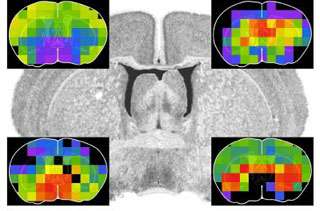
Abundance profiles of four different proteins compiled from 1 millimeter cubes (voxels) in a mouse brain. The boxes correspond to the locations of the voxels in the brain, and the colors represent their relative abundance in each region (from high, red, to low, violet). Credit: Pacific Northwest National Laboratory
The Allen Brain Atlas, a genome-wide map of the mouse brain on the Internet, has been hailed as “Google of the brain.” The atlas now has a companion or the brain’s working molecules, a sort of pop-up book of the proteins, or proteome map, that those genes express.
The protein map is “the first to apply quantitative proteomics to imaging,” said Richard D. Smith, Battelle Fellow at the Department of Energy’s Pacific Northwest National Laboratory, who led the mapping effort with Desmond Smith of UCLA’s David Geffen School of Medicine.
“Proteins are the lead actors, the most important part of the picture,” PNNL’s Smith said. “They are the molecules that do the work of the cells.”
Fine-tuning such proteome maps will enable comparisons of healthy brains with others whose protein portraits look different. Contrasts in location and abundance of proteins may display the earliest detectable stages of Alzheimer’s, Parkinson’s and other neurological diseases. They hope such diseases might be curbed if caught and treated early enough.
The National Institutes of Health-funded study, performed at DOE’s Environmental Molecular Sciences Laboratory on PNNL’s campus, is published in the advance online edition of Genome Research and featured in current Nature online Neuroscience Gateway (http://www.brainat … ainatlas.org). PNNL staff scientists Vladislav A. Petyuk, Wei-Jun Qian and UCLA’s Mark Chin are co-lead authors.
To produce the map, the team characterized center-brain slices as several dozen 1 millimeter cubes, or “voxels,” to “show us where proteins appear in the brain and where they vary in abundance,” PNNL’s Smith said. “We labeled all the proteins so we would have reference points so we know we’re looking at the same protein between different parts of the brain and from one mouse to another.”
Until now, proteomics, which enlists a specially modified instrument called a mass spectrometer for the task of identifying proteins and tallying them, has been akin to flying blind over a lake of proteins. The abundance and protein type could be discerned from a given sample, but “knowing their location and how the abundances change in different cases is important for understanding what they do,” PNNL’s Smith said.
He said that variations in genomic material across the slice, specifically messenger RNA, from the Allen Brain Atlas should be similar to the observed proteome. This turned out to be the case, which helped to validate the new measurements.
“What the Allen Brain Atlas doesn’t tell you is which genes produce proteins and how much of each of them,” he said. Marrying the voxel map with proteomics, researchers were able to generate “quantitative information on close to 1,200 different proteins.”
Source: Pacific Northwest National Laboratory
-
Making the worms turn
Feb 03, 2012 |
not rated yet |
0
-
Transcriptional barcoding of retinal cells identifies disease target cells
Jan 23, 2012 |
5 / 5 (2) |
0
-
New method pinpoints important gene-regulation proteins
Jan 18, 2012 |
5 / 5 (3) |
0
-
Study offers clue as to why alcohol is addicting: Drinking releases brain endorphins
Jan 11, 2012 |
3.5 / 5 (2) |
0
-
How the brain cell works: A dive into its inner network
Dec 21, 2011 |
3 / 5 (2) |
0
-
Engineers build first sub-10-nm carbon nanotube transistor
Feb 01, 2012 |
4.9 / 5 (31) |
30
-
Something old, something new: Evolution and the structural divergence of duplicate genes
Jan 31, 2012 |
4.6 / 5 (7) |
1
-
The hidden nanoworld of ice crystals: Revealing the dynamic behavior of quasi-liquid layers
Jan 30, 2012 |
5 / 5 (3) |
1
-
Stock market network reveals investor clustering
Jan 27, 2012 |
3.9 / 5 (23) |
8
-
Of microchemistry and molecules: Electronic microfluidic device synthesizes biocompatible probes
Jan 26, 2012 |
5 / 5 (1) |
0
-
Is Everyday Technology Killing Us?
Feb 08, 2012
-
Exercise and weight loss
Feb 08, 2012
-
Why do we have head aches? Our brains can't feel anything.
Feb 07, 2012
-
"The end of diseases" by David Agus, interview from Daily Show with Jon Stewart
Feb 04, 2012
-
Oncolytic adenovirus
Feb 04, 2012
-
Nutrition label stuffs and diets
Feb 02, 2012
- More from Physics Forums - Medical Sciences
More news stories
Study finds that anti-diabetic medication can prevent the long-term effects of maternal obesity
In a study to be presented today at the Society for Maternal-Fetal Medicine's annual meeting, The Pregnancy Meeting, in Dallas, Texas, researchers will report findings that show that short therapy with the anti-diabetic medication ...
16 hours ago |
5 / 5 (1) |
1
Steroid injections prove effective in treatment of lumbar disc herniations
The use of epidural steroid injections may be a more efficient treatment option for lumbar disc herniations, according to research presented today at the American Orthopaedic Society for Sports Medicine's Specialty Day in ...
16 hours ago |
5 / 5 (1) |
0
Amateur football players not always keen on returning to play after ACL injuries
Despite the known success rates of reconstructive Anterior Cruciate Ligament (ACL) surgery, the number of high school and collegiate football players returning to play may not be as high as anticipated, say researchers presenting ...
16 hours ago |
not rated yet |
0
FDA-approved drug rapidly clears amyloid from the brain, reverses Alzheimer's symptoms in mice
Neuroscientists at Case Western Reserve University School of Medicine have made a dramatic breakthrough in their efforts to find a cure for Alzheimer's disease. The researchers' findings, published in the journal Science, show t ...
Medicine & Health / Neuroscience
Feb 09, 2012 |
4.9 / 5 (51) |
20
|
Study finds elevated levels of cell-free DNA in first trimester do not predict preeclampsia
In a study to be presented today at the Society for Maternal-Fetal Medicine's annual meeting, The Pregnancy Meeting, in Dallas, Texas, researchers will report findings that indicate that elevated levels of cell-free DNA in ...
16 hours ago |
not rated yet |
0
Walney offshore wind farm is world's biggest (for now)
(PhysOrg.com) -- The Walney wind farm on the Irish Sea--characterized by high tides, waves and windy weather--officially opened this week. The farm is treated in the press as a very big deal as the Walney ...
GPS court ruling leaves US phone tracking unclear
A US Supreme Court decision requiring a warrant to place a GPS device on the car of a criminal suspect leaves unresolved the bigger issue of police tracking using mobile phones, legal experts say.
Europeans protest controversial Internet pact
Tens of thousands of people marched in protests in more than a dozen European cities Saturday against a controversial anti-online piracy pact that critics say could curtail Internet freedom.
Europe stakes billion-dollar bet on new rocket
A pencil-slim rocket is scheduled to lift into space from South America on Monday, carrying a billion-dollar bet that Europe can grab a juicy slice of the market to place satellites in low orbit.
Netflix settlement trims 14 pct off 4Q earnings
(AP) -- Netflix pressed the rewind button on its fourth-quarter earnings after settling allegations that the video subscription service violated a consumer-privacy law.
Navy to begin tests on electromagnetic railgun prototype launcher
The Office of Naval Research (ONR)'s Electromagnetic (EM) Railgun program will take an important step forward in the coming weeks when the first industry railgun prototype launcher is tested at a facility ...