Stem cells determine their daughters' fate
February 15, 2007
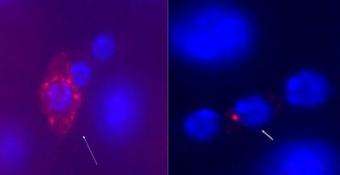
Intestinal stem cells (ISCs) in the gut of the fruit fly, Drosophila melanogaster, directly determine the fate of their daughter cells. The signaling protein called Delta, seen here in red, determines what type of cell the ISCs will produce. Large amounts of Delta signal the daughter cells to become gut-lining enterocytes (left panel), while small amounts of Delta signal them to become hormone-generating enteroendocrine cells (right panel). Images used with permission of the American Association for the Advancement of Science, Science, February 16, 2007.
From roundworm to human, most cells in an animal's body ultimately come from stem cells. When one of these versatile, unspecialized cells divides, the resulting "daughter" cell receives instructions to differentiate into a specific cell type. In some cases this signal comes from other cells. But now, for the first time, researchers at the Carnegie Institution's Department of Embryology have found a type of stem cell that directly determines the fate of its daughters.
The finding, reported in the January 25 online edition of the journal Science, could transform our basic understanding of stem cells by demonstrating that some tissues maintain themselves throughout life. It could also prove valuable in the fight against some cancers.
"We found that stem cells can participate actively in determining what type of cell their daughters will become right at the moment of stem cell division," said Embryology director and study co-author Allan Spradling. "This suggests that tissue stem cells might not just be a source of new cells, but could actually be the ‘brains' of the tissue—the cells that figure out what type of new cell is needed at any given moment."
Because they truly can become any cell in the body, "embryonic" stem cells tend to receive a lot of attention. Yet "adult" stem cells remain in fully-developed organisms, where they replace specific cell types lost to age or disease. Spradling and postdoctoral researcher Benjamin Ohlstein performed the study using intestinal stem cells (ISCs), a type of adult stem cell in the fruit fly Drosophila melanogaster that they discovered only a year ago.
These cells directly use the "Notch" signaling pathway, a system well-known to biologists, to replenish one of two cell types in the fruit fly's gut. The fate of any given daughter appears to depend on a protein, called Delta, which sits on the surface of the ISC and activates the Notch pathway in its daughters.
"Delta and the Notch receptor protein are both attached to the surface of cells, and don't float around freely, so we always have to assume that the Delta signal comes from nearby cells," Ohlstein said. "But the ISC is literally about as nearby as you can get."
Most daughters receive a strong Delta signal from the ISC and become enterocytes (ECs)—cells that line the inside of the gut and absorb nutrients. But when the Delta signal is weak, the daughters will become hormone-generating enteroendocrine cells. For every 15-20 ECs it creates, a given ISC will also produce two enteroendocrine cells, usually in matched pairs at the same time.
Spradling and Ohlstein tracked the whereabouts of Delta, Notch, and several other related proteins using fluorescent marker molecules. They found that most ISCs have large amounts of Delta protein. This made it relatively easy to single out ISCs during the experiments—usually a significant challenge with stem cells—and to track where Delta molecules moved over time.
Delta seems to control not just what types of new cells are made, but also puts the brakes on excessive cell division. In several experiments where Delta or other Notch signaling genes were disabled or blocked, the daughter cells continued to divide, eventually producing tumors.
"Each individual stem cell seems to have a great degree of independence from the rest of the animal's body," Spradling explained. "On one hand, the ISCs can respond quickly to the needs of the gut lining as it loses cells. On the other hand, they seem rather vulnerable to losing control of cell division."
It remains to be proven whether ISCs require a specific microenvironment created by neighboring cells, known as a niche, as other types of stem cells in Drosophila and mammals do. Understanding such a niche could have huge implications for the study of certain kinds of cancer, including those of the brain and intestine.
Future studies of ISCs might also reveal how the mammalian intestine responds to nutrition, stress, and illness. Like the fruit fly gut, mammalian intestines also contain large numbers of dispersed stem cells.
"Our hope is that the distinctive molecular properties of Drosophila ISCs we discovered will now allow mammalian intestinal stem cells to be definitively identified and better studied," Spradling added.
Source: Carnegie Institution
-
Neurologic improvement detected in rats receiving stem cell transplant
13 hours ago |
not rated yet |
0
-
Cure of ADPKD by selection for spontaneous genetic repair events in Pkd1-mutated iPS cells
11 hours ago |
not rated yet |
0
-
Nanotube therapy takes aim at breast cancer stem cells
Feb 09, 2012 |
5 / 5 (1) |
0
-
US begins stem cell trial for hearing loss
Feb 08, 2012 |
not rated yet |
1
-
Exercise triggers stem cells in muscle
Feb 06, 2012 |
4.7 / 5 (6) |
0
-
Engineers build first sub-10-nm carbon nanotube transistor
Feb 01, 2012 |
4.9 / 5 (31) |
30
-
Something old, something new: Evolution and the structural divergence of duplicate genes
Jan 31, 2012 |
4.6 / 5 (7) |
1
-
The hidden nanoworld of ice crystals: Revealing the dynamic behavior of quasi-liquid layers
Jan 30, 2012 |
5 / 5 (3) |
1
-
Stock market network reveals investor clustering
Jan 27, 2012 |
3.9 / 5 (23) |
8
-
Of microchemistry and molecules: Electronic microfluidic device synthesizes biocompatible probes
Jan 26, 2012 |
5 / 5 (1) |
0
More news stories
Entire genome of extinct human decoded from fossil
(PhysOrg.com) -- In 2010, Svante Pääbo and his colleagues presented a draft version of the genome from a small fragment of a human finger bone discovered in Denisova Cave in southern Siberia. The ...
Feb 07, 2012 |
4.7 / 5 (58) |
44
|
Why are there so few fish in the Earth's oceans?
(PhysOrg.com) -- A Stony Brook University researcher has found that, contrary to popular belief, there are not plenty of fish in the sea.
Feb 08, 2012 |
4.3 / 5 (17) |
26
|
Miami battling invasion of giant African snails
No one knows how they got there. But an invasion of African giant snails has southern Florida in a panic over potential crop damage, disease and general yuckiness surrounding the slimy gastropods.
Feb 10, 2012 |
4.5 / 5 (2) |
5
Deciding to go left or right: Researchers use device to determine that lower animals can navigate too
For decades, scientists have associated binary decision making opting to go left or right with higher-ranking animals, including humans. A team of Harvard researchers, however, is rewriting that ...
Feb 09, 2012 |
4 / 5 (1) |
4
|
The power of estrogen -- male snakes attract other males
A new study has shown that boosting the estrogen levels of male garter snakes causes them to secrete the same pheromones that females use to attract suitors, and turned the males into just about the sexiest ...
Feb 10, 2012 |
4.8 / 5 (6) |
2
|
Walney offshore wind farm is world's biggest (for now)
(PhysOrg.com) -- The Walney wind farm on the Irish Sea--characterized by high tides, waves and windy weather--officially opened this week. The farm is treated in the press as a very big deal as the Walney ...
GPS court ruling leaves US phone tracking unclear
A US Supreme Court decision requiring a warrant to place a GPS device on the car of a criminal suspect leaves unresolved the bigger issue of police tracking using mobile phones, legal experts say.
Europeans protest controversial Internet pact
Tens of thousands of people marched in protests in more than a dozen European cities Saturday against a controversial anti-online piracy pact that critics say could curtail Internet freedom.
Europe stakes billion-dollar bet on new rocket
A pencil-slim rocket is scheduled to lift into space from South America on Monday, carrying a billion-dollar bet that Europe can grab a juicy slice of the market to place satellites in low orbit.
Study finds that anti-diabetic medication can prevent the long-term effects of maternal obesity
In a study to be presented today at the Society for Maternal-Fetal Medicine's annual meeting, The Pregnancy Meeting, in Dallas, Texas, researchers will report findings that show that short therapy with the anti-diabetic medication ...
Netflix settlement trims 14 pct off 4Q earnings
(AP) -- Netflix pressed the rewind button on its fourth-quarter earnings after settling allegations that the video subscription service violated a consumer-privacy law.