Peering into the Pillars of Creation
February 15, 2007 Peering into the Pillars of Creation

Credit: X-ray: NASA/CXC/U.Colorado/Linsky et al.; Optical: NASA/ESA/STScI/ASU/J.Hester & P.Scowen

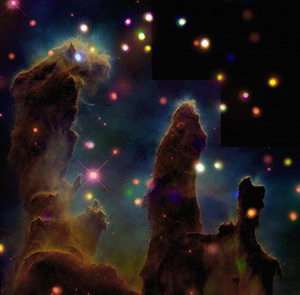
A new look at the famous "Pillars of Creation" with NASA’s Chandra X-ray Observatory has allowed astronomers to peer inside the dark columns of gas and dust. This penetrating view of the central region of the Eagle Nebula reveals how much star formation is happening inside these iconic structures.

The Chandra data shows bright X-ray sources in this field, most of which are young stars. In this image, red, green, and blue represent low, medium, and high energy X-rays. The Chandra data have been overlaid on the Hubble Space Telescope image to show the context of these X-ray data.

Very few X-ray sources are found in the pillars themselves. This suggests that the Eagle Nebula may be past its star-forming prime, since young stars are usually bright X-ray sources. However, there are two X-ray objects found near the tips of the pillars. One is a young star about 4 or 5 times as massive as the Sun, visible as the blue source near the tip of the pillar on the left. The other is a lower mass star near the top of the other pillar that is so faint it is not visible in the composite image.

The Chandra observations did not detect X-rays from any of the so-called evaporating gaseous globules, or EGGs. The EGGs are dense, compact pockets of interstellar gas where stars are believed to be forming. The lack of X-rays from these objects may mean that most of the EGGs do not contain enshrouded stars. However, infrared observations have shown that 11 of the 73 EGGs contain infant stellar objects and 4 of these are massive enough to form a star. The stars embedded in these 4 EGGs might be so young that they have not generated X-rays yet and one of them - estimated to have about the mass of the Sun - could represent one of the earliest stages of evolution of our nearest star. The Sun was likely born in a region like the Pillars of Creation.

The pillars and the few stars forming inside them are the last vestiges of star formation in the Eagle Nebula, also known as M16, which peaked several million years earlier. This contrasts strongly with the active star forming regions in other clusters such as NGC 2024, where Chandra sees a dense cluster of embedded young stars.

The results were published in the January 1st issue of The Astrophysical Journal.

Source: Chandra X-ray Center


print this article email this article download pdf blog this article bookmark this article     Stumble it Digg this share on Facebook retweet share on Reddit add to delicious
Rate this story - 4.5 /5 (15 votes)


February 15, 2007 all stories

Comments: 0

4.5 /5 (15 votes)
  • Stumble this up

  • Digg this

  • share this

  • hide
  • Related Stories

  • Animated Movie of Ice
    created Jan 07, 2008 | popularity not rated yet | comments 0
  • The world's smallest synchrotron, MIRRORCLE-6X, now commercially available
    created Feb 21, 2005 | popularity not rated yet | comments 0
  • X-ray Method Images Ions at Interface
    created Jun 12, 2004 | popularity not rated yet | comments 0


  • hide
  • Relevant PhysicsForums posts

Other News

2 Earth-sized bodies with oxygen rich atmospheres found -- but they're stars not planets

Two Earth-sized bodies with oxygen rich atmospheres found -- but they're stars not planets

Space & Earth / Astronomy

created 6 hours ago | popularity 4.7 / 5 (7) | comments 1

(PhysOrg.com) -- Astrophysicists at the University of Warwick and Kiel University have discovered two earth sized bodies with oxygen rich atmospheres - however there is a bit of a disappointing snag for anyone ...


Research gives new insights into 4 billion year-old meteorites

Research gives new insights into 4 billion year-old meteorites

Space & Earth / Astronomy

created 4 hours ago | popularity not rated yet | comments 0

(PhysOrg.com) -- Scientists have gained new insight into the makeup of ancient meteorites called Carbonaceous Chondrites, in research published in the October edition of the journal Earth Science and Planetary Le ...


NASA to Begin Attempts to Free Sand-Trapped Mars Rover

NASA to Begin Attempts to Free Sand-Trapped Mars Rover

Space & Earth / Space Exploration

created 4 hours ago | popularity not rated yet | comments 0

(PhysOrg.com) -- NASA will begin transmitting commands to its Mars exploration rover Spirit on Monday as part of an escape plan to free the venerable robot from its Martian sand trap.


Greenland ice cap melting faster than ever

Greenland ice cap melting faster than ever

Space & Earth / Earth Sciences

created 6 hours ago | popularity 3.5 / 5 (11) | comments 7

Satellite observations and a state-of-the art regional atmospheric model have independently confirmed that the Greenland ice sheet is loosing mass at an accelerating rate, reports a new study in Science.


Discoveries in the Deep

Discoveries in the Deep

Space & Earth / Earth Sciences

created 2 hours ago | popularity not rated yet | comments 0

Scientists from NASA and the Canadian Space Agency have been using Pavilion Lake as a testing ground for the future human exploration of other worlds.