More Evidence Found for Water on Mars
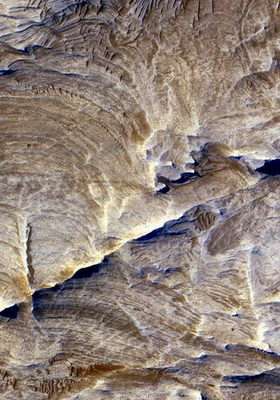
A spacecraft recently arrived at Mars has provided new evidence that fluids, likely including water, once flowed widely through underlying bedrock in a canyon that is part of the great Martian rift valley.
The new color images from the HiRISE camera aboard NASA's Mars Reconnaissance Orbiter show an equatorial landscape of hills composed of dozens of alternating layers of dark- and light-toned rocks, and crossed by dark sand dunes.
Within those layered deposits, the exquisitely detailed images show, there are a series of linear fractures, called joints, that are surrounded by "halos" of light-toned bedrock. In a paper to be published 16 February in the journal Science researchers argue that the "halos" offer clear evidence of past fluid flow through the bedrock.
Minerals in the fluid acted like cement to strengthen and bleach the rock, they say. The cemented rock proved more resistant to wind erosion than other features on the canyon walls and floor. It now serves as an exposed record of hydrological activity and offers a promising site to search for evidence of habitable niches in the Martian past.
Chris H. Okubo, the principal author of the paper and a postdoctoral researcher at the University of Arizona's Lunar and Planetary Laboratory, said the new images strongly suggest that subsurface fluids -- probably water, liquid carbon dioxide or a combination of the two -- once flowed abundantly in the western Candor Chasma region of Mars.
Okubo will discuss the paper during a 15 February news briefing at the 2007 AAAS Annual Meeting in San Francisco.
Candor Chasma is one of several canyons that make up the great Martian rift valley called Valles Marineris. The rift valley would extend across the United States and is 6 to 7 times deeper than the Grand Canyon in places. It is the deepest gash on any planet in the solar system.
The linear fractures photographed by HiRISE (the High Resolution Imaging Science Experiment) are hundreds of meters to several kilometers in length. The origin of the joints remains a mystery, Okubo said. But once formed, they provided a pathway for substantial flows from an underground reservoir of some kind. The timing of the flows remains uncertain, Okubo said, but could have occurred many millions or several billions of years ago.
"The fractures helped to increase the fluid flow through this area," Okubo said. And the associated halos of light-colored rocks suggest a familiar mechanism of action.
"On Earth, bleaching of rock surrounding a fracture is a clear indication of chemical interactions between fluids circulating within the fracture and the host rock," write Okubo and his co-author, Alfred S.McEwen. McEwen is a professor of planetary science at the University of Arizona and principal investigator for HiRISE.
McEwen said the fluid very likely was water, a key ingredient in any scenario for past or present life on Mars. Direct analysis of the chemical composition of the rock by future Mars rovers could confirm that, he said.
In the meantime, NASA's Opportunity rover, which has been roaming the Martian surface for three years, is now exploring the layered deposits exposed by Victoria Crater. That crater sits on a vast plain just south of the Martian equator. Scientists believe the layered deposits in the crater may have been formed by fluid processes similar to those at work in the Candor Chasma region photographed by the HiRISE camera. HiRISE images of Victoria Crater revealed structures along the eastern slopes of the crater that the authors believe could have formed from fluid motion along fractures, as in Candor Chasma.
Layered deposits have intrigued scientists since they first were discovered by the Mariner 9 and Viking orbiters in the 1970s. "The origin, history and nature of the light-toned, layered deposits are of great interest," McEwen said. "There has been lots of debate about the significance of these materials."
The layered outcrops suggest cycles of change in which materials were deposited in regular episodes of water, wind or volcanic activity. Scientists have debated whether the layered features in the Candor Chasma region were formed before or after the chasm opened up.
The HiRISE camera can detect surface features that are less than the size of a pixel, or about one foot across. That sort of resolution has allowed images of layered deposits with exceptional clarity and is providing new clues on the history and origin of the deposits.
The photos discussed in the Science paper were taken as part of an initial set of about 60 test images shortly after the Mars Reconnaissance Orbiter reached its final mapping orbit last fall. "We knew this region of Candor Chasma contained hydrated minerals," McEwen said. It had been observed previously by an instrument aboard the European Mars Express orbiter, which found spectral signatures for water-associated minerals called hydrated sulfates (including perhaps epsomite, a key ingredient in bath salts.)
In reviewing the first HiRISE images of the canyon, Okubo said, "We saw something very interesting," the first detailed evidence for cemented joints in the region. The spacecraft subsequently has found even more of the joints. (If rock is brittle, it can be laced with cracks. If the fractures or breaks occur where movement has taken place, such as seismic activity, they are called faults. If the cracks occur without movement --typically because of tension forces in the rock -- they are called joints.)
Organizers of the Mars symposium at the AAAS Annual Meeting note that Mars is the only other planet in the solar system that appears to have once had a habitable climate similar to that of Earth. Recent missions, now including the Mars Reconnaissance Orbiter, have returned ample evidence suggesting that early Mars had an active hydrological cycle, with streams, lakes, precipitation and groundwater flows. There even have been Mars Global Surveyor images, published in Science in December, suggesting that water may have flowed briefly in two Martian gullies within the past few years.
Much of the attention in the "follow the water" strategy had been devoted to features that appear to be dry lake or river beds. The new HiRISE images demonstrate that exposed joints and faults in underlying bedrock also may provide valuable new information on the history of Martian hydrology and geology, according to Okubo and McEwen.
Source: American Association for the Advancement of Science


