Scientists Find Lakes Under Antarctica
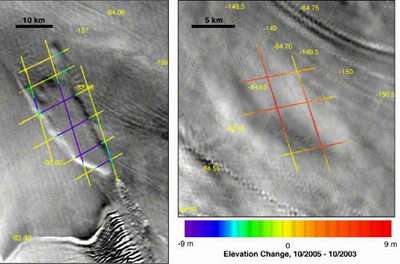
Scientists using NASA satellites have discovered an extensive network of waterways beneath a fast-moving Antarctic ice stream that provide clues as to how "leaks" in the system impact sea level and the world's largest ice sheet. Antarctica holds about 90 percent of the world's ice and 70 percent of the world's reservoir of fresh water.
With data from NASA satellites, a team of scientists led by research geophysicist Helen Fricker of the Scripps Institution of Oceanography, La Jolla, Calif., detected for the first time the subtle rise and fall of the surface of fast-moving ice streams as the lakes and channels nearly a half-mile of solid ice below filled and emptied. Results were presented Thursday at the annual meeting of the American Association for the Advancement of Science (AAAS) in San Francisco. The study will be published in the Feb. 16 issue of Science magazine.
"This exciting discovery of large lakes exchanging water under the ice sheet surface has radically altered our view of what is happening at the base of the ice sheet and how ice moves in that environment," said co-author Robert Bindschadler, chief scientist of the Laboratory for Hydrospheric and Biospheric Sciences at NASA's Goddard Space Flight Center, Greenbelt, Md.
"NASA's state-of-the-art satellite instruments are so sensitive we are able to capture an unprecedented three-dimensional look at the system beneath the thick ice sheet and measure from space changes of a mere 3 feet in its surface elevation. That is like seeing an elevation change in the thickness of a paperback book from an airplane flying at 35,000 feet."
The surface of the ice sheet appears stable to the naked eye, but because the base of an ice stream is warmer, water melts from the basal ice to flow, filling the system's "pipes" and lubricating flow of the overlying ice. This web of waterways acts as a vehicle for water to move and change its influence on the ice movement. Moving back and forth through the system's "pipes" from one lake to another, the water stimulates the speed of the ice stream's flow a few feet per day, contributing to conditions that cause the ice sheet to either grow or decay. Movement in this system can influence sea level and ice melt worldwide.
"There's an urgency to learning more about ice sheets when you note that sea level rises and falls in direct response to changes in that ice," Fricker said. "With this in mind, NASA's ICESat, Aqua and other satellites are providing a vital public service."
In recent years, scientists have discovered more than 145 subglacial lakes, a smaller number of which composes this "plumbing system" in the Antarctic. Bindschadler and Fricker; Ted Scambos of the National Snow and Ice Data Center in Boulder, Colo.; and Laurence Padman of Earth and Space Research in Corvallis, Ore.; observed water discharging from these under-ice lakes into the ocean in coastal areas. Their research has delivered new insight into how much and how frequently these waterways "leak" water and how many connect to the ocean.
The study included observations of a subglacial lake the size of Lake Ontario buried under an active area of west Antarctica that feeds into the Ross Ice Shelf. The research team combined images from the Moderate Resolution Imaging Spectroradiometer (MODIS) instrument aboard NASA's Aqua satellite and data from the Geoscience Laser Altimeter System (GLAS) on NASA's Ice Cloud and Land Elevation Satellite (ICESat) to unveil a multi-dimensional view of changes in the elevation of the icy surface above the lake and surrounding areas during a three-year period. Those changes suggest the lake drained and that its water relocated elsewhere.
MODIS continuously takes measurements of broad-sweeping surface areas at three levels of detail, revealing the outline of under-ice lakes. ICESat's GLAS instrument uses laser altimetry technology to measure even the smallest of elevation changes in the landscape of an ice sheet. Together, data from both have been used to create a multi-year series of calibrated surface reflectance images, resulting in a new technique called satellite image differencing that emphasizes where surface slopes have changed.
Source: Goddard Space Flight Center


