The Moon is a School for Exploration
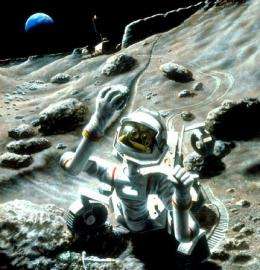
NASA has been exploring space for nearly half a century, often with stupendous success. Yet "there's one thing we really don't know: what is the best way to explore a planet?" declares Paul D. Spudis, a senior planetary scientist at Johns Hopkins University’s Applied Physics Laboratory in Laurel, Maryland.
Discovering the most effective techniques for exploring a planet is itself cutting-edge research—just as discovering the most effective mining technologies or the best ways of surviving and making machinery work in Antarctica are pioneering research.
Thus, for the same reasons that nations have founded university-level schools of mines and the U.S. Army founded its own Cold Regions Research and Engineering Laboratory, NASA wants to use the Moon as a graduate school for exploration.
On the Moon, astronauts can develop and test techniques for building habitats, harvesting resources and operating machinery in low gravity, high vacuum, harsh radiation, pervasive dust and fantastic extremes of temperature—an environment whose prolonged combination is simply impossible to duplicate on Earth. What they learn will be useful not only on the Moon, but also essential for preparations in going to Mars.
One research project topping the curriculum: What is the best combination of humans and robots? Unmanned orbiting spacecraft and rovers have returned millions of gigabytes of high-quality data from the Moon and planets, revolutionizing our understanding of the solar system. But for geological field work, says Spudis, nothing can replace a trained geologist with a rock hammer, experienced eyes, and the knowledge to "understand rocks in the context of their environment."
For that reason, NASA wants to explore how best to blend humans and machines. One promising technology is telepresence, similar to what's now used in hospital operating rooms for certain types of surgery. From the safety of a radiation-shielded underground lunar habitat, a geologist's movements could be "instantly mirrored by a robot on the surface, complete with instant sensory feedback much as an astronaut has through the gloves of a space suit," Spudis explains. Is that the best way, though? In some circumstances, a robot on its own making lightning-fast decisions with artificial intelligence might do a better job. Again, it's a question best answered by on-site research.
Other crucial things humans could learn from lunar experience is how to "make useful things from dirt," Spudis says. On the Moon and Mars, local resources are going to be crucial to astronauts who cannot remain wholly dependent on Earth for supplies. "Aside from solar power, we've never used space resources for any mission," Spudis says, "so we need to understand [how to do it]."
The official NASA acronym for living off the land is ISRU, for In-Situ Resource Utilization. ISRU is basically figuring out how to dig into the surface of another planet, how to get the alien dirt to funnel down a hopper in low gravity (a surprisingly tricky problem), and how to crack and heat the soil to extract valuable liquids and gases—all with high reliability and few mechanical problems.
What's in the lunar regolith that astronauts might need or want to mine? Most immediately useful are oxygen and hydrogen. "From those two elements, we can generate electricity using fuel cells, which make drinkable water as a by-product," Spudis explains. "Hydrogen and oxygen are also rocket propellant. The oxygen astronauts can breathe."
Good news: Oxygen on the Moon is abundant. The lunar crust is 40 percent oxygen by mass, and NASA scientists have lots of ideas for how to extract it. Simply heating lunar soil to very high temperature causes gaseous oxygen to emerge. The most efficient techniques remain to be discovered.
Not-so-good news: Hydrogen on the Moon is relatively rare. That's one reason NASA is keen to explore the lunar poles where some 10 billion metric tons of frozen water may exist in permanently shaded craters: "ice is a concentrated form of hydrogen," Spudis notes. Experience gained at the Moon's poles may apply to Mars, where ice is also thought to be mixed with deep soil and rock.
"We need to set up shop on the Moon for one clear and understandable reason," he concludes. "The Moon is a school for exploration."
Source: Science@NASA, by Trudy E. Bell


