New energy source? Scientists convert heat to power using organic molecules
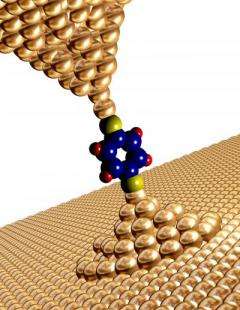
Researchers at the University of California, Berkeley, have successfully generated electricity from heat by trapping organic molecules between metal nanoparticles, an achievement that could pave the way toward the development of a new source for energy.
The discovery, described in a study published today in Science Express, an electronic publication of the journal Science, is a milestone in the quest for efficient ways to directly convert heat into electricity. Currently, the dominant method of power generation involves burning fossil fuels to create heat, often in the form of steam, to spin a turbine that, in turn, drives a generator that produces electricity.
An estimated 90 percent of the world's electricity - from power plants to car engines - is created through this indirect conversion of heat. In the process, a great deal of heat is wasted and released. Anyone who has ever had a car engine fail because of a malfunctioning radiator has experienced firsthand this excess heat.
"Generating 1 watt of power requires about 3 watts of heat input and involves dumping into the environment the equivalent of about 2 watts of power in the form of heat," said Arun Majumdar, UC Berkeley professor of mechanical engineering and principal investigator of the study. "If even a fraction of the lost heat can be converted into electricity in a cost-effective manner, the impact it would have on energy can be enormous, amounting to massive savings of fuel and reductions in carbon dioxide emissions."
Unfortunately, the temperature at which the heat is released is too low to be effectively used by traditional heat engines.
For the past 50 years, utilizing this wasted heat has been a major focus of research into thermoelectric converters, which employ a simpler, more direct method of generating electricity. Such converters rely upon the Seebeck effect, a phenomenon in which a voltage is created when the junctions of two different metals are kept at different temperatures.
However, such thermoelectric generators operate at a paltry 7 percent efficiency, compared with the 20 percent efficiency rate for traditional heat engines. Moreover, such converters are made up of exotic, expensive metal alloys, such as bismuth and tellurium, making them too costly and impractical for widespread use.
The new UC Berkeley study marks the first time the Seebeck effect has been measured in an organic molecule, laying the groundwork for the development of more cost-effective thermoelectric converters.
"The goal is to make things out of materials that are more abundant and more easily processed," said study co-author Rachel Segalman, UC Berkeley professor of chemical engineering. "Organics are cheap and can be processed easily."
The researchers coated two gold electrodes with molecules of benzenedithiol, dibezenedithiol or tribenzenedithiol, then heated one side to create a temperature differential. For each degree Celsius of difference, the researchers measured 8.7 microvolts of electricity for benzenedithiol, 12.9 microvolts for dibezenedithiol, and 14.2 microvolts for tribenzenedithiol. The maximum temperature differential tested was 30 degrees Celsius (54 degrees Fahrenheit).
"The effect may seem quite small now, but this is a significant proof of concept, and the first step in organic molecular thermoelectricity," said Pramod Reddy, a graduate student in UC Berkeley's Applied Science and Technology Program and co-lead author of the paper. "We are going down the road of cheap thermoelectric materials."
The next step for the researchers includes testing different organic molecules and metals, as well as fine tuning the assembly of the structure.
Majumdar, who is also a faculty scientist in materials science at Lawrence Berkeley National Laboratory, said the field of organic thermoelectricity could open doors to a new, inexpensive source of energy. "The use of inexpensive organic molecules and metal nanoparticles offers the promise of low-cost, plastic-like power generators and refrigerators," he said.
Source: University of California - Berkeley


