Strain Has Major Effect on High-Temp Superconductors
February 15, 2007 Strain Has Major Effect on High-Temp Superconductors

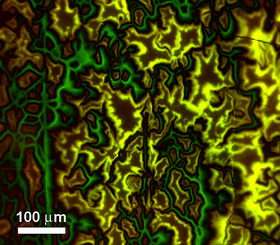
Magneto-optical image of magnetic fields within a YBCO superconductor showing electrically connected grains (yellow) and grain boundaries (green) that form barriers to superconducting currents. The large reversible effect of strain observed by NIST might be due to associated changes in grain boundaries, which raise the barriers to current flow and lower the material´s current-carrying capability. Credit: D.C. van der Laan/NIST

Just a little mechanical strain can cause a large drop in the maximum current carried by high-temperature superconductors, according to novel measurements carried out by the National Institute of Standards and Technology.

The effect, which is reversible, adds a new dimension to designing superconducting systems—particularly for electric power applications—and it also provides a new tool that will help scientists probe the fundamental mechanism behind why these materials carry current with no resistance.

The measurements, reported in Applied Physics Letters, revealed a 40 percent reduction in critical current, the point at which superconductivity breaks down, at just 1 percent compressive strain. This effect can be readily accommodated in the engineering design of practical applications, NIST project leader Jack Ekin says, but knowing about it ahead of time will be important to the success of many large-scale devices. The effect was measured in three types of yttrium-barium-copper-oxide (YBCO), a brittle ceramic considered the best prospect for making low-cost, high-current, superconducting wires.

The researchers developed a “four point” bend technique that enables studies of superconducting properties over a wide range of uniform strain at high current levels. The superconductor is soldered on top of a flexible metal beam, which is then bent up or down at both ends while the critical current is measured.

The discovery is the first major reversible strain effect found in practical high-temperature superconductors, which generally have been tested under smaller tensile strains only, or at strains so high they caused the material to break down permanently. The newly discovered effect is totally reversible and symmetric for both compressive and tensile (pushing and pulling) strains, suggesting it is intrinsic to the fundamental mechanism of superconductivity in YBCO.

The NIST team is now pursuing the possibility of using the effect as a new tool for probing the elusive mechanism underlying high-temperature superconductivity. The next step is to investigate how magnetic fields affect the strain effect, and several collaborations are under way with universities and other research organizations to study the interplay of the effect with other factors affecting high-temperature superconductivity. The research described in the new paper was supported in part by the U.S. Department of Energy.

Citation: D.C. van der Laan and J.W. Ekin. Large intrinsic effect of axial strain on the critical current of high-temperature superconductors for electric power applications. Applied Physics Letters, 90, 052506, 2006. Posted online Jan. 31.

Source: NIST


print this article email this article download pdf blog this article bookmark this article     Stumble it Digg this share on Facebook retweet share on Reddit add to delicious
Rate this story - 3.9 /5 (7 votes)


February 15, 2007 all stories

Comments: 0

3.9 /5 (7 votes)
  • Stumble this up

  • Digg this

  • share this

  • hide
  • Related Stories


  • hide
  • Relevant PhysicsForums posts

Other News

Solving big problems

Solving big problems with new quantum algorithm

Physics / Quantum Physics

created 6 hours ago | popularity 4.4 / 5 (11) | comments 0

(PhysOrg.com) -- In a recently published paper, Aram Harrow at the University of Bristol and colleagues from MIT in the United States have discovered a quantum algorithm that solves large problems much faster ...


The LHC tunnel

Peckish bird briefly downs big atom smasher

Physics / General Physics

created 18 hours ago | popularity 3.8 / 5 (9) | comments 11

A peckish bird briefly knocked out part of the world's biggest atom smasher by causing a chain reaction with a piece of bread, the European Organisation for Nuclear Research (CERN) said Monday.


First Bose-Einstein condensation of strontium

First Bose-Einstein condensation of strontium

Physics / Quantum Physics

created 12 hours ago | popularity 5 / 5 (4) | comments 1

In an international first, scientists from the Institute of Quantum Optics and Quantum Information (IQOQI, Austria) produced a Bose-Einstein condensate of the alkaline-earth element strontium, thus narrowly ...


Contracts Awarded for Production of NSLS-II Storage Ring Magnets

Physics / General Physics

created 4 hours ago | popularity not rated yet | comments 0

(PhysOrg.com) -- All seven contracts for the production of the NSLS-II storage ring magnets have now been awarded -- a significant milestone for the project. The magnets -- 750 in total -- will be made by vendors in the United ...


Ginzburg helped develop the Soviet Union's hydrogen bomb in the late 1940s and early 1950s

Russian bomb physicist Ginzburg dead at 93

Physics / General Physics

created 20 hours ago | popularity 5 / 5 (4) | comments 0

Nobel Physics prize winner Vitaly Ginzburg, who helped develop the Soviet hydrogen bomb, has died at age 93, the Russian Academy of Sciences said Monday.