First X-ray detection of a colliding-wind binary beyond Milky Way
February 16, 2007
First X-ray detection of a colliding-wind binary beyond Milky Way

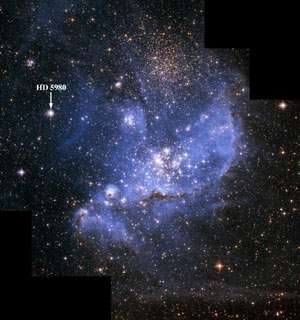
The Hubble Space Telescope captured this image of the Small Magellanic Cloud, a satellite of our Milky Way Galaxy. The arrow indicates the position of HD 5980, which is located near the edge of the star cluster NGC 346. Click image to enlarge. Credit: NASA/ ESA/Antonella Nota (STScI/ESA).

Imagine two stars with winds so intense that they eject an Earth's worth of material roughly once every month. Next, imagine those two winds colliding head-on. Such titanic collisions produce multimillion-degree gas, which radiates brilliantly in X-rays. Astronomers have conclusively identified the X-rays from about two-dozen of these systems in our Milky Way. But they have never seen one outside our galaxy — until now.

Thanks to the European Space Agency's XMM-Newton X-ray observatory, with help from NASA's Chandra X-ray Observatory, an international team led by Dr. Yaël Nazé of the Université de Ličge in Belgium has found such a system in the Small Magellanic Cloud, a dwarf galaxy located about 170,000 light-years from Earth.

The binary star system, known as HD 5980, contains two stars "weighing" about 50 and 30 times the mass of our Sun. Each star radiates more than a million times as much light as the Sun. The sheer photon pressure of this incredible outpouring of light blows off gas from each star in a "wind" that is 5 times faster than the solar wind. Each star's rate of mass loss is about 10 billion times greater than the solar wind.

HD 5980's two stars are separated by only about 56 million miles (90 million kilometers), roughly half Earth's average distance from the Sun. With such close proximity, the winds smash into each other with tremendous force, heating the gas and generating enormous numbers of X-rays. The system emits about 10 times more energy in X-rays alone than the Sun radiates over the entire spectrum.

Using data from Chandra, the same team first reported HD 5980's highly energetic X-ray emission in 2002. But its origin was uncertain. Data taken from 2000 to 2005 with XMM-Newton shows that it is indeed produced by a wind collision. The stars orbit each other every 20 days in a plane that is edge-on to Earth's line of sight, so the stars periodically eclipse each other. The wind collision is thus seen from different angles and through different amounts of material. XMM-Newton saw the X-ray emission rise and fall in a repeating, predictable pattern.

"Similar X-ray variability from massive binaries inside the Milky Way has been detected, but this is the first indisputable evidence for the phenomenon outside our galaxy," says Nazé. "This discovery highlights the great capabilities of modern X-ray observatories."

XMM-Newton has the largest mirrors of any X-ray observatory ever flown, which enabled astronomers to monitor this distant system. HD 5980 itself is embedded inside hot interstellar material that creates a diffuse X-ray glow that makes the object difficult to study. Chandra data enabled the scientists to pinpoint HD 5980 and resolve the system from the diffuse emission.

HD 5980 is one of the Small Magellanic Cloud's brightest stars. Situated on the periphery of the star cluster NGC 346, the two stars are nearing the end of their lives and will eventually explode as supernovae.

"Colliding winds provide an important handle on how massive stars shed material," says team member Dr. Michael F. Corcoran, a scientist with the Universities Space Research Association at NASA's Goddard Space Flight Center in Greenbelt, Md. "Being able to study them in external galaxies means we can study the effects of different compositions and environments on how these massive stars evolve. From the XMM-Newton data, we can study the delicate balance between the two winds, and determine the changing strength of the winds."

The team's paper has been accepted for publication in The Astrophysical Journal Letters.

Source: by Bob Naeye, Goddard Space Flight Center

4.7 /5 (19 votes)  

Rank 4.7 /5 (19 votes)
Tags

Related Stories
Relevant PhysicsForums posts
  • Scale of the Universe
    created11 hours ago
  • Titan's lack of impact craters
    createdFeb 09, 2012
  • Real pictures of black hole eating a star?
    createdFeb 08, 2012
  • Hypothetical way to travel faster than light, but not technically exceed lightspeed
    createdFeb 06, 2012
  • How do scientists monitor the Sun's activity?
    createdFeb 05, 2012
  • Search patterns in observational studies
    createdFeb 05, 2012
  • More from Physics Forums - General Astronomy

More news stories

Humans may have helped the decline of African rainforests 3000 years ago

(PhysOrg.com) -- Large areas of rainforests in Central Africa mysteriously disappeared over three thousand years ago, to be replaced by savannas. The prevailing theory has been that the cause was a change ...

Space & Earth / Environment

created 22 hours ago | popularity 4.3 / 5 (12) | comments 13 | with audio podcast report

Could Venus be shifting gear?

(PhysOrg.com) -- ESA’s Venus Express spacecraft has discovered that our cloud-covered neighbour spins a little slower than previously measured. Peering through the dense atmosphere in the infrared, the ...

Space & Earth / Space Exploration

created 18 hours ago | popularity 5 / 5 (7) | comments 8 | with audio podcast

NASA budget will axe Mars deal with Europe: scientists

US President Barack Obama's budget proposal to be submitted next week for 2013 will cut NASA's budget by 20 percent and eliminate a major partnership with Europe on Mars exploration, scientists said Thursday.

Space & Earth / Space Exploration

created 21 hours ago | popularity 5 / 5 (2) | comments 18

Two new moons for Jupiter

Advances in technology have lead to the discovery of new planets outside of our Solar System, and now even new moons in our own backyard.

Space & Earth / Space Exploration

created 18 hours ago | popularity 4 / 5 (1) | comments 7

Mars Science Laboratory computer issue resolved

(PhysOrg.com) -- Engineers have found the root cause of a computer reset that occurred two months ago on NASA's Mars Science Laboratory and have determined how to correct it.

Space & Earth / Space Exploration

created 19 hours ago | popularity 4.7 / 5 (6) | comments 3 | with audio podcast


Anonymous knocks CIA website offline (Update)

The website of the Central Intelligence Agency was inaccessible on Friday after the hacker group Anonymous claimed to have knocked it offline.

New error-correcting codes guarantee the fastest possible rate of data transmission

Error-correcting codes are one of the triumphs of the digital age. They’re a way of encoding information so that it can be transmitted across a communication channel — such as an optical fiber o ...

Google users warned of threat to smartphone wallets

Users of Google smartphone wallets were being warned on Friday that there is a way to crack pass codes intended to thwart thieves from going on illicit shopping sprees.

New power source discovered

(PhysOrg.com) -- Researchers at the Massachusetts Institute of Technology (MIT) and RMIT University have made a breakthrough in energy storage and power generation.

Small modular reactor design could be a 'SUPERSTAR'

(PhysOrg.com) -- Though most of today's nuclear reactors are cooled by water, we've long known that there are alternatives; in fact, the world's first nuclear-powered electricity in 1951 came from a reactor ...

The power of estrogen -- male snakes attract other males

A new study has shown that boosting the estrogen levels of male garter snakes causes them to secrete the same pheromones that females use to attract suitors, and turned the males into just about the sexiest ...