Handheld 'T-ray' Device earns new $30,000 Lemelson-Rensselaer Student Prize
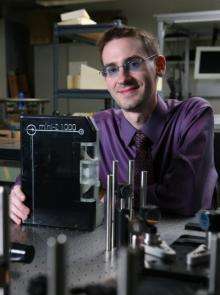
"T-rays" have been touted as the next breakthrough in sensing and imaging, but the need for bulky equipment has been an obstacle to reaching the field's potential. Enter Brian Schulkin, winner of the first-ever $30,000 Lemelson-Rensselaer Student Prize. Schulkin has invented an ultralight, handheld terahertz spectrometer — an advance that could help catapult T-ray technology from the lab bench to the marketplace.
Schulkin's "Mini-Z" is dramatically smaller and lighter than any previous terahertz device, and it already has proven its ability to detect cracks in space shuttle foam, image tumors in breast tissue, and spot counterfeit watermarks on paper currency. The system, which weighs less than five pounds and fits snugly in a briefcase, could open the door to a wide range of applications in homeland security, biomedical imaging, and nondestructive testing of industrial components.
Schulkin, a doctoral student in physics at Rensselaer Polytechnic Institute, is the first recipient of the $30,000 Lemelson-Rensselaer Student Prize. The award is given to a Rensselaer senior or graduate student who has created or improved a product or process, applied a technology in a new way, or otherwise demonstrated remarkable inventiveness.
"Discovery and innovation are the sparks that drive the global economy and enhance quality of life. The Lemelson-Rensselaer Student Prize is designed to inspire and reward those who push the boundaries of imagination, and do the creative work to break new ground," said Rensselaer President Shirley Ann Jackson. "Brian Schulkin embodies that spirit of innovation, discovery, and excellence. We celebrate his ingenuity and commitment. We applaud him and all of our students who participated in this inaugural competition, and we encourage them to keep exploring and to keep pushing the boundaries."
The Next Wave in Sensing and Imaging
T-rays are based on the terahertz region of the electromagnetic spectrum, which is defined by frequencies from 0.1 to 10 terahertz — just between infrared light and microwave radiation. "Terahertz waves are the last window in the electromagnetic spectrum to be exploited by scientists," Schulkin said.
T-rays are useful for imaging defects within materials without destroying the objects or even removing them from their setting, and they offer major advantages over other techniques, according to Schulkin. They can penetrate many dry, non-metallic materials with better resolution than microwave radiation; they don't pose the same health risks as X-rays; and unlike ultrasound, terahertz waves can provide images without contacting an object.
And T-ray systems offer more than just images: they can provide valuable spectroscopic information about the composition of a material, especially in chemical and biological species. Scientists have been exploring the terahertz region for more than two decades, but one of the main obstacles has been the size and weight of T-ray devices. "Conventional systems are tied down to the bench," Schulkin said. "They are incredibly heavy, not portable, and require high-powered lasers, which are both expensive and large."
The Mini-Z, however, is about the size of a laptop computer, and it does not require any peripheral equipment. "The first time the Mini-Z was on display, the kinds of comments we got were, 'Where is the rest of it?'" Schulkin said.
The device also provides real-time data with absolutely no waiting, and its user-friendly design means people do not need special training to operate it. "It's a turnkey system — all you have to do is open the box, set it up, and turn it on," Schulkin said. "My vision for the Mini-Z is that it will be standard equipment in offices around the world, or in the lab for research."
A Multitude of Applications
Schulkin's patent-pending technology is available for licensing, and his team has received interest from a number of companies looking to commercialize the Mini-Z. The potential applications for such a device are numerous: evaluating the integrity of carbon fiber composites used in airplanes; imaging tumors without the need for harmful radiation; detecting explosives at airport security checkpoints; spotting landmines from a distance; and seeing biological agents through a sealed envelope.
The spray-on foam insulation used in the space shuttle is an ideal subject for terahertz imaging, Schulkin said. During the STS-114 shuttle mission in July 2005, video analysis indicated a piece of foam was lost from the bright orange, 15-story-tall external fuel tank of Space Shuttle Discovery. The tank's aluminum skin is covered with polyurethane-like foam averaging an inch thick, which insulates the propellants, prevents ice formation on its exterior, and protects its skin from heat during flight, according to NASA.
Schulkin and his colleagues have conducted tests with foam samples provided by NASA's Marshall Space Flight Center and fuel-tank manufacturer Lockheed Martin Space Systems. To help prove the viability of terahertz imaging, the team purposely embedded defects in specially prepared foam samples, and then they used T-rays to spot them. In one test, a total of eight man-made defects of various sizes were scattered throughout the sample and successfully detected.
A prototype of the Mini-Z is being evaluated by NASA's External Tank Project Office, which is seeking new methods to either complement or replace those it currently uses in nondestructive evaluation. Schulkin's technology will be put in a "run-off" against several other technologies that will help NASA determine which to designate as "space certified," allowing them to become part of NASA's regular manufacturing and inspection process.
A Shining Star on the Research Stage
"Not only does Brian have an impressive grasp of theoretical concepts, but he also has the rare ability to combine this understanding with solid engineering principles," said Alan Cramb, dean of the School of Engineering at Rensselaer. "His innovative spirit and creative spark are an inspiration to us all, and we are fortunate to have the Lemelson-MIT Program to recognize innovative students like Brian."
Schulkin works under the guidance of Xi-Cheng Zhang, the J. Erik Jonsson '22 Distinguished Professor of Science and director of the Center for Terahertz Research at Rensselaer. "Brian's innovative approach combined the integration of materials, optics, and electronics expertise to realize a quantum leap in robustness, while reducing the size and weight of the system by an order of magnitude," Zhang said. "His miniature terahertz spectrometer project, after only one year's worth of research and development, has become the shining star on our research stage."
At the Center for Terahertz Research, more than 30 scientists actively conduct research and development in terahertz wave science and technology. Scientists and engineers from more than 100 universities, companies, medical schools, and clinics have visited Rensselaer's terahertz facilities, and the team has helped scientists from 25 countries learn to use the technology.
The Lemelson-Rensselaer Student Prize is funded through a partnership with the Lemelson-MIT Program, which has awarded the $30,000 Lemelson-MIT Student Prize to outstanding student inventors at MIT since 1995.
Source: Rensselaer Polytechnic Institute


