From Farm Waste to Fuel Tanks
February 16th, 2007 From Farm Waste to Fuel Tanks

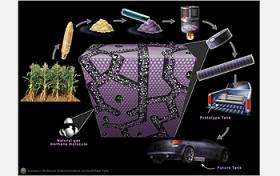
Researchers at the University of Missouri-Columbia and the Midwest Research Institute in Kansas City have developed a method to convert corncob waste into a carbon "sponge" with nanoscale pores. The new material can store large quantities of natural gas and can be formed into a variety of shapes, ideal characteristics for next-generation gas storage tanks on methane-powered automobiles. Credit: Nicolle Rager Fuller, National Science Foundation

Using corncob waste as a starting material, researchers have created carbon briquettes with complex nanopores capable of storing natural gas at an unprecedented density of 180 times their own volume and at one seventh the pressure of conventional natural gas tanks.

The breakthrough, announced today in Kansas City, Mo., is a significant step forward in the nationwide effort to fit more automobiles to run on methane, an abundant fuel that is domestically produced and cleaner burning than gasoline.

Supported by the National Science Foundation Partnership for Innovation program, researchers at the University of Missouri-Columbia and Midwest Research Institute in Kansas City developed the technology. The technology has been incorporated into a test bed installed on a pickup truck used regularly by the Kansas City Office of Environmental Quality.

The briquettes are the first technology to meet the 180 to 1 storage to volume target set by the U.S. Department of Energy in 2000, a long-term goal of principal project leader Peter Pfeifer of MU.

"We are very excited about this breakthrough because it may lead to a flat and compact tank that would fit under the floor of a passenger car, similar to current gasoline tanks," said Pfeifer. "Such a technology would make natural gas a widely attractive alternative fuel for everyone."

According to Pfeifer, the absence of such a flatbed tank has been the principal reason why natural gas, which costs significantly less than gasoline and diesel and burns more cleanly, is not yet widely used as a fuel for vehicles.

Standard natural gas storage systems use high-pressure natural gas that has been compressed to a pressure of 3600 pounds per square inch and bulky tanks that can take up the space of an entire car trunk. The carbon briquettes contain networks of pores and channels that can hold methane at a high density without the cost of extreme compression, ultimately storing the fuel at a pressure of only 500 pounds per square inch, the pressure found in natural gas pipelines.

The low pressure of 500 pounds per square inch is central for crafting the tank into any desired shape, so ultimately, fuel storage tanks could be thin-walled, slim, rectangular structures affixed to the underside of the car, not taking up room in the vehicle.

Pfeifer and his colleagues at MU and MRI discovered that that fractal pore spaces (spaces created by repetition of similar patterns at different scales) are remarkably efficient at storing natural gas.

"Our project is the first time a carbon storage material has been made from corncobs, an abundantly available waste product in the Midwest," said Pfeifer. "The carbon briquettes are made from the cobs that remain after the kernels have been harvested. The state of Missouri alone could supply the raw material for more than 10 million cars per year. It would be a unique opportunity to bring corn to the market for alternative fuels--corn kernels for ethanol production, and corncob for natural gas tanks."

The test pickup truck, part of a fleet of more than 200 natural gas vehicles operated by Kansas City, has been in use since mid-October and the researchers are monitoring the technology's performance, from mileage data to measurements of the stability of the briquettes.

In addition to efforts to commercialize the technology, the researchers are now focusing on the next generation briquette, one that will store more natural gas and cost less to produce. Pfeifer believes this next generation of briquette might even hold promise for storing hydrogen.

Source: NSF


print this article email this article download pdf blog this article bookmark this article     Digg this Stumble it share on Facebook share on Reddit add to delicious save to Yahoo! bookmarks
4.6/5 after 48 votes


February 16th, 2007 all stories
Technology / Energy

Comments: 0
Rank: 4.6/5 after 48 votes

  • Stumble this up

  • Digg this

  • Share it:
  • share on Facebook
  • share on MySpace
  • share on Slashdot
  • rss-newsfeed
  • share on Google
  • share on Reddit
  • add to delicious
  • save to Yahoo! bookmarks
  • share on Windows Live
  • Add to Mixx!
Rating: 4.6/5 after 48 votes

  • Related Stories

  • Calif. board postpones decision on pollution tax
    created Jun 26, 2009 | popularity not rated yet | comments 0
  • Plant making gas from wood opens in Austria
    created Jun 24, 2009 | popularity not rated yet | comments 0
  • Feather fibers fluff up hydrogen storage capacity
    created Jun 23, 2009 | popularity not rated yet | comments 0
  • Fertilizer industry finds its alternative energy: corncobs
    created Jun 18, 2009 | popularity not rated yet | comments 0
  • 'Green-collar' jobs ruffled by recession, but may rebound
    created Jun 16, 2009 | popularity not rated yet | comments 0

Tags


  • Physicists Demonstrate Quantum Memory with Matter Qubits
    Physicists Demonstrate Quantum Memory with Matter Qubits
    Physics / General Physics
    created Jul 03, 2009 | popularity 4.4 / 5 (17) | comments 1
  • 'Holey' Nanosheets for Wastewater Dye Removal
    Nanotechnology / Nanomaterials
    created Jul 01, 2009 | popularity 5 / 5 (5) | comments 1
  • Jellyfish Robot Swims Like its Biological Counterpart
    Jellyfish Robot Swims Like its Biological Counterpart
    Electronics / Robotics
    created Jun 26, 2009 | popularity 4.4 / 5 (8) | comments 1
  • Could Maxwell's Demon Exist in Nanoscale Systems?
    Could Maxwell's Demon Exist in Nanoscale Systems?
    Physics / General Physics
    created Jun 24, 2009 | popularity 4.4 / 5 (18) | comments 29
  • Living Safely with Robots, Beyond Asimov's Laws
    Living Safely with Robots, Beyond Asimov's Laws
    Electronics / Robotics
    created Jun 22, 2009 | popularity 4.6 / 5 (54) | comments 40
  • Other News

    Translate this: 'cognition-strength interfaces'

    Translate this: 'cognition-strength interfaces'

    Technology / Engineering

    created 5 hours ago | popularity 5 / 5 (1) | comments 0

    (PhysOrg.com) -- A highly ambitious European project used basic cognitive function, eye-tracking and keystroke logging as the starting point for the study of human-computer interaction for translation. It ...


    US Justice Dept probing telecom companies: WSJ

    Technology / Telecom

    created 1hour ago | popularity not rated yet | comments 0

    The US Justice Department is conducting an initial review to determine whether large US telecom companies have abused their market power, The Wall Street Journal reported on Monday.


    National Semiconductor Introduces Industry's Lowest-Noise Frequency Synthesizer

    National Semiconductor Introduces Industry's Lowest-Noise Frequency Synthesizer

    Technology / Semiconductors

    created 1hour ago | popularity not rated yet | comments 0

    National Semiconductor today announced the industry’s lowest-noise, fully integrated frequency synthesizer. The PowerWise LMX2541 provides less than 2 milli-radians (mrad) root-mean-square (rms) noise at 2.1 ...


    Pages of the Codex Sinaiticus are pictured on a laptop in Westminster Cathedral, central London

    World's oldest surviving Bible published online

    Technology / Internet

    created 2 hours ago | popularity 5 / 5 (2) | comments 0

    About 800 pages of the world's oldest surviving Bible have been pieced together and published on the Internet for the first time, experts in Britain said Monday.


    EMC raises offer for Data Domain

    Technology / Business

    created 3 hours ago | popularity not rated yet | comments 0

    Computer storage giant EMC raised its offer to purchase data storage firm Data Domain on Monday in a bid to top a rival offer for the company by data management firm NetApp.