The Cosmic Shredder and the Magnetar
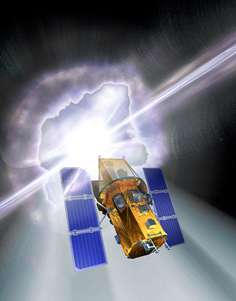
No, it is not the title of the next Harry Potter book - but the latest discoveries from NASA's Swift mission which is studying gamma-ray bursts (GRB's) - the most powerful explosions occurring in the Universe. As reported in Nature today, scientists from the UK, USA, Italy and Sweden have witnessed the probable destruction of a neutron star by a black hole.
In a further Nature paper also issued today, astronomers from the University of Hertfordshire have discovered that some of the "short" gamma-ray bursts occur much closer to home than previously thought and could result from the tearing apart of an exotic object called a magnetar.
Every couple of days or so a burst of gamma rays will appear randomly from any direction in the sky. Most of these events last a few tens of seconds. These "long bursts" are thought due to the collapse of a massive star which forms a black hole. Occasionally, however, a much shorter duration event is seen (lasting less than 2 seconds). The origin of these "short bursts" is one of the great unsolved mysteries in astronomy.
Observations made by Swift and other telescopes, including the European Southern Observatory's Very Large Telescope, over the last six months indicate that some short bursts may be due to the merger of two neutron stars - dense cores of dead stars. These can combine after orbiting each other for perhaps hundreds of millions of years to form a black hole which powers a brief flash of gamma-rays. The light from such an event will decay away very quickly. The new observation suggests that another, rarer mechanism may be involved in the formation of some short bursts in which the objects that merge are a black hole and a neutron star.
Dr. Paul O'Brien from the University of Leicester says "This short burst emitted X-rays for over a day after the bright gamma-ray flash had faded. Multiple X-ray flares were also seen. This all suggests a binary system of a black hole and a dense neutron star was involved. The neutron star, around the mass of the Sun, was literally torn apart after coming too close to the black hole. At peak, the total power output was equivalent to about a million, billion Suns."
Professor Andrew King, also from the University of Leicester says "The black hole shredded the neutron star and either swallowed it in chunks or it formed a disc around the black hole which was then accreted. This could be the first ever observation of a black hole-neutron star binary system."
Data from previous missions is not forgotten though - astronomers from the University of Hertfordshire, have made a new and unexpected discovery. By statistically comparing the distribution of the nine years of short-duration bursts detected by the Compton Gamma Ray Observatory with the distribution of galaxies within about 300 million light years of the Milky Way, they conclude that around 15% originate from these relatively nearby galaxies. This is more than ten times closer than previously thought. A report of this work also appears in Nature this week.
These nearby short bursts, could, like their more distant brethren, result from catastrophic collisions of neutron stars, but if so then their outbursts must be much weaker. Alternatively, they could be a fundamentally different kind of explosion. A prime candidate would be an exotic object called a magnetar, a lone neutron star with a magnetic field 100,000 billion times that of the Earth, tearing itself apart due to enormous magnetic stresses.
An example of such an explosion was seen a year ago coming from a magnetar in our own galaxy, the Milky Way, so it seems reasonable to expect they should occur occasionally in other galaxies too, said Dr Nial Tanvir from the University of Hertfordshire. If so, they would look very much like short-duration gamma-ray bursts. He continues, "Although we still don't know for sure what produces the short duration gamma-ray bursts, this is a crucial breakthrough in astronomy as knowing where a phenomenon occurs is often the first step towards understanding it."
Since its launch on 20 November 2004, Swift has observed over 100 GRB's. Swift's power lies in its ability to detect a fast-fading burst and then turn autonomously to point sensitive telescopes at the burst before it has faded. Dr. Julian Osborne, Lead Investigator for Swift at the University of Leicester says "Swift is unique in being able to observe the fading X-ray light from a GRB so quickly after the gamma-ray flash. The accurately determined position in this case was sent to observers on the ground who found the host galaxy for the burst within a few hours. This particular burst occurred four billion light years from Earth."
Source: PPARC


