Integral expands our view of the gamma-ray sky
February 20th, 2007 Integral expands our view of the gamma-ray sky

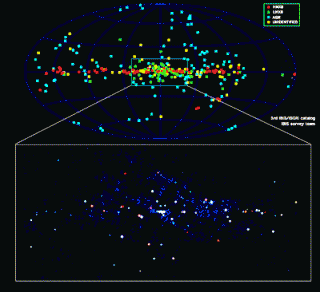
The upper image shows the sky distribution of four of the main soft gamma-ray source populations observed in the third Integral/IBIS survey catalogue. This newly-released catalogue contains 421 sources. Of the known systems, the low-mass X-ray binaries (LMXB) are old systems mainly populating the galactic bulge, the high-mass X-ray binaries (HMXB) are younger systems seen along the galactic plane, and the active galactic nuclei (AGN) are extragalactic sources seen over the whole sky. Around one out of four of the sources seen by Integral are unidentified, and their distribution is also shown. The lower picture is a false colour image of the central region of our galaxy. This is a composite image based on all-sky IBIS/ISGRI maps in three energy windows (between 17 and 100 keV) and represents the true 'X-ray colours' of the sources. Red sources are dominated by emission below 30 keV, while blue sources have harder spectra, emitting strongly above 40 keV. Credits: IBIS survey team

Integral's latest survey of the gamma-ray universe continues to change the way astronomers think of the high-energy cosmos. With over seventy percent of the sky now observed by Integral, astronomers have been able to construct the largest catalogue yet of individual gamma-ray-emitting celestial objects. And there is no end in sight for the discoveries.

Integral is the European Space Agency's latest orbiting gamma-ray observatory. Ever since Integral began scientific operations in 2003, the project team has been devoting a substantial proportion of its observing time to a survey of the gamma-ray universe.

"The gamma-ray sky is notoriously variable and extremely unpredictable," says Anthony Dean, University of Southampton, UK, one of the original proposers of the Integral mission. Hence, the need for Integral's constant vigilance and an accurate catalogue of all gamma-ray sources. With this, astronomers can target individual gamma-ray objects for more detailed, study.

For the past three and a half years, Integral has been collecting survey data. At the end of every year, the data has been turned into a catalogue of sources.

During the first year, it concentrated on the regions close to the centre of our galaxy and found more than 120 sources. During the following year, Integral broadened its reach and found almost 100 more sources.

Now Integral has observed over 70 percent of the sky, with a total exposure time of 40 million seconds. A European team of astronomers led by Antony Bird, University of Southampton, UK, have turned all three years' worth of data into the third Integral catalogue of gamma-ray sources. It contains a total of 421 gamma-ray objects. Most have been identified as either binary stars in our Galaxy containing exotic objects such as black holes and neutron stars, or active galaxies, far away in space. But a puzzling quarter of sources remain unidentified so far.

"I think many of these will turn out to be either star systems enshrouded in dust and gas, or cataclysmic variable stars," says Dean. Integral observes in the gamma-ray band so it can see through the intervening material. It has demonstrated that it can discover sources obscured at other wavelengths.

One surprise has been the efficiency with which Integral has detected just one minor subclass of cataclysmic variable stars (CVs), the so-called intermediate polars. Initially astronomers were not sure that CVs would emit gamma rays. Indeed, Integral has already shown that only about one percent of them do. "At the moment, the reason why this should be is totally mysterious," says Dean.

As its surveys points further from our Galaxy, so Integral increasingly sees the active galaxies. These represent about a tenth of all galaxies and each one has some kind of extraordinary activity taking place in its core. It is widely accepted that this activity is driven by a gigantic black hole sucking matter out of existence.

Roman Krivonos, Max-Planck-Institute für Astrophysik, Germany, and colleagues have used the Integral survey to show that AGN are concentrated in the same places that ordinary galaxies are found. Whilst this is not an unexpected result, it is the first time such an AGN distribution has been seen at high-energies.

"Integral represents a milestone in gamma-ray astronomy," says Dean. Thirty years ago, NASA’s Einstein observatory produced a catalogue of X-ray sources that became the standard reference document for all X-ray observatories – including ESA's XMM-Newton. "Integral is doing the same for gamma-ray astronomy," says Dean.

"We are in a golden age of gamma-ray astronomy," agrees Bird. And ESA's Integral is at the forefront of this brave new universe.

Source: European Space Agency


print this article email this article download pdf blog this article bookmark this article     Digg this Stumble it share on Facebook share on Reddit add to delicious save to Yahoo! bookmarks
4.6/5 after 22 votes


February 20th, 2007 all stories
Space & Earth / Astronomy

Comments: 0
Rank: 4.6/5 after 22 votes

  • Stumble this up

  • Digg this

  • Share it:
  • share on Facebook
  • share on MySpace
  • share on Slashdot
  • rss-newsfeed
  • share on Google
  • share on Reddit
  • add to delicious
  • save to Yahoo! bookmarks
  • share on Windows Live
  • Add to Mixx!
Rating: 4.6/5 after 22 votes


Tags


  • Physicists Demonstrate Quantum Memory with Matter Qubits
    Physicists Demonstrate Quantum Memory with Matter Qubits
    Physics / General Physics
    created Jul 03, 2009 | popularity 4.4 / 5 (17) | comments 1
  • 'Holey' Nanosheets for Wastewater Dye Removal
    Nanotechnology / Nanomaterials
    created Jul 01, 2009 | popularity 5 / 5 (5) | comments 1
  • Jellyfish Robot Swims Like its Biological Counterpart
    Jellyfish Robot Swims Like its Biological Counterpart
    Electronics / Robotics
    created Jun 26, 2009 | popularity 4.4 / 5 (8) | comments 1
  • Could Maxwell's Demon Exist in Nanoscale Systems?
    Could Maxwell's Demon Exist in Nanoscale Systems?
    Physics / General Physics
    created Jun 24, 2009 | popularity 4.4 / 5 (18) | comments 29
  • Living Safely with Robots, Beyond Asimov's Laws
    Living Safely with Robots, Beyond Asimov's Laws
    Electronics / Robotics
    created Jun 22, 2009 | popularity 4.6 / 5 (52) | comments 40
  • Other News

    Steam billows from the cooling towers at a nuclear power generating station in Byron

    Tropical zone expanding due to climate change: study

    Space & Earth / Earth Sciences

    created 1hour ago | popularity 5 / 5 (2) | comments 0

    Climate change is rapidly expanding the size of the world's tropical zone, threatening to bring disease and drought to heavily populated areas, an Australian study has found.


    US ambitions to send astronauts back to the moon as a prelude to missions to Mars have been put in doubt

    Forty years ago man first walked on the moon

    Space & Earth / Space Exploration

    created 23 hours ago | popularity 4.3 / 5 (4) | comments 2

    Forty years ago on July 20, 1969, American astronaut Neil Armstrong realized the oldest dream of human civilizations when he became the first man to walk on the moon.


    The least sea ice in 800 years

    The least sea ice in 800 years

    Space & Earth / Earth Sciences

    created Jul 01, 2009 | popularity 4.1 / 5 (65) | comments 60

    New research, which reconstructs the extent of ice in the sea between Greenland and Svalbard from the 13th century to the present indicates that there has never been so little sea ice as there is now. The ...


    Gas around young galaxy

    Intense heat killed the Universe's would-be galaxies, researchers say

    Space & Earth / Astronomy

    created Jul 01, 2009 | popularity 3.4 / 5 (21) | comments 27

    (PhysOrg.com) -- Our Milky Way galaxy only survived because it was already immersed in a large clump of dark matter which trapped gases inside it, scientists led by Durham University's Institute for Computational ...


    Scientists' Drill Hits Magma: Only Third Time on Record

    Scientists' Drill Hits Magma: Only Third Time on Record

    Space & Earth / Earth Sciences

    created Jun 29, 2009 | popularity 4.7 / 5 (22) | comments 21

    (PhysOrg.com) -- Scientists drilling a borehole deep into Iceland’s rocky crust to explore new methods of using geothermal energy hit a major roadblock on Thursday: Their drill ran into molten rock at a depth ...