An ancient retrovirus is resurrected
February 20, 2007
An ancient retrovirus is resurrected

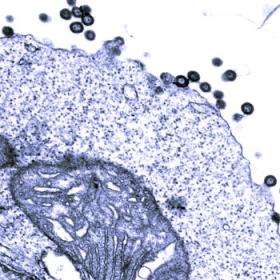
Budding system. Human cells expressing structural proteins from the resurrected retrovirus, HERV-KCON, build retrovirus-like particles and release them from the cell membrane, just as cells infected with a true retrovirus do.

Retroviruses have been around longer than humanity itself. In fact, the best-known family member, HIV, is a relative youngster, with its first known human infections occurring sometime in the mid-20th century.

But although many retroviruses went extinct hundreds of thousands or millions of years ago, researchers studying the pathogens don’t use the traditional tools of paleontologists: They need look only as far as our own DNA. R

etroviruses infect cells and replicate by inserting their DNA into their host cell’s genome. If that cell happens to be a germ cell, such as a sperm, an egg or their precursors, then the retroviral DNA is inherited by offspring just like a normal gene. Humans have many defunct retroviruses deposited in our DNA, remnants of ancient retroviruses that replicated in our ancestors millions of years ago. Now, researchers have brought one of those retroviruses back to life.

“In our DNA, there’s a fossil record of retroviruses that used to infect us,” says Paul Bieniasz, associate professor and head of the Laboratory of Retrovirology at Rockefeller University and the Aaron Diamond AIDS Research Center.

In fact, about eight percent of human DNA is made up of retroviral sequences. Bieniasz and Youngnam Lee, a graduate student in the Bieniasz lab, have excavated some of that DNA and — in an attempt to better understand how humans and retroviruses co-evolved — they have resurrected an ancient retrovirus, one that can create new viral particles and infect human cells. They describe their work in a paper published by PLoS Pathogens last month.

The extinct retroviruses embedded in our DNA can’t reproduce because of mutations in one or more of their genes. The younger of these human endogenous retroviruses (or HERVs) have fewer changes, and judging by the paucity of genetic alterations, at least one subfamily — HERV-K — was likely still active less than a few hundred thousand years ago. Different members of this subfamily have slightly different mutations. “But as of a few months ago,” Bieniasz says, “there was no replication-competent form of this virus.”

To eliminate those mutations that kept HERV-K from replicating, the two researchers deduced a genetic sequence that was a consensus of 10 different HERV-K proviruses and synthesized the whole viral genome from scratch. Then, they took that sequence (which they dubbed HERV-KCON) and inserted it into cultured human cells to see if it would result in the creation of HERV-K structural proteins. Their consensus sequence resulted in not only functional proteins, but in a retrovirus that was capable of creating new viral particles and integrating itself into a host cell’s genome. “This is the first time this has been done with a viral genome that was effectively dead, and now is alive — or at least has all the functions that suggest it should replicate,” Bieniasz says.

The project began, Lee says, because certain human and non-human primate cells produce proteins that appear to block HIV from replicating. “And the question is where did the proteins come from?” she asks. “By studying these extremely old viruses, we can tap into what happened in our ancestors millions and millions of years ago.”

Citation: Public Library of Science Pathogens 3(1): e10 (January 26, 2007)

Source: Rockefeller University

4.8 /5 (28 votes)  

Rank 4.8 /5 (28 votes)
Tags

Relevant PhysicsForums posts

More news stories

The power of estrogen -- male snakes attract other males

A new study has shown that boosting the estrogen levels of male garter snakes causes them to secrete the same pheromones that females use to attract suitors, and turned the males into just about the sexiest ...

Biology / Plants & Animals

created 9 hours ago | popularity 5 / 5 (3) | comments 0 | with audio podcast

Grass to gas: Researchers' genome map speeds biofuel development

Researchers at the University of Georgia have taken a major step in the ongoing effort to find sources of cleaner, renewable energy by mapping the genomes of two originator cells of Miscanthus x giganteus, a large perenn ...

Biology / Biotechnology

created 6 hours ago | popularity 3.7 / 5 (3) | comments 0 | with audio podcast

Experts reveal how plants don't get sunburn

(PhysOrg.com) -- Experts at the University of Glasgow have discovered how plants survive the harmful rays of the sun.

Biology / Cell & Microbiology

created 9 hours ago | popularity 5 / 5 (2) | comments 0 | with audio podcast

Protein libraries in a snap

(PhysOrg.com) -- A Rice University undergraduate will depart with not only a degree but also a possible patent for his invention of an efficient way to create protein libraries, an important component of biomolecular ...

Biology / Cell & Microbiology

created 12 hours ago | popularity 5 / 5 (2) | comments 0 | with audio podcast

Miami battling invasion of giant African snails

No one knows how they got there. But an invasion of African giant snails has southern Florida in a panic over potential crop damage, disease and general yuckiness surrounding the slimy gastropods.

Biology / Ecology

created 13 hours ago | popularity 4 / 5 (1) | comments 4


Google users warned of threat to smartphone wallets

Users of Google smartphone wallets were being warned on Friday that there is a way to crack pass codes intended to thwart thieves from going on illicit shopping sprees.

Anonymous knocks CIA website offline (Update)

The website of the Central Intelligence Agency was inaccessible on Friday after the hacker group Anonymous claimed to have knocked it offline.

Complex wiring of the nervous system may rely on a just a handful of genes and proteins

Researchers at the Salk Institute have discovered a startling feature of early brain development that helps to explain how complex neuron wiring patterns are programmed using just a handful of critical genes. ...

NASA sees wide-eyed cyclone Jasmine

Cyclone Jasmine's eye has opened wider on NASA satellite imagery, as it moves through the Southern Pacific Ocean.

NASA sees Giovanna reach cyclone strength, threaten Madagascar

Tropical Storm 12S built up steam and became a cyclone on February 10, 2012 as NASA's Terra satellite passed overhead. Residents of east-central Madagascar should prepare for this cyclone to make landfall ...

Putting the squeeze on planets outside our solar system

(PhysOrg.com) -- Using high-powered lasers, scientists at Lawrence Livermore National Laboratory and collaborators discovered that molten magnesium silicate undergoes a phase change in the liquid state, abruptly ...