Less is more for label readers, research shows
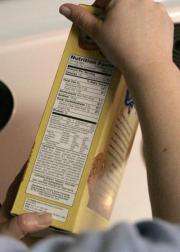
Apparently, most grocery-store goers shop for what they don’t want. Of course, they don’t want calories. But what about looking for the good stuff — the vitamins, nutrients, and other goodies listed on the side of the package?
According to researchers from the University of Florida’s Institute of Food of Agricultural Sciences, just over half of the shopping populace examines nutrition labels. However, the vast majority of shoppers look primarily at calorie counts to see how selections will affect their waistline — rather than evaluating how foods will fit into their nutritional bottom line.
“In a country that is — and, quite frankly, needs to be — concerned about weight issues, the fact that people look at calories isn’t a bad thing,” said Ron Ward, the UF researcher who, along with graduate student Carlos Jauregui, produced the findings. “However, this does tell us that we can do a lot more to inform the consumer and give them a bigger picture of how their product choices affect their health.”
Ward and Jauregui investigated how and why people use nutrition labels by analyzing more than a decade’s worth of self-recorded information kept by tens of thousands of U.S. households. The labels became mandatory in May 1994 and how they’re used has changed little since then.
The fact that calorie count is and always has been the primary concern is no surprise, said Burkey Belser, who designed the modern U.S. nutrition label. That’s why it’s the most prominent number on the label.
“People were making choices based off the claims on the front of the box and whatever other knowledge they could scrape together on their own,” Belser said. “We wanted a simple design that would quickly give people both what they need and want. We were very much aware of the rising tide of obesity at the time, so prominently displaying calorie count fit — and still fits — both of those.
“Unfortunately, people like to stop reading after the first line of a story,” he said. “You’ve got to hope that they will have the curiosity to read on.”
The problem is that people don’t know what else to look for, said Kimberly Lord Stewart, author of “Eating Between the Lines,” a how-to book on interpreting food labels.
“We went from virtually nothing to information overload,” she said.
For example, a cereal box may claim in big letters that it reduces cholesterol. However, in small print it also says that the average person needs three grams of fiber to statistically have a chance to reduce cholesterol, she said. “Look on the side, and the label will probably say that each serving only has one gram or less.”
And despite more than a decade of federally mandated nutrition labels, the big words on the front of the box often trump the small ones on the side. Ward and Jauregui’s research shows that those who have developed brand loyalties typically only check the product name instead of scrutinizing the label for nutritional content.
The pair have presented their research at several conferences — including last year’s American Economic Association annual meeting — and are preparing a paper based on selected portions of their work. Among their other findings: the poor pay slightly more attention to nutrition labels than the wealthy; people in the South are more likely to use nutrition labels than their Northern counterparts; and, for most people, where food was produced is of little importance.
Source: University of Florida


