Perseus Spiral Arm of the Milky Way much closer than thought
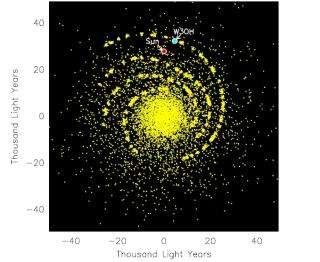
The Perseus spiral arm, the nearest spiral arm in the Milky Way outside the Sun's orbit, lies only half as far from Earth as some previous results had suggested. An international team of astronomers including scientists from the Max-Planck-Institut für Radioastronomie has recently achieved the most accurate distance measurement ever to the Perseus arm.
Figure 1: Our Milky Way galaxy as an observer located far above its plane would see it. Shown are the known spiral arms. The locations of our solar system and of W3OH are indicated.
This was done by use of a vast array of radio telescopes in the USA called the Very Long Baseline Array, observing very bright spots within clouds of gas that contain methyl alcohol in the placental material surrounding a newly formed star called W3OH.
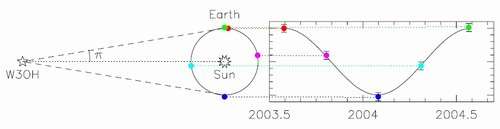
Dr. Xu Ye, an astronomer at Shanghai Observatory now working at the Max-Planck-Institut für Radioastronomie and one of the members of the international team who made the measurements, stated that "we measured distance by the simplest and most direct method in astronomy - essentially the technique used by surveyors called triangulation." Specifically, the team used the changing vantage point of the Earth as it orbits the Sun to form one leg of a triangle. Measuring the change in apparent position of a source, they could calculate the source's distance by simple trigonometry (resulting in 6357±130 light years).
This result resolves the longstanding problem of the distance to this spiral arm. In thje past, different methods of measuring distance have disagreed by more than a factor of 2. Prof. Karl Menten, another member of the team, states that "this confirms distances based on the apparent luminosity of young stars but disagrees with distances based on a model of the rotation of the Milky Way. The reason for the discrepancy is that young stars in the Perseus spiral arm have unexpectedly large motions."
The astronomers found that the young star is not moving in a circular orbit around the Milky Way, but deviates by 10% from circular. It is rotating more slowly and "falling" toward the center of the Milky Way. Team member Zheng Xing-Wu of Nanjing University points out that "the simplest explanation is that the cloud of gas out of which the star formed was gravitationally attracted by excess mass of material in the Perseus spiral arm."
"Studies such as ours are the first steps to accurately map the Milky Way," says Dr. Mark Reid, a member of the team from the Harvard-Smithsonian Center for Astrophysics. "We have established that the radio telescope we used, the Very Long Baseline Array, can measure distances with unprecedented accuracy--nearly a factor of 100 times better than previously accomplished." To get a feeling for this measurement one may visualize a person standing on the moon, holding a torch in his stretched-out hand. Let her turn around herself like an ice scater, but only making a single turn in the course of one year. The VLBA measurement is equivalent to measuring the torch's motion with an accuracy comparable to the torch's size.
The technique used is Very Long Baseline Interferometry (VLBI), where observations made with many telescopes are combined to achieve the resolution of an extraordinarily large telescope nearly the size of the Earth. The VLBA telescopes stretch from Hawaii over the continental United States to the Virgin Island of St. Croix, producing the resolution of an 8000 km diameter telescope. While the VLBA has extremely high resolution, it requires extremely bright and very compact radio sources such as masers for such measurements (a maser is the microwave equivalent of a laser.) Along with water, methanol is the most widespread maser molecule found in star-forming regions. The methanol spectral line used for the present experiment was discovered in the course of Prof. Menten's dissertation in the 1980s. In 1988, while working with Dr. Reid, they conducted the first VLBI observations of methanol masers; the target then was also W3OH. "Already then we dreamt of observations such as this one" says Menten.
In fact similar VLBA observations have also been made on water masers in W3OH. This effort, led by the MPIfR's Kazuya Hachisuka, yielded a distance similar to the methanol masers. "A splendid confirmation!" says Hachisuka. His team also includes Reid and Menten and a number of Japanese scientists.
The methanol observations are only the start of a very large-scale project that Reid and Menten have initiated. It will determine distances and motions of methanol masers all over the Milky Way. It has been granted a large block of VLBA observing time. In addition to the motions on the sky these observations also yield the star's velocity toward or away from the observer by measuring the Doppler shift of the methanol lines. The resulting three dimensional motions will deliver unique constraints not only on the rotation of the Milky Way but also on the distribution of the unseen Dark Matter that is postulated to surround it.
While the method - simple trigonometry - sounds basic, the transformation into practical results requires a comprehensive understanding of VLBA and all aspects of the observations, including thorough modeling of the Earths' atmosphere which affects the incoming radio waves. Dr. Reid has dedicated many years of his life to reach the point were programs such as this one can be performed.
Original Paper: The Distance to the Perseus Spiral Arm in the Milky Way , Y. Xu, M. J. Reid, X. W. Zheng, K. M. Menten, (Science, Published Online December 8, 2005).
Source: Max-Planck-Institut


