New research shakes belief that forethought is unique to humans
February 21st, 2007 Birds found to plan for the future

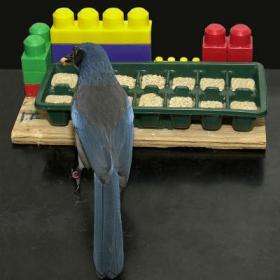
Experiments at the University of Cambridge show the birds are able to plan for future food shortages by caching food. Researchers believe this is the first example of future planning in animals other than humans. Credit: University of Cambridge

Some birds recognise the idea of ‘future’ and plan accordingly, researchers at the University of Cambridge have discovered. According to their findings, published today in the journal Nature, western scrub-jays will store food items they believe will be in short supply in the future.

Planning for the future is a complex skill that was previously believed to be unique to humans. Other animals were perceived to be incapable of dissociating themselves from the present and any current motivation. Sometimes animals may appear to recognise future needs, but they are only exhibiting behaviours that are either instinctual (e.g. nest building) or prompted by immediate needs like hunger (e.g. food hoarding).

In order to determine whether some animals plan for future food needs or are simply acting on instinct, Professor Nicky Clayton and her team at the Department of Experimental Psychology tested the western scrub-jay.

Every morning, eight scrub-jays either were allowed into the compartment with ‘no breakfast’ or the compartment with ‘breakfast’. They were then allowed to eat for the rest of the day. After several days, the birds were then provided with pine nuts suitable for caching (hoarding) in the evening. In anticipation of a morning without breakfast, the scrub-jays consistently hid food in the ‘no breakfast’ compartment rather than the ‘breakfast’ compartment, demonstrating an understanding of future needs (rather than just their immediate needs).

In a similar experiment, the scrub-jays were given either dog food in one compartment or peanuts in a second compartment for breakfast. When they were allowed to cache either food where they liked in the evenings, they once again demonstrated an understanding of future needs and a desire for a varied diet by hoarding peanuts in the dog food compartment and dog kibble in the peanut compartment. If they were caching for current hunger, they would not have discriminated between the types of food or the location of the cache.

Professor Nicky Clayton said, “The western scrub-jays demonstrate behaviour that shows they are concerned both about guarding against food shortages and maximising the variety of their diets in the future. It suggests they have advanced and complex thought processes as they have a sophisticated concept of past, present and future, and factor this into their planning.”

Together with her colleague Professor Tom Dickinsons, Professor Clayton and her team have published a number of papers demonstrating the remarkable memories of scrub-jays. Some forms of memory and future thinking are believed to be linked in the human brain and the scientists were interested to see if the same might be true of the scrub-jay brain.

Source: University of Cambridge


print this article email this article download pdf blog this article bookmark this article     Digg this Stumble it share on Facebook share on Reddit add to delicious save to Yahoo! bookmarks
4.7/5 after 23 votes


February 21st, 2007 all stories
Biology /

Comments: 0
Rank: 4.7/5 after 23 votes

  • Stumble this up

  • Digg this

  • Share it:
  • share on Facebook
  • share on MySpace
  • share on Slashdot
  • rss-newsfeed
  • share on Google
  • share on Reddit
  • add to delicious
  • save to Yahoo! bookmarks
  • share on Windows Live
  • Add to Mixx!
Rating: 4.7/5 after 23 votes

  • Related Stories

  • Study: cow-powered fuel cells grow smaller, mightier
    created Aug 21, 2007 | popularity not rated yet | comments 0
  • Progress Resupply Ship Docks With Station
    created Aug 06, 2007 | popularity not rated yet | comments 0
  • ESA prepares for a human mission to Mars
    created Apr 02, 2007 | popularity not rated yet | comments 0
  • Key to evolutionary fitness: Cut the calories
    created Jul 01, 2009 | popularity not rated yet | comments 0
  • Some Eczema Sufferers More Prone to Smallpox and Other Viruses
    created Jun 30, 2009 | popularity not rated yet | comments 0

Tags


  • Physicists Demonstrate Quantum Memory with Matter Qubits
    Physicists Demonstrate Quantum Memory with Matter Qubits
    Physics / General Physics
    created Jul 03, 2009 | popularity 4.4 / 5 (17) | comments 1
  • 'Holey' Nanosheets for Wastewater Dye Removal
    Nanotechnology / Nanomaterials
    created Jul 01, 2009 | popularity 5 / 5 (5) | comments 1
  • Jellyfish Robot Swims Like its Biological Counterpart
    Jellyfish Robot Swims Like its Biological Counterpart
    Electronics / Robotics
    created Jun 26, 2009 | popularity 4.4 / 5 (8) | comments 1
  • Could Maxwell's Demon Exist in Nanoscale Systems?
    Could Maxwell's Demon Exist in Nanoscale Systems?
    Physics / General Physics
    created Jun 24, 2009 | popularity 4.4 / 5 (18) | comments 29
  • Living Safely with Robots, Beyond Asimov's Laws
    Living Safely with Robots, Beyond Asimov's Laws
    Electronics / Robotics
    created Jun 22, 2009 | popularity 4.6 / 5 (52) | comments 40
  • Other News

    California water plan aims to save Puget Sound orcas

    Biology / Ecology

    created 14 hours ago | popularity not rated yet | comments 0

    A plan to restore salmon runs on California's Sacramento River also could help revive killer whale populations 700 miles to the north in Puget Sound, as federal scientists struggle to protect endangered species in a complex ...


    Scientists 'rebuild' giant moa using ancient DNA

    Biology / Plants & Animals

    created Jul 01, 2009 | popularity 5 / 5 (10) | comments 12

    (PhysOrg.com) -- Scientists have performed the first DNA-based reconstruction of the giant extinct moa bird, using prehistoric feathers recovered from caves and rock shelters in New Zealand.


    Pacific Giant Salamander (Dicamptodon tenebrosus)

    Salamanders, regenerative wonders, heal like mammals, people

    Biology / Microbiology

    created Jul 01, 2009 | popularity 5 / 5 (20) | comments 11

    The salamander is a superhero of regeneration, able to replace lost limbs, damaged lungs, sliced spinal cord -- even bits of lopped-off brain. But it turns out that remarkable ability isn't so mysterious after ...


    Genetically modified trees

    Anti-biotech groups obstruct forest biotechnology

    Biology / Biotechnology

    created Jun 30, 2009 | popularity 3.7 / 5 (7) | comments 5

    The potential of forest biotechnology to help address significant social and environmental issues is being "strangled at birth" by the rigid opposition of some groups and regulations that effectively preclude ...


    Super-sleepers could help super-sizers!

    Super-sleepers could help super-sizers!

    Biology / Plants & Animals

    created Jun 29, 2009 | popularity 5 / 5 (2) | comments 4

    Burrowing frogs can survive buried for several years without food or water. Scientists have discovered that the metabolism of their cells changes radically during the dormancy period allowing the frogs to ...