XMM-Newton reveals a magnetic surprise
February 22, 2007
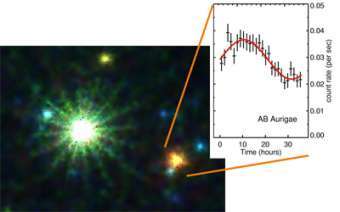
This picture shows a small extract of one of the X-ray images shot by the EPIC cameras on board ESA's XMM-Newton for the Taurus-Auriga survey project. The bright star on the left is one of many normal, young, solar-like stars in the Taurus-Aurigae star-formation region. It shows bright X-rays from very hot gas. The star to its right is AB Aurigae. The image has been color-coded, and the orange color shows that the gas of AB Aurigae is much cooler than that in the other young stars. The insert on the right (light-curve) shows how the X-ray intensity moved cyclically up and down with a period of about 42 hours. Credits: M. Guedel/ESA
ESA's X-ray observatory XMM-Newton has revealed evidence for a magnetic field in space where astronomers never expected to find one. The magnetic field surrounds a young star called AB Aurigae and provides a possible solution to a twenty-year-old puzzle.
At 2.7 times the mass of the Sun, AB Aurigae is one of the most massive stars in the Taurus-Auriga star-forming cloud. Although amongst nearly 400 smaller stars, its ultraviolet radiation plays a key role in shaping the cloud. Its massive status puts it in a class known as Herbig stars, named after their discoverer George Herbig.
As part of a large programme to survey Taurus-Auriga at X-ray wavelengths, XMM-Newton systematically targeted AB Aurigae and the other young stars in this region, using its European Photon Imaging Camera (EPIC). AB Aurigae stood out brightly in the image, indicating that it was releasing X-rays.
X-rays are expected to come from young stars with strong magnetic fields but computer calculations have repeatedly suggested that Herbig stars do not have the correct internal conditions to generate an appreciable magnetic field. Yet for twenty years, astronomers have been detecting X-ray emission from them.
Where could the X-rays be coming from? Some astronomers suggested that Herbig stars could have a smaller companion star in orbit around them and the X-rays are coming from the companion.
However, when an international team led by Manuel Güdel and his graduate student Alessandra Telleschi, of the Paul Scherrer Institut, Switzerland, analysed the AB Aurigae data, they found that the temperature of the gas producing the X-rays lay between one and five million degrees centigrade. "That was suspiciously low," Güdel says. Young sun-like stars possess gaseous atmospheres that are heated to 10 million degrees and higher, by their magnetic field.
Güdel and his team found another clue that the X-rays must be coming from AB Aurigae itself: the X-rays varied in intensity every 42 hours. This is a magic number for the star because astronomers know that the optical and ultraviolet light from AB Aurigae also varies by this same amount. "Finding the same periodicity confirms that the X-rays are coming from AB Aurigae and not from a companion star," says Güdel. But how are they generated?
To search for an explanation Telleschi and colleagues looked at high-resolution data of AB Aurigae taken with the orbiting observatory's Reflection Grating Spectrometers.
In this data they looked for a spectral fingerprint that would tell them how far above the star’s surface the X-ray-emitting gas was located.
To their surprise, they found that the X-rays were coming from high above the star. They had expected them to be much closer to the surface. X-rays high above the surface means that gas given off by the star, called the stellar wind, from two different hemispheres is probably being guided together into a collision. And the only thing that could do that was a magnetic field. It would not be a strong magnetic field, but it had to be a magnetic field nonetheless.
Luckily, a group of astronomers who had developed a magnetic field model of this kind for another class of star also worked in the Taurus-Auriga observing team. So it was easy for them to contribute their expertise.
Working with them, Telleschi, Güdel and their colleagues now propose that, as the vast pocket of gas collapsed to become AB Aurigae, it pulled with it part of the magnetic field that threaded that region of space. This field is now trapped inside the star and funnels the stellar winds together. Winds from the two hemispheres thus collide to create the X-rays.
It is a neat explanation for a twenty-year mystery but, at the moment, Güdel and colleagues do not know whether this is applicable to other Herbig stars. "That's the important question," Güdel says. To resolve it, high-resolution spectra of other Herbig stars will have to be taken.
Source: European Space Agency
-
NARVAL -- The first observatory dedicated to stellar magnetism
Feb 08, 2007 |
4.7 / 5 (3) |
0
-
Dutch team has solution for troubled ITER nuclear fusion reactor
15 hours ago |
5 / 5 (1) |
3
-
High planetary tilt lowers odds for life?
Feb 06, 2012 |
4.8 / 5 (12) |
14
-
Radio stars: Caltech's astronomy professor searches for cosmic radio waves
Feb 03, 2012 |
not rated yet |
0
-
Stellar astrophysics explains the behavior of fast rotating neutron stars in binary systems
Feb 02, 2012 |
5 / 5 (7) |
2
-
Engineers build first sub-10-nm carbon nanotube transistor
Feb 01, 2012 |
4.9 / 5 (31) |
30
-
Something old, something new: Evolution and the structural divergence of duplicate genes
Jan 31, 2012 |
4.6 / 5 (7) |
1
-
The hidden nanoworld of ice crystals: Revealing the dynamic behavior of quasi-liquid layers
Jan 30, 2012 |
5 / 5 (3) |
1
-
Stock market network reveals investor clustering
Jan 27, 2012 |
3.9 / 5 (23) |
8
-
Of microchemistry and molecules: Electronic microfluidic device synthesizes biocompatible probes
Jan 26, 2012 |
5 / 5 (1) |
0
-
Never ending outer space.....
3 hours ago
-
Neutron Star fragments?
5 hours ago
-
stationary or not?
9 hours ago
-
Scale of the Universe
Feb 10, 2012
-
Titan's lack of impact craters
Feb 09, 2012
-
Real pictures of black hole eating a star?
Feb 08, 2012
- More from Physics Forums - General Astronomy
More news stories
Europe stakes billion-dollar bet on new rocket
A pencil-slim rocket is scheduled to lift into space from South America on Monday, carrying a billion-dollar bet that Europe can grab a juicy slice of the market to place satellites in low orbit.
Space & Earth / Space Exploration
16 hours ago |
3.5 / 5 (2) |
0
Political leaders play key role in how worried Americans are by climate change: study
More than extreme weather events and the work of scientists, it is national political leaders who influence how much Americans worry about the threat of climate change, new research finds.
Feb 06, 2012 |
5 / 5 (6) |
72
NASA budget will axe Mars deal with Europe: scientists
US President Barack Obama's budget proposal to be submitted next week for 2013 will cut NASA's budget by 20 percent and eliminate a major partnership with Europe on Mars exploration, scientists said Thursday.
Space & Earth / Space Exploration
Feb 10, 2012 |
5 / 5 (3) |
48
Humans may have helped the decline of African rainforests 3000 years ago
(PhysOrg.com) -- Large areas of rainforests in Central Africa mysteriously disappeared over three thousand years ago, to be replaced by savannas. The prevailing theory has been that the cause was a change ...
Could Venus be shifting gear?
(PhysOrg.com) -- ESAs Venus Express spacecraft has discovered that our cloud-covered neighbour spins a little slower than previously measured. Peering through the dense atmosphere in the infrared, the ...
Space & Earth / Space Exploration
Feb 10, 2012 |
5 / 5 (8) |
10
|
Walney offshore wind farm is world's biggest (for now)
(PhysOrg.com) -- The Walney wind farm on the Irish Sea--characterized by high tides, waves and windy weather--officially opened this week. The farm is treated in the press as a very big deal as the Walney ...
GPS court ruling leaves US phone tracking unclear
A US Supreme Court decision requiring a warrant to place a GPS device on the car of a criminal suspect leaves unresolved the bigger issue of police tracking using mobile phones, legal experts say.
Europeans protest controversial Internet pact
Tens of thousands of people marched in protests in more than a dozen European cities Saturday against a controversial anti-online piracy pact that critics say could curtail Internet freedom.
Study finds that anti-diabetic medication can prevent the long-term effects of maternal obesity
In a study to be presented today at the Society for Maternal-Fetal Medicine's annual meeting, The Pregnancy Meeting, in Dallas, Texas, researchers will report findings that show that short therapy with the anti-diabetic medication ...
Netflix settlement trims 14 pct off 4Q earnings
(AP) -- Netflix pressed the rewind button on its fourth-quarter earnings after settling allegations that the video subscription service violated a consumer-privacy law.
Navy to begin tests on electromagnetic railgun prototype launcher
The Office of Naval Research (ONR)'s Electromagnetic (EM) Railgun program will take an important step forward in the coming weeks when the first industry railgun prototype launcher is tested at a facility ...