February 22, 2007 feature
Robot builds itself for special tasks
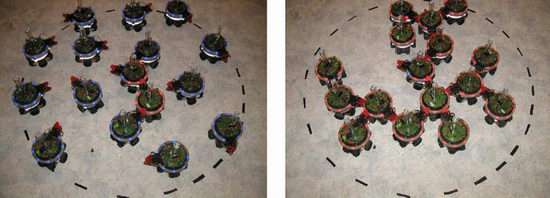
In one of the latest studies on autonomous robots, scientists sat back and watched as their robot created itself out of smaller robotic modules. The result, called “swarm-bot,” comes in many varieties, depending on the assigned task and available components. As the current state of the art in autonomous self-assembly, swarm-bots offer insight into the potential versatility and robustness that robots may possess to perform missions beyond human abilities.
A project coordinated by Professor Marco Dorigo, which was sponsored by the Future and Emerging Technologies program of the European Community, provided the impetus behind the swarm-bots. The researchers built small identical robots that can sense and latch onto each other to self-configure a giant specimen with no center of command. Looking sort of like a train or a swarm of bees, swarm-bots can assemble themselves up to any finite size, the scientists predict.
“As components of many living systems, the s-bots of our system can self-organize,” co-author Roderich Groß told PhysOrg.com. “Each individual robot module, called an ‘s-bot,’ interacts only with other s-bots in its immediate vicinity. Failures that occur in one or a few s-bots are therefore unlikely to have any significant impact on the performance of the entire system. Also, the system does not require any supplementary equipment such as global communication channels. We make use of a design approach based on swarm intelligence and evolutionary computation principles, as it helps shape the control to be both reliable and effective even if large numbers of s-bots are involved.”
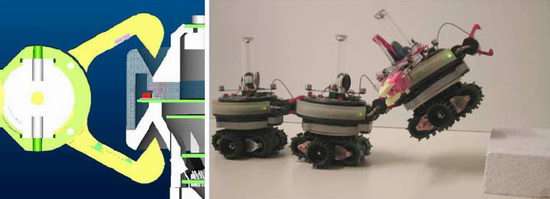
Although a single s-bot is rather complex, the mechanisms used to create and control swarm-bots are fairly straightforward. The s-bots are 19 cm (7.5 in) high and weigh 700 g (1.5 lbs). They currently run on lithium ion batteries, with a lifetime of two hours. Around the center of an s-bot’s cylindrical body is a connection ring, which carries a claw-like gripper that can open and close around the rings of other s-bots. A loose grip enables some mobility, while a tight grip can enable lifting of the grasped s-bot.
With a camera and eight colored LEDs, the s-bots can “communicate” with each other on their status. For example, blue lights mean that an s-bot is not connected, while a red light signifies that the s-bot has gripped another s-bot (or a passive object) and tells other s-bots to approach and latch on. A mobility system of tracks and wheels, or “treels,” enables the s-bots to navigate on rough terrain, and gives them good steering abilities.
“Swarm-bot combines the advantages of multi-robot and modular robot systems,” said Groß of the robot’s intelligence. “The component modules of swarm-bot, the s-bots, are fully autonomous and mobile, and they choose whether to assemble into a bigger entity to perform a task.”
Each s-bot can perceive and connect only with its neighbors. However, as the assemblages build incrementally, the process allows for far-reaching connections. Additionally, in their tests, the scientists found that the more s-bots available, the higher the connection performance (up to 100%). Further, the bigger the swarm-bot structure becomes, the more surface it provides for potential connections—increasing the swarm-bot’s growth rate. The scientists explain that such super-linear growth likely occurs due to the decentralized control and evolutionary control design of the system.
“Simulations with up to 100 modules indicate that a high density of modules is required to self-assemble a single artifact,” Groß said. “If the initial density of modules in the environment is too low, spare modules can lose visual contact with each other and consequently do not assemble. However, the control can easily be extended to let such isolated modules explore the environment. Ideally, the size of the final artifact should only be limited by the amount of resources, that is, the abundance of modules and the energy to charge them.”
While the scientists did not design the swarm-bot for any particular application at this stage, a variety of applications that require high flexibility and autonomy could potentially benefit from this concept. Future tasks might include planetary precolonization, deep sea exploration, underground search for energy resources, and search and rescue missions, the group says. The scientists report that the swarm-bots have already succeeded in crossing ditches, transporting small heavy objects, and navigating rough terrain—none of which a single s-bot could have accomplished alone.
Citation: Groß, Roderich, Bonani, Michael, Mondada, Francesco, and Dorigo, Marco. “Autonomous Self-Assembly in Swarm-Bots.” IEEE Transactions on Robotics, Vol. 22, No. 6, December 2006.
By Lisa Zyga, Copyright 2007 PhysOrg.com.
All rights reserved. This material may not be published, broadcast, rewritten or redistributed in whole or part without the express written permission of PhysOrg.com.


