New engine helps satellites blast off with less fuel
February 22, 2007 Engine Thruster

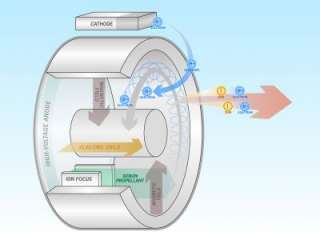
Georgia Tech's new engine uses a novel electric and magnetic field design that helps better control the exhaust particles. Ground control units can then exercise this control remotely to conserve fuel. Credit: Georgia Tech

Georgia Tech researchers have developed a new protoype engine that allows satellites to take off with less fuel, opening the door for deep space missions, lower launch costs and more payload in orbit.

The efficient satellite engine uses up to 40 percent less fuel by running on solar power while in space and by fine-tuning exhaust velocity. Satellites using the Georgia Tech engine to blast off can carry more payload thanks to the mass freed up by the smaller amount of fuel needed for the trip into orbit. Or, if engineers wanted to use the reduced fuel load another way, the satellite could be launched more cheaply by using a smaller launch vehicle.

The fuel-efficiency improvements could also give satellites expanded capabilities, such as more maneuverability once in orbit or the ability to serve as a refueling or towing vehicle.
New engine helps satellites blast off with less fuel

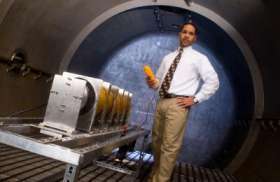
Dr. Mitchell Walker, an assistant professor in the Daniel Guggenheim School of Aerospace Engineering, tests an engine. Credit: Georgia Tech

The Georgia Tech project, lead by Dr. Mitchell Walker, an assistant professor in the Daniel Guggenheim School of Aerospace Engineering, was funded by a grant from the U.S. Air Force. The project team made significant experimental modifications to one of five donated satellite engines from aircraft engine manufacturer Pratt & Whitney to create the final prototype.

The key to the engine improvements, said Walker, is the ability to optimize the use of available power, very similar to the transmission in a car. A traditional chemical rocket engine (attached to a satellite ready for launch) runs at maximum exhaust velocity until it reaches orbit, i.e. first gear.

The new Georgia Tech engine allows ground control units to adjust the engine’s operating gear based on the immediate propulsive need of the satellite. The engine operates in first gear to maximize acceleration during orbit transfers and then shifts to fifth gear once in the desired orbit. This allows the engine to burn at full capacity only during key moments and conserve fuel.

"You can really tailor the exhaust velocity to what you need from the ground," Walker said.

The Georgia Tech engine operates with an efficient ion propulsion system. Xenon (a noble gas) atoms are injected into the discharge chamber. The atoms are ionized, (electrons are stripped from their outer shell), which forms xenon ions. The light electrons are constrained by the magnetic field while the heavy ions are accelerated out into space by an electric field, propelling the satellite to high speeds.

Tech’s significant improvement to existing xenon propulsion systems is a new electric and magnetic field design that helps better control the exhaust particles, Walker said. Ground control units can then exercise this control remotely to conserve fuel.

The satellite engine is almost ready for military applications, but may be several years away from commercial use, Walker added.

Source: Georgia Institute of Technology


print this article email this article download pdf blog this article bookmark this article     Stumble it Digg this share on Facebook retweet share on Reddit add to delicious
Rate this story - 4.4 /5 (33 votes)


February 22, 2007 all stories

Comments: 0

4.4 /5 (33 votes)
  • Stumble this up

  • Digg this

  • share this

  • hide
  • Related Stories

  • New Instrument Could Detect Hidden Aviation Hazards
    created Mar 03, 2009 | popularity not rated yet | comments 0
  • India says no to Google Earth's peering
    created Mar 10, 2006 | popularity not rated yet | comments 0
  • S. Korea to use APEC to show off hi-tech
    created Oct 26, 2005 | popularity not rated yet | comments 0
  • Space debris mitigation: the case for a code of conduct
    created Apr 18, 2005 | popularity not rated yet | comments 0
  • IBM Researchers Lower Language Barrier With Text Translator
    created 18 hours ago | popularity not rated yet | comments 0


  • hide
  • Relevant PhysicsForums posts

  • Base Isolation Systems in Skyscrapers?
    created 14 hours ago
  • Need to interview a Computer Hardware Engineer for school project
    created 16 hours ago
  • transient heat transfer
    created 22 hours ago
  • Trying to adapt a fuel gage circuit
    created Nov 22, 2009
  • More from Physics Forums - General Engineering

Other News

NREL Uncovers Clean Energy Leaders State by State

NREL Uncovers Clean Energy Leaders State by State

Technology / Energy

created 4 hours ago | popularity 1 / 5 (1) | comments 1

(PhysOrg.com) -- That California and Texas still lead the United States in generating renewable energy probably is no surprise. But, NREL's 2009 State of the States report shows that several smaller states ...


Opera logo

Stable Opera 10.10 browser with Unite now available

Technology / Software

created 5 hours ago | popularity 4.7 / 5 (3) | comments 1

(PhysOrg.com) -- The web browser Opera 10.10 has been released as a stable version, and it has a number of new features to enhance the browsing experience, including "Unite", which is a group of applications ...


Intelligence inside metal components

Intelligence inside metal components

Technology / Engineering

created 2 hours ago | popularity 4.5 / 5 (2) | comments 0

Up to now, extreme production temperatures made it impossible to equip metallic components with RFID chips during the operating process. At Euromold in Frankfurt (Dec. 2-5), Germany, Fraunhofer researchers ...


Key scientist says politics behind stolen e-mails

Technology / Other

created 5 hours ago | popularity 1 / 5 (1) | comments 4

(AP) -- A leading climate change scientist said hackers breaking into a university's computer server and then posting documents online show the nasty politics of global warming.


Just in time for Black Friday: students turn iPhone into barcode scanner

Just in time for Black Friday: students turn iPhone into barcode scanner

Technology / Software

created 16 hours ago | popularity 4.7 / 5 (3) | comments 0

(PhysOrg.com) -- Comparing prices over the Internet has become a common practice for consumers. Now, just in time for Black Friday, a group of Missouri University of Science and Technology students is putting ...