Looking for life on Jupiter's moon Europa
While NASA and the European Space Agency focus on Mars rovers and future missions to search for life on the Red Planet, a determined core of scientists is lobbying for equal attention to a place they feel is just as likely to harbor life - Jupiter's icy moon Europa.
"Because of the well-supported presence of water ice on Europa and the probability that there are briny oceans, Europa has to be a major target for the search for life in the solar system," said paleobiologist Jere H. Lipps, professor of integrative biology at the University of California, Berkeley. "Many of us are proposing that there is habitat there where we can expect to find evidence of life."
Lipps took up the issue with three other scientists on a panel Sunday (Feb. 18) at the annual meeting of the American Association for the Advancement of Science in San Francisco. The group, organized by Lipps, reviewed what is known about Europa and focused on the problems that need to be solved before undertaking a search for life on the frozen moon.
With years of experience studying life in the Antarctic and Arctic ice, Lipps, a member of the campus's Museum of Paleontology, knows the bizarre places organisms can thrive, and the unique processes that can bring life from deep under the ice to the surface. This is relevant because Europa, the third largest of Jupiter's moons, is thought to have a thick ocean of water overlain by a layer of ice that could be miles thick.
"Life thrives in ice, it doesn't mind at all," said Lipps, whose interest in single-celled organisms drew him to consider the possibility of life on other planets, which is likely to be more akin to bacteria than to humans. "In Antarctica, every phylum of algae, protozoan, bacteria and animal lives in the ice, many of them in brine channels that don't freeze."
Bacteria, diatoms, clams, snails, sponges and even fish larvae live under the ice shelves, yet often appear on the surface because of upheavals in the ice.
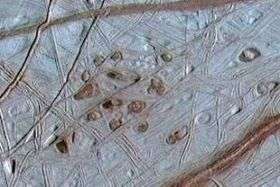
Similarly, photos taken by the Galileo spacecraft reveal a highly fractured ice surface on Europa with domes and ridges and uptilted ice rafts indicating that the surface has been reworked in a way that could have brought organisms living under the ice to the surface. There's also evidence that liquid water has welled up through cracks and refrozen in smooth lakes.
Using his knowledge of Earth's polar environments gained over 12 years working in Antarctica, including on the Ross Ice Shelf, Lipps proposed 25 likely habitats for life on Europa in a 2005 paper in the journal Icarus. Any exploration of the moon should examine these sites in detail, he said.
Lipps does not assume that life on Europa would be like life on Earth. However, he said, "The strategy of seeking and exploring habitats, rather than the life itself, should provide a most powerful search strategy," as well as guiding instrument development and deployment programs.
Lipps argues that the environments of life, the energy for life and all the chemicals needed for life, including oxygen, have been present on the moon for a long time, probably at least 60 million years, judging from crater counts on the moon's surface. Scientists suspect that liquid water near the freezing point, zero degrees Celsius (32 degrees Fahrenheit), is able to exist on Europa because of heat generated by tidal friction between the moon and its immense neighbor, the planet Jupiter.
"Based on analogy with Earth's polar seas, Europan life may occur in many habitats: on soft and rocky bottoms at the ocean's floor, associated with hydrothermal vents on the floor of the oceans, at different levels in the water column as plankton and nekton, and in and on the ice cover itself," Lipps noted. "Some of these might contain complex associations of life forms, including both micro- and macroscopic forms and consumers and predators."
Just as turnover of Antarctic ice brings organisms to the top, so would the dynamic oceanographic and geologic processes evident on Europa's icy surface expose these life forms at the surface, where they could be detected by orbiting spacecraft or roving landers.
"This is a paleontological search strategy, which is what I do," he said. "If I want to collect fossils in Nevada, I get a map and look for likely spots, like rock outcroppings, where fossils will be found. Ice turned on its edge is just a geologic outcrop to me - let's go there and see if we can find evidence of past or present life."
Surface sites that might contain habitats with life or fossils include the areas of refrozen ocean, chaotic terrains with tilted and rotated blocks of ice, the ridges and rills associated with fissures, low areas where water may have collected, and "dirty" ice that may include material and organisms floated to the surface by ice formed on the bottom of the ocean or gouged by moving ice, as well as a variety of habitats in the ice itself.
Lipps noted, too, that while radiation at the surface could be intense enough to kill any Earth-like life, it would not penetrate more than a meter or two, so that many cracks, tubes, caves, and overhangs might exist in the surface ice that could be inhabited by life forms. Ices of different ages could provide an evolutionary look at life on the moon.
"A sampling strategy for life and its history on Europa should include paleontological, molecular biological, and volatile and organic chemical objectives that would clearly document the present and/or former existence of life on Europa," he said. He also urged detailed imaging of surface features, even at the microscopic level, since "the most exciting and convincing evidence for the general public would be an image of a life form."
Lipps said that if we start planning now, we could perhaps have a spacecraft on Europa in 15 years.
"We'd like a mission to Europa, and we've pointed out the likely places for life," Lipps said. "It's now up to the engineers, and to NASA decision-makers and funders, to determine how to get there."
Source: UC Berkeley


