Pulsar Racing Through Space Reveals Comet-Like Trail
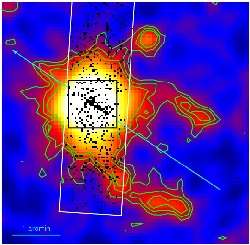
A team led by Dr. Patrizia Caraveo of the Italian National Institute for Astrophysics (INAF) in Milan discovered this cometary trail with data from NASA's Chandra X-ray Observatory Archive. The discovery follows the team's discovery in 2003 using ESA's XMM-Newton of Geminga's twin X-ray tails stretching for billions of chilometers.
Together, these observations provide unique insight into the contents and density of the interstellar "ocean" Geminga is plowing through, as well as the physics of Geminga itself. Not only is Geminga close, only about 500 light years from Earth, it is cutting across our line of sight, offering a spectacular view of a pulsar in motion.
"Geminga is the only isolated pulsar we know of showing both a small comet-like trail and a larger tail structure," said Dr. Andrea De Luca of INAF's Istituto di Astrofisica Spaziale e Fisica Cosmica, lead author on an article about this discovery in Astronomy & Astrophysics. "This jettison from Geminga's journey through interstellar space provides unprecedented information about the physics of pulsars."
A pulsar is a type of rapidly spinning neutron star that emits steady pulses of radiation with each rotation, funnelled along strong magnetic field lines, much like a lighthouse beam sweeping across space. A neutron star is the core remains of an exploded star once at least eight times as massive as the sun.
These dense stars, only about 20 kilometers across, still contain roughly the mass of the sun. Neutron stars contain the densest material known. Like many neutron stars, Geminga got a "kick" from the explosion that created it and has been flying through space like a cannonball ever since.
De Luca said that Geminga's complex phenomenology of tails and a trail must be from high-energy electrons escaping the pulsar magnetosphere following paths clearly driven by the pulsar's motion in the interstellar medium.
Most pulsars emit radio waves. Yet Geminga is "radio quiet" and was discovered 30 years ago as a unique "gamma-ray only" source (only later was Geminga seen in the X-ray and optical light wavebands). Geminga generates gamma rays by accelerating electrons and positrons, a type of antimatter, to high speeds as it spins like a dynamo four times per second.
"Astronomers have known that only a fraction of these accelerated particles produce gamma rays, and they have wondered what happens to the remaining ones," said Caraveo, a co-author on the Astronomy & Astrophysics article. "Thanks to the combined capabilities of Chandra and XMM-Newton, we now know that such particles can escape. Once they reach the shock front, created by the supersonic motion of the star, the particles lose their energy radiating X-rays."
Meanwhile, an equal number of particles (with a different electric charge) should move in the opposite direction, aiming back at the star. Indeed, when they hit the star's crust they create tiny hotspots, which have been detected through their varying X-ray emission.
The next generation of high-energy gamma-ray instruments - namely, the planned Italian Space Agency's AGILE mission and NASA's GLAST mission - will explore the connection between the X-ray and gamma ray behaviour of pulsars to provide clues to the nature of unknown gamma-ray sources, according to Prof. Giovanni Bignami, a co-author and director of the Centre d'Etude Spatiale des Rayonnements (CESR) in Toulouse, France. Of the 271 higher-energy gamma-ray objects detected by a NASA telescope called EGRET, 170 remained unidentified in other wavebands. These unidentified objects could be "gamma-ray pulsars" like Geminga, whose optical and X-ray light might be visible only because of its nearness to Earth.
Only about a dozen other radio-quiet isolated neutron stars are known, and Geminga is the only one with tails and trails and copious gamma-ray emission. Bignami named Geminga for "Gemini gamma-ray source" in 1973. In his local Milan dialect, the name is a pun on "ghè minga," which means "it is not there." Indeed, Geminga was unidentified in other wavelengths until 1993, twenty years after its discovery.
The discovery team also includes Drs. Fabio Mattana and Alberto Pellizzoni of the INAF - Istituto di Astrofisica Spaziale e Fisica Cosmica.
Source: INAF


