Model Predicts Colder Winter Temperatures in the East, Warmer in the West
December 16, 2005
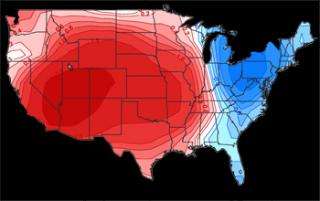
A weather model for Dec., Jan., and Feb. shows cooler and snowier weather in the East and warmer, dryer weather in the West.

According to a model developed by atmospheric scientist Judah Cohen of Atmospheric and Environmental Research (AER), Inc., temperatures during Dec., Jan., and Feb. will be cold in the eastern United States and warm west of the Mississippi River.

Image: A weather model for Dec., Jan., and Feb. shows cooler and snowier weather in the East and warmer, dryer weather in the West. White areas on the map indicate typical winter temperatures. Blue indicates colder than normal, and red indicates warmer than normal. Credit: Judah Cohen, Atmospheric and Environmental Research, Inc.

The largest departures from normal are found in the eastern Great Lakes (darkest blue) and in the Southwest (darkest red). Cohen's model uses El Nino, recent temperature trends and Siberian snow cover in Oct, as well as sea-level pressure anomalies, in its winter forecast.

For Jan., Feb., and Mar. (at right), the model shows cold temperatures in the Northeast, the Great Lakes, and the Northern Plains and warm in the Rockies and along the West Coast.

Cohen says regions impacted by snow variability differ from those influenced by El Nino, which is often used in forecast models. "The influence of snow cover extent has the potential to complement El Nino-derived forecasts, and to advance our understanding of climate variability and its application in prediction models," he said.

Source: NSF

3.5 /5 (10 votes)  

Rank 3.5 /5 (10 votes)
Tags

Relevant PhysicsForums posts

More news stories

Could Venus be shifting gear?

(PhysOrg.com) -- ESA’s Venus Express spacecraft has discovered that our cloud-covered neighbour spins a little slower than previously measured. Peering through the dense atmosphere in the infrared, the ...

Space & Earth / Space Exploration

created 22 hours ago | popularity 5 / 5 (8) | comments 8 | with audio podcast

Two new moons for Jupiter

Advances in technology have lead to the discovery of new planets outside of our Solar System, and now even new moons in our own backyard.

Space & Earth / Space Exploration

created 22 hours ago | popularity 4 / 5 (1) | comments 7

Mars Science Laboratory computer issue resolved

(PhysOrg.com) -- Engineers have found the root cause of a computer reset that occurred two months ago on NASA's Mars Science Laboratory and have determined how to correct it.

Space & Earth / Space Exploration

created 23 hours ago | popularity 4.6 / 5 (7) | comments 4 | with audio podcast

NASA sees wide-eyed cyclone Jasmine

Cyclone Jasmine's eye has opened wider on NASA satellite imagery, as it moves through the Southern Pacific Ocean.

Space & Earth / Earth Sciences

created 14 hours ago | popularity 3.5 / 5 (2) | comments 2

Clam fields found at deep, low-temperature Mariana vents

(PhysOrg.com) -- Scientists have marveled at the unusual life forms thriving at high temperature hydrothermal vents of the deep ocean.

Space & Earth / Earth Sciences

created 23 hours ago | popularity 4.3 / 5 (3) | comments 0 | with audio podcast


Anonymous knocks CIA website offline (Update)

The website of the Central Intelligence Agency was inaccessible on Friday after the hacker group Anonymous claimed to have knocked it offline.

Small modular reactor design could be a 'SUPERSTAR'

(PhysOrg.com) -- Though most of today's nuclear reactors are cooled by water, we've long known that there are alternatives; in fact, the world's first nuclear-powered electricity in 1951 came from a reactor ...

New power source discovered

(PhysOrg.com) -- Researchers at the Massachusetts Institute of Technology (MIT) and RMIT University have made a breakthrough in energy storage and power generation.

The power of estrogen -- male snakes attract other males

A new study has shown that boosting the estrogen levels of male garter snakes causes them to secrete the same pheromones that females use to attract suitors, and turned the males into just about the sexiest ...

Advanced power-grid model finds low-cost, low-carbon future in West

(PhysOrg.com) -- The least expensive way for the Western U.S. to reduce greenhouse gas emissions enough to help prevent the worst consequences of global warming is to replace coal with renewable and other ...

Fool's gold may prove an unlikely alternative to overexploited catalytic materials

Catalytic materials, which lower the energy barriers for chemical reactions, are used in everything from the commercial production of chemicals to catalytic converters in car engines. However, with current catalytic materials ...