Study finds advanced 20th-century geometry in 15th-century tilings
February 23rd, 2007 Study finds advanced geometry in 15th century tilings

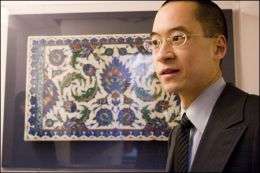
"We're finding widespread evidence for the same approach being used for 500 years across the Islamic world," says Peter J. Lu, a graduate student in physics. "Again and again, girih tiles provide logical explanations for complicated designs." Photo: Stephanie Mitchell/Harvard News Office

Intricate decorative tilework found in medieval architecture across the Islamic world appears to exhibit advanced decagonal quasicrystal geometry -- a concept discovered by Western mathematicians and physicists only in the 1970s and 1980s. If so, medieval Islamic application of this geometry would predate Western mastery by at least half a millennium.

The finding, by Peter J. Lu at Harvard University and Paul J. Steinhardt at Princeton University, will be published this week in the journal Science.

"We can't say for sure what it means," says Lu, a graduate student in physics at Harvard's Graduate School of Arts and Sciences. "It could be proof of a major role of mathematics in medieval Islamic art or it could have been just a way for artisans to construct their art more easily. It would be incredible if it were all coincidence, though. At the very least, it shows us a culture that we often don't credit enough was far more advanced than we ever thought before."

Breathtakingly elaborate geometric tiling is a distinctive feature of medieval Islamic architecture throughout the Middle East and Central Asia. Art historians have long assumed that simpler elements of the patterns were created with elementary tools such as straightedges and compasses. But there has been no explanation for how artists and architects could have created the unmistakably complex tile patterns adorning many medieval Islamic edifices.

"Straightedges and compasses work fine for the recurring symmetries of the simplest patterns we see," Lu says, "but it probably required far more powerful tools to fully explain the elaborate tilings with decagonal symmetry."

While it's possible to create these patterns individually with basic tools, they are incredibly difficult to replicate on a larger scale without generating extensive geometric distortions. The most complex medieval Islamic tilings have little such distortion, leading Lu to believe more is at play.

"Individually placing and drafting hundreds of decagons with a straightedge would have been exceedingly cumbersome," Lu says. "It's much more likely these artisans used particular tiles that we've found by decomposing the artwork."

These tiles, dubbed "girih tiles" by Lu and Steinhardt, consist of sets of five contiguous polygons (a decagon, pentagon, diamond, bowtie, and hexagon), each with a unique decorative line pattern. For medieval Islamic artisans, they may have represented a toolkit for generating huge numbers of distinctive tile patterns without the lengthy, painstaking, and often flawed process of creating each line segment individually.

These girih tiles may have been used to generate a wide range of complex tiling patterns on major buildings from medieval Islam, including mosques in Isfahan, Iran, and Bursa, Turkey; madrasas in Baghdad; and shrines in Herat, Afghanistan, and Agra, India.

In some cases, Lu found girih tiles used to create patterns of two distinct scales on medieval Islamic buildings. This approach generates infinite patterns with decagonal symmetry that never repeats -- also known as a quasicrystalline tiling, a phenomenon first described in the West in the 1970s by famed British mathematician Roger Penrose and more fully explained by Steinhardt and Dov Levine over the past 30 years.

In addition to examples on medieval structures that are still standing, Lu has been able to match his girih tiles with drawings in 15th-century Persian scrolls drafted by master architects to document their techniques.

"We're finding widespread evidence for the same approach being used for 500 years across the Islamic world," Lu says. "Again and again, girih tiles provide logical explanations for complicated designs."

Source: Harvard University


print this article email this article download pdf blog this article bookmark this article     Digg this Stumble it share on Facebook share on Reddit add to delicious save to Yahoo! bookmarks
4.6/5 after 55 votes


February 23rd, 2007 all stories
Other Sciences / Other

Comments: 0
Rank: 4.6/5 after 55 votes

  • Stumble this up

  • Digg this

  • Share it:
  • share on Facebook
  • share on MySpace
  • share on Slashdot
  • rss-newsfeed
  • share on Google
  • share on Reddit
  • add to delicious
  • save to Yahoo! bookmarks
  • share on Windows Live
  • Add to Mixx!
Rating: 4.6/5 after 55 votes

  • Related Stories

  • Probing Question: Can humans control the weather?
    created Apr 16, 2009 | popularity not rated yet | comments 0
  • The tulip entered Europe through al-Andalus five centuries before believed
    created Apr 16, 2009 | popularity not rated yet | comments 0
  • Satellites show how Earth moved during Italy quake
    created Apr 15, 2009 | popularity not rated yet | comments 0
  • 'Pristine' Amazonian region hosted large, urban civilization, study finds
    created Aug 28, 2008 | popularity not rated yet | comments 0
  • Revolutionary chefs? Not likely, shows physics research
    created Jul 10, 2008 | popularity not rated yet | comments 0

Tags


  • Physicists Demonstrate Quantum Memory with Matter Qubits
    Physicists Demonstrate Quantum Memory with Matter Qubits
    Physics / General Physics
    created 16 hours ago | popularity 4.8 / 5 (8) | comments 1
  • 'Holey' Nanosheets for Wastewater Dye Removal
    Nanotechnology / Nanomaterials
    created Jul 01, 2009 | popularity 5 / 5 (5) | comments 1
  • Jellyfish Robot Swims Like its Biological Counterpart
    Jellyfish Robot Swims Like its Biological Counterpart
    Electronics / Robotics
    created Jun 26, 2009 | popularity 4.4 / 5 (7) | comments 1
  • Could Maxwell's Demon Exist in Nanoscale Systems?
    Could Maxwell's Demon Exist in Nanoscale Systems?
    Physics / General Physics
    created Jun 24, 2009 | popularity 4.4 / 5 (18) | comments 29
  • Living Safely with Robots, Beyond Asimov's Laws
    Living Safely with Robots, Beyond Asimov's Laws
    Electronics / Robotics
    created Jun 22, 2009 | popularity 4.6 / 5 (50) | comments 39
  • Other News

    Will Murphy, 7, inspects the teeth of a Theropod dinosaur

    Australian scientists hail triple dinosaur find

    Other Sciences / Archaeology & Fossils

    created 21 hours ago | popularity 4.5 / 5 (8) | comments 1

    Australian scientists hailed the country's most significant dinosaur discovery in decades on Friday after three new species were unearthed in a Queensland billabong.


    Creation Museum president Ken A. Ham

    Paleontologists brought to tears, laughter by Creation Museum

    Other Sciences / Other

    created Jun 30, 2009 | popularity 4.5 / 5 (34) | comments 54

    For a group of paleontologists, a tour of the Creation Museum seemed like a great tongue-in-cheek way to cap off a serious conference.


    Mummified dinosaur skin yields up new secrets

    Mummified dinosaur skin yields up new secrets

    Other Sciences / Archaeology & Fossils

    created Jul 01, 2009 | popularity 4.8 / 5 (13) | comments 9

    (PhysOrg.com) -- Scientists from The University of Manchester have identified preserved organic molecules in the skin of a dinosaur that died around 66-million years ago.


    Bush's court appointments emphasized ideology over diversity

    Other Sciences / Other

    created Jun 26, 2009 | popularity 2 / 5 (8) | comments 11

    The judicial appointments of former president George W. Bush suggests that his motivation for appointing nontraditional judges was driven more by ideology and strategy than concerns for diversity, a new analysis shows.


    Liberal? Conservative? Stanford study says mental nudge can make voters flip-flop

    Liberal? Conservative? Stanford study says mental nudge can make voters flip-flop

    Other Sciences / Social Sciences

    created Jul 02, 2009 | popularity 3.5 / 5 (4) | comments 3

    (PhysOrg.com) -- No doubt you’ve worked hard for your success. But chances are you’ve also had some help and lucky breaks along the way.