February 23, 2007 feature
Chain Mail Fabric a Perfect Fit
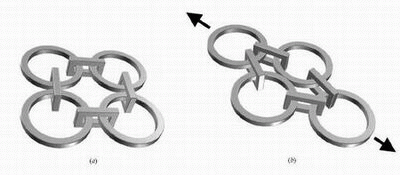
Contemporaries of the ancient Greeks might find something familiar within the walls of the Micro and Nanotechnology Lab at the University of Illinois. In constructing a new type of smart fabric, researchers Jonathan Engel and Chang Liu have used interconnecting rings and links to create a textile looking a bit like the chain mail used by warriors dating back 2,000-plus years.
“It’s somewhat of a crazy idea, I guess,” Liu told PhysOrg.com. “We were interested in using microtechnology to build something that could flex and bend. The chain mail construction is nothing fancy, but it’s an interesting structure that hasn’t been used much recently.”
As a flexible MEMS (Microelectromechanical Systems) device, the new fabric represents a milestone in the development of smart textiles. A type of smart device, smart textiles will likely be incorporated into wearable computers—shirts that can detect vital signs, locate bullet wounds, or provide an information network for soldiers on a dispersed battleground, according to recent research (Georgia Tech). Generally, most work on smart fabrics involves integrating the electronic elements into conventional fabrics. Engel and Liu’s integrated circuit, however, is the fabric—a continuous, flexible and stretchable metallic cloth with unique electrical and mechanical properties.
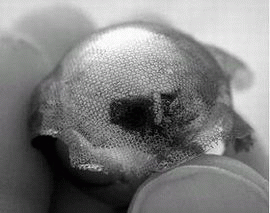
One of the interesting physical characteristics of the micro chain mail is its ability to bend along two axes, allowing the fabric to drape over curved surfaces, wrinkle-free. This ability comes from the geometric network of rings connected by links—each piece of about half a millimeter in length—which can slide and rotate against each other. As the links are pulled taut, the researchers found that the fabric’s length could expand by 32%, with its width decreasing by 56%.
“The flexible fabric can conform to curved surfaces, and be used on objects that move,” explained Liu. “Because of the nature of the fabric, electronics can be easily integrated into the technology. In the future, for example, this type of clothing could shield electromagnetic waves for construction workers.”
Regarding the electronic properties, Engel and Liu found that the displacement of the copper fabric caused variations in its electrical conduction properties, which would enable using the fabric as an electrical device. When the links were fully stretched, making solid electrical contact, the researchers observed a decrease in electrical resistance of nearly seven orders of magnitude.
The scientists also investigated the fabric’s mechanical tensile strength, finding a value of less than half that of the ultimate strength of copper. By inspecting how the fabric broke—failure occurred mostly in the rings rather than the links—the researchers predict that a complex loading occurs in the fabric, different from that in normal copper.
To fabricate this first batch, Engel and Liu used a multilayer microelectroplating process, depositing thin layers of aluminum, copper and photoresist on a substrate to form a mold, which was then filled with copper. In the end, the sacrificial mold layers were “washed out” by soaking in chemicals, leaving the links or rings behind.
While this fabrication occurred on a small scale, the researchers suggest that large-scale manufacturing of the fabric is quite realistic for the future. Further, besides using metal materials, other materials may offer advantages for different applications. For example, a silicon chain mail fabric could generate electricity using solar cells, or detect motion or strain. Polymer elastomers could have an advantage in sensing chemicals, strain or pressure.
“This is just one of the first steps in wearable electronics technology,” said Liu. “The long-term interest is to make computer gear blend in to everyday clothing so that it doesn’t feel intrusive. This is a barrier for people for wearing, for example, solar cells or sensors on their clothing, but it can be overcome by a robust fabric that moves with you.”
Citation: Engel, Jonathan, and Liu, Chang. “Creation of a metallic micromachined chain mail fabric.” J. Micromech. Microeng. 17 (2007) 551-556.
By Lisa Zyga, Copyright 2007 PhysOrg.com.
All rights reserved. This material may not be published, broadcast, rewritten or redistributed in whole or part without the express written permission of PhysOrg.com.


