New Microlab on Chip for Medical Imaging Biomarkers
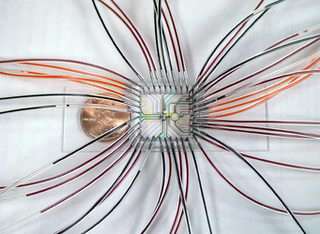
A collaboration among scientists at UCLA, the California Institute of Technology, Stanford, Siemens and Fluidigm has developed a new technology using integrated microfluidic chips for simplifying, lowering the cost and diversifying the types of molecules used to image the biology of disease with the medical imaging technology, positron emission tomography (PET).
Image: Microchip for Production of FDG
These molecules are used with PET to search diagnostically throughout the body to look for, or image, the molecular errors of disease and to guide the development of new molecular therapeutics.
PET is a new generation of medical imaging for examining the biology of disease that has been shown to improve dramatically the detection of cancer, stage the extent of cancer throughout the body, detect recurrence of cancer and help select the right therapy for individual patients.
In Alzheimer's disease, PET has been shown to be 93 percent accurate in detecting the disease about three years before the conventional diagnosis of "probable Alzheimer's" when integrated into the clinical workup of patients.
In addition, PET has been shown to detect Alzheimer's and other neurological disease years before even symptoms are expressed. PET also is employed to determine which patients with cardiovascular disease will benefit from bypass surgery and angioplasty.
These and other clinical uses of PET employ a labeled version of the sugar glucose, called fluorodeoxyglucose (FDG). Glucose is a critical fuel for cells throughout the body to perform their normal functions. For example, 95 percent of the energy for the brain to function comes from glucose. In addition, cancer cells increase their metabolism of glucose about 25-fold. There were about 3 million clinical PET studies performed in clinical services throughout the world in 2005.
The research was published this week in the journal Science.
Researchers demonstrated a new technology of a programmable chip that can dramatically accelerate the development of many new molecular imaging molecules for PET. As a proof of principle, this group of academic and commercial scientists demonstrated that FDG could be synthesized on a "stamp-size" chip. These chips have a design similar to integrated electronic circuits, except they are made up of fluid channels, chambers, and values, or switches, that can carry out many chemical operations to synthesize and label molecules for PET imaging. All the operations of the chip are controlled and executed by a PC.
FDG was produced on the chip and used to image glucose metabolism in a mouse with a specially designed PET scanner for mice produced by Siemens, called a microPET. The Science paper illustrates that this technology also can produce the amount of FDG required for human studies.
More importantly, the paper illustrates a new base technology for producing and delivering a diverse array of molecular imaging molecules and labeled drugs for use with PET to examine the biology of many diseases for molecular diagnostics and to guide the development of new molecular therapeutics, or drugs.
"Chemists synthesize molecules in a lab by mixing chemicals in beakers and repeating experiments many times, but one day soon they'll sit at a PC and carry out chemical synthesis with the digital control, speed and flexibility of today's world of electronics using a tiny integrated microfluidic chip," said Hsian-Rong Tseng, assistant professor of molecular and medical pharmacology, Crump Institute for Molecular Imaging, David Geffen School of Medicine at UCLA.
There is a vast distribution of manufacturing sites throughout the world producing PET molecular imaging molecules for hospitals, universities and pharmaceutical companies. The goal is to integrate these new chips into a small control device operated by a PC that will be commercially produced, then to ship chips to users so they can produce whatever molecules they choose for molecular imaging with PET. These chips will be an enabling technology to fuel growth in the number and diversity of imaging molecules and applications of PET in biology and pharmaceutical research and in the care of patients.
Source: UCLA


