No Safe Place
Imagine hiking across Antarctica, through ice, cold and bitter wind, enduring months of hardship, and finally arriving at the doorstep of the South Pole itself. At that moment you get hit by a Sahara sandstorm.
That's the analogy scientists are using to describe what happened to the ESA-NASA Ulysses spacecraft last December. "Ulysses was approaching the South Pole of the sun when it was 'sandblasted' by a cloud of high-energy particles—protons, electrons and heavy ions," says Arik Posner, Ulysses Program Scientist at NASA headquarters. The cloud was as foreign to the sun's South Pole as a Sahara sandstorm would be to Antarctica.
The strange tale begins on Dec. 5, 2006.
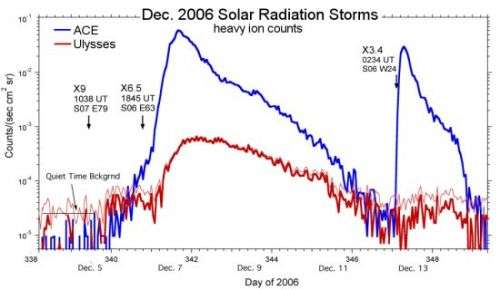
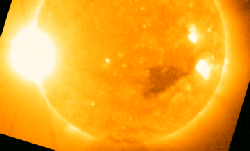
Astronomers were in a state of excitement due to the sudden appearance of a giant and angry-looking sunspot on the sun's eastern limb—"sunspot 930," says Posner. On Dec. 5th it exploded, producing one of the strongest solar flares of the past 25 years. On the "Richter scale" of solar flares, X1 is considered intense; the Dec. 5th flare was an X9. A flash of X-rays announced the blast to sensors in Earth orbit, and moments later a cloud of protons, electrons and heavy ions came rushing out of the blast site. This is the cloud that pelted Ulysses.
The process repeated on Dec. 6th (X6) and Dec. 13th (X3). Each explosion created its own cloud of high-energy particles. "We call these clouds 'radiation storms,'" says Posner. "They are common after big flares."
What's strange about these storms is where they went—to the South Pole. "All three storms were detected by the Ulysses spacecraft," says University of New Hampshire physicist Bruce McKibben. He is principal investigator for COSPIN (Cosmic and Solar Particle INvestigation), an array of sensors onboard Ulysses that counts high energy particles. "The Dec. 6th event was particularly strong and rich in heavy ions."
The Dec. 6th storm was so strong, in fact, "that if Earth had been where Ulysses was, we would have experienced a full-fledged Ground-Level Event," says Prof. Bernd Heber of the Institute for Experimental and Applied Physics in Keil, Germany. In other words, the particles were capable of tunneling all the way through Earth’s atmosphere to reach the ground. Heber is principle investigator for the Kiel Electron Telescope (KET), a sensor onboard Ulysses able to detect such super-energetic electrons, protons and ions.
These observations add up to "a big puzzle," says McKibben. Sunspot 930 was near the sun's equator, while Ulysses was over the sun's South Pole. The sun's magnetic field should have kept the storms bottled up at low latitudes. How did they reach Ulysses?
It's a puzzle NASA is keen to solve. Solar radiation storms can cause communication blackouts on Earth; they can disable satellites in Earth-orbit; and in extreme cases they could be deadly to astronauts. "We need to be able to predict the trajectory of these storms," says Posner.
The key is the sun's magnetic field. Just as Earth's magnetic field guides compass needles, the sun’s magnetic field guides radiation storms. "Radiation storms consist of charged particles which naturally follow lines of magnetic force."
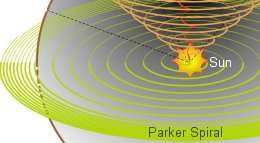
To forecast the path of a radiation storm, researchers have in the past relied on the "Parker spiral," a pioneering magnetic model developed by University of Chicago physicist Eugene Parker. According to his work, the sun's magnetic field emerges radially from the sun's surface and spirals outward into the solar system. "The spiral shape is caused by the spinning motion of the sun," explains Posner. "It's like a spiral stream of water from a spinning lawn sprinkler."
The Parker spiral makes a straightforward prediction: Radiation storms that begin near the equator should remain near the equator. A storm might expand into the solar system and hit Earth, which is not far off the sun’s equatorial plane, but it should not hit Ulysses over the sun's South Pole.
Clearly, there's more to the story than a graceful spiral. The real solar magnetic field may contain kinks and twists that provide a polar passage, a route storms can travel from equator to poles. There is evidence for the idea: In 2000 and 2001, the last Solar Max, the sun's magnetic field was full of convoluted, non-Parkerian structures. "During that time, Ulysses experienced six high-latitude radiation storms," notes McKibben: data.
Mapping and understanding these passages, if they exist, is work for the future. Meanwhile, one thing is clear: "There is no place in the inner solar system completely safe from radiation storms," says Posner.
Source: by Dr. Tony Phillips, Science@NASA


