Probing Question: Are today's nuclear power plants safe?
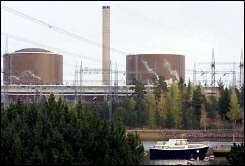
Burning fossil fuels to make electricity releases many tons of carbon into the atmosphere, contributing to global warming. Today, as the United States and other nations search for "greener" ways of generating energy, nuclear power is getting a fresh look. The process yields huge quantities of electricity with essentially zero emissions of greenhouse gases. But are nuclear power plants safe?
"Nuclear plants are very safe," asserted Forrest J. Remick, professor emeritus of nuclear engineering, adding, "It helps to compare their safety record with that of other major industries." In 2005, the industrial accident rate for nuclear power plant workers was 0.24 per 200,000 worker hours, compared with 3.5 accidents per 200,000 worker hours for all manufacturing industries (14.6 times greater). But what about those of us who live near nuclear plants? Said Remick, "No member of the public has been killed or injured from radiation during the nearly 50 years that commercial nuclear power plants have been operating in the U.S."
Many of the 104 nuclear plants in the nation today are approaching the end of their 40-year licenses. But instead of utilities shutting down these profitable facilities, virtually all are expected to apply for 20-year license renewals. To date, the Nuclear Regulatory Commission (NRC) has renewed the operating licenses of 47 plants, and a number of others are currently under review. "The NRC is very thorough in inspecting for safety," said Remick, citing an average of 22 months for the NRC to sign off on a license renewal for a given plant.
"Almost all of the equipment in a plant, with the exception of the pressure vessel" -- the structure, made of ductile, high-strength steel, that holds the reactor core -- "is replaceable: motors, pumps, pipes, wiring and so on," he said. "The integrity of the pressure vessel itself is monitored through the use of sample coupons of the same material, which are irradiated within the reactor vessel and are periodically removed for evaluation to determine effects of aging."
As of early 2007, the NRC had received around 30 indications from U.S. utilities that they will soon apply to build new nukes. According to Remick, a new generation of reactors has been designed to include passive safety features. "Instead of having a safety system operated by motors and pumps," he noted, "the new designs rely on water stored at an elevation higher than the core, so that if you have an emergency and need cooling water, it automatically arrives by gravity." Operators can replenish the cooling water later by mechanical means, including tanker trucks. "In older designs, you might need electricity to open a valve for cooling," said Remick. "In many of the new designs, spring-loaded valves require electricity to remain shut and open automatically in the event of a loss of power." (Remick hastened to add that today's operating nuclear plants have multi-tiered backup systems for delivering electric current in the event of a power failure.)
The NRC has issued design certification for four advanced, next-generation nuclear power plant designs. These plants will be simpler and cheaper to build than older ones, thanks to increasing standardization and the ability to assemble many components off-site.
New designs are more efficient than older designs, and they are safer. One, known as VHTR (Very High Temperature Reactor), will include a helium-cooled reactor that uses tiny pellets of uranium fuel encased in graphite. "If you lose cooling in such a reactor," said Remick, "those little pellets will absorb heat without failing and releasing radioactivity." The concept has been demonstrated in test reactors in the United States, Germany, China and South Africa.
"Existing nuclear plants are cash cows for utilities," Remick said. "Although fairly expensive to build, nuclear plants are much less expensive to operate than oil or gas plants and slightly less expensive to run than coal-burners. Also, they're non-polluting."
The industry has come a long way in understanding how to safely produce power since the 1979 accident at the Unit 2 assembly at Three Mile Island (TMI), near Harrisburg, that resulted in a partial core meltdown. Although considered the worst accident in U.S. commercial nuclear power-generating history, the mishap led to no deaths or injuries among plant workers or members of the local community. Since then, noted Remick, "TMI has twice set world records for consecutive days of operation without a shutdown for refueling or to repair or replace malfunctioning equipment."
Source: By Charles Fergus, Research Penn State


