February 27, 2007 feature
Viking navigation hypothesis under foggy and cloudy skies requires more light

While history portrays the Vikings as skillful masters of the sea, sailing treacherous routes in the northern Atlantic Ocean during the 10th-13th centuries, just how much knowledge, technology and ability they possessed is debatable. One theory claims that the Vikings could navigate even on cloudy or foggy days using skylight polarization, which would not only require specific atmospheric conditions, but technology beyond anything known in Viking culture.
Scientists Ramon Hegedus, Susanne Akesson, Rudiger Wehner, and Gabor Horvath have recently investigated the idea of polarimetric Viking navigation, which was first proposed in 1966 by the archaeologist Thorkild Ramskou. While no archeological evidence has been found to support the idea, several pieces of published material cite the Viking polarization hypothesis as an assumed fact. The scientists, however, have found that more light needs to be shed on the Viking navigation polarization hypothesis for confirmation.
“Since the Vikings did not possess a magnetic compass, it is an enigma how these excellent sailors could have navigated on the open waters,” Horvath told PhysOrg.com. “This enigma was partly solved when archaeologists found some remains of a Viking sun-dial, a splendid instrument composed of a wooden disk with a perpendicular gnomon in its center. In the disk, some hyperbolas were engraved, which corresponded with the curves described by the tip of the gnomon’s shadow cast on the disk from sunrise to sunset during the sailing season from April to August on the 61 degrees north latitude.
“To read the direction of geographical North, the disk was rotated around the vertical gnomon until the tip of the gnomon’s shadow touched the appropriate hyperbola. This is the so-called 'solar Viking navigation'. However, the Viking sun-dial could have functioned only in sunshine. Thus the next enigma was how the Vikings could have navigated by their sun-dials under cloudy or foggy conditions.”
To detect skylight polarization on cloudy or foggy days, the idea is that the Vikings could have used a sunstone, an enigmatic birefringent (double-refracting) crystal, like cordierite, turmalin, or calcite, which are common in the Scandinavian region and even mentioned in a Viking saga. The sunstone could signal the direction of the sun by the display of polarized light traveling through the crystal, which would be useful on the Viking’s typical east-west route between Greenland and Norway.
“In polarimetric Viking navigation, first the direction of polarization of light from a clear, blue sky region should be determined,” Horvath explained. “Then, from the direction of polarization of skylight, the azimuth direction of the solar-antisolar meridian is obtained (according to the Rayleigh theory of skylight polarization, these two directions are perpendicular to each other).
“The idea that the azimuth direction of the sun occluded by a cloud can be determined from the direction of polarization of light from the clear, blue sky regions, originates from the Austrian biologist Karl von Frisch (later Nobel Prize winner). In 1949, von Frisch discovered the polarization vision of honey bees, and showed that these insects are able to navigate by means of the sky polarization when the sun is hidden by clouds, as long as there are some clear, blue sky regions.”
In investigating the validity of the idea, a group Horvath belongs to at the Biooptics Laboratory at the Eotvos University in Hungary has been traveling on a journey of its own. In 2005, this group tested an assumption that solar positions, or solar azimuth directions, could be estimated by the naked eye, even if the sun is behind the clouds or below the sea horizon (Roslund and Beckman, 1994). If true, then the Vikings would have had no need for using skylight polarization during cloudy or foggy skies to determine the sun’s position.
“Our data from 2005, obtained in psychophysical laboratory experiments, did not support the common belief that the invisible sun can be located quite accurately from the celestial brightness and/or color patterns under partly cloudy or twilight conditions,” said Horvath. ”Thus, Roslund and Beckman’s counter-argument cannot be a valid criticism of the hypothesis of polarimetric Viking navigation.”
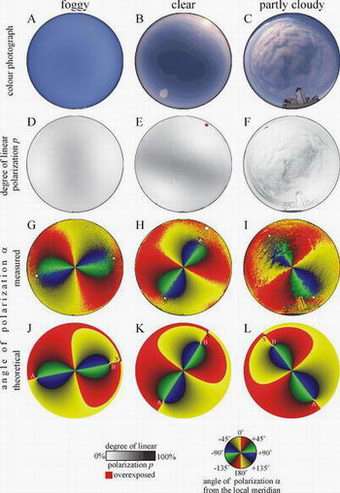
In their current paper, Horvath’s group performed a second important step, defining five prerequisites for the possibility of navigation by polarization. The group investigated two of them: how similar the pattern of the angle of polarization of a foggy or cloudy sky is compared with a clear sky, and whether or not an adequate degree of linear polarization exists on cloudy or foggy days. The other three conditions were based on the Vikings’ knowledge and technology, which require further examination.
“Using full-sky imaging polarimetry, we have shown that one of the two atmospheric optical prerequisites of the polarimetric Viking navigation is always fulfilled under both foggy and cloudy conditions,” said Horvath. “The distribution (pattern) of the direction of polarization of skylight on the foggy or cloudy celestial hemisphere is similar to that of the clear sky, which was a great surprise for us. However, we would like to emphasize that the Dutch meteorologist Guenther P. Koennen has already hypothesized this phenomenon in his famous book Polarized Light in Nature (Cambridge University Press, 1985).
“If the fog layer is illuminated by direct sunlight, the other prerequisite is usually satisfied only for cloudy skies,” he continued. “In sunlit fog, the Vikings could have navigated by polarization, only if the polarization of light from the foggy sky was sufficiently strong.”
Although by using modern linear polarization filters, the scientists could determine the sun’s approximate location on an average cloudy day, they speculate that the Vikings’ crystals likely would have required more than the available amount of polarization.
For now, physics cannot rule one way or another until further research reveals more about the Vikings’ culture and technology—anything else is speculation. But the political aspect of speculation is intriguing in itself: it’s easy to romanticize the past, to project modern knowledge onto ancient peoples, without realizing that we may be making too many assumptions. On the other hand, we have often underestimated the abilities of past peoples, and been surprised at discovering that some of our modern inventions have been invented more than once.
Citations: Hegedus, Ramon, Akesson, Susanne, Wehner, Rudiger, and Horvath, Gabor. “Could Vikings have navigated under foggy and cloudy conditions by skylight polarization? On the atmospheric optical prerequisites of polarimetric Viking navigation under foggy and cloudy skies.” Proc. R. Soc. A. 463 : 1081-1095 (2007).
Barta, Andras, Horvath, Gabor, and Meyer-Rochow, Benno. “Psychophysical study of the visual sun location in pictures of cloudy and twilight skies inspired by Viking navigation.” Journal of the Optical Society of America A 22: 1023-1034 (2005).
Copyright 2007 PhysOrg.com.
All rights reserved. This material may not be published, broadcast, rewritten or redistributed in whole or part without the express written permission of PhysOrg.com.


