Cancer cells forming blood vessels send their copper to the edge
New information about a link between the growth of blood vessels critical to the spread of cancer and the copper in our bodies has been discovered by researchers from the U.S. Department of Energy's Argonne National Laboratory and the University of Chicago, using a beamline at the Advanced Photon Source.
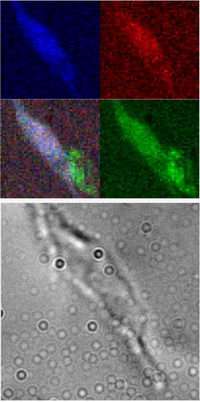
Growing new blood vessels from existing ones — a process called angiogenesis — is important in growth, development and wound healing. But it also enables the spread of tumors throughout the body, so researchers have been scrambling for ways to stop angiogenesis in the fight against cancer.
One element critical to blood vessel growth is copper, a vital nutrient that plays important roles in many life processes. Compounds that reduce copper in the body without disrupting the body's normal functions can inhibit the growth of blood vessels — and some of these compounds are even in clinical trials for use in cancer therapy. Yet, the biological basis for this sensitivity of angiogenesis to copper has been an enigma.
In search of an answer, researchers from the Biosciences and X-ray Science divisions at Argonne and the Department of Medicine, Section of Hematology/Oncology, at the University of Chicago, have used X-ray fluorescence microprobe imaging at the Advanced Photon Source at Argonne, the Western Hemisphere's most brilliant source of X-rays for research. The X-rays allowed the researchers to look at the distribution of copper in both a cell model of angiogenesis and sections of breast tumor tissue rich in blood vessels.
"We found that cells undergoing angiogenesis exhibit a distribution of their cellular copper that is distinctly different from other cells," said Argonne biologist and lead author Lydia Finney. "This discovery may help explain how copper-reducing cancer therapy works." The findings are reported in the current issue of the Proceedings of the National Academy of Sciences.
"We began our study," Finney explained, " by examining a model of angiogenesis that uses human microvascular endothelial cells to form capillary-like structures within about eight hours of being stimulated with specific growth factors. We then examined the distribution of elements in these structures by using imaging resources."
The APS played a key role in the research. The particular APS beamline Finney and her colleagues used employs specialized optics to focus coherent X-rays to sub-micrometer spot sizes, through which the sample is raster scanned (scanning from side to side, top to bottom). By collecting emitted fluorescence spectra at each point using an energy-dispersive detector, the researchers obtained images displaying the concentration and spatial distribution of many elements, including phosphorous, sulfur, iron, copper and zinc. Overlaying these elemental maps onto optical images of the cells, Finney and her colleagues then correlated elemental content with cellular structures.
"Our findings were very clear," said Finney. "We observed a dramatic relocalization of between 80 and 90 percent of cellular copper to the tips of the tendril-like projections angiogenic cells send out between one another and across the cellular membrane within the first two hours." Copper did, indeed, appear to play a special role in angiogenesis, at least on the basis of this observation.
To extend these studies to a living organism, Finney and her colleagues then examined sections of breast tumor tissue that were rich in newly formed blood vessels. "Once again," said Finney, "we found that in contrast to both non-vascularized areas and areas of mature blood vessels, in areas of tissue where blood vessels were newly invading surrounding tissue, the cells showed copper localized at the periphery of the cells and in areas immediately outside of any apparent cellular structures."
What are the implications of this discovery?
According to Finney, "These findings improve our understanding of how removing copper from the body can help stop angiogenesis. If a drug can be used to intercept vital copper being translocated outside of the cell during angiogenesis, the process stops, preventing growth of the tumor."
The implications of the research do not end with the effect on angiogenesis. The dynamics of cellular copper this study revealed also have broad implications on the regulation of the metal ion content in metal-binding proteins. If such dramatic changes in where cellular copper is stored and used can happen so rapidly during angiogenesis, then the interactions of metal ions, such as copper, with the proteins and macromolecules that bind them in the cell must have very fluid dynamics themselves.
Source: Argonne National Laboratory


