New guide to sharks and rays of Indonesia
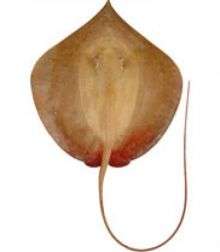
February 28, 2007 A Hortle's Whipray

A Hortle's Whipray -- only found in West Papua. Credit: CSIRO

At least 20 new species have been discovered in the first comprehensive survey of Indonesia's sharks and rays since the 1850s.

The five-year survey of catches at local fish markets provided the first detailed description of Indonesia's shark and ray fauna – information which is critical to their management in Indonesia and Australia. Based on the survey's findings, the Australian Centre for International Agricultural Research has published a 330-page, full-colour, bilingual 'field guide' entitled: Economically Important Sharks and Rays of Indonesia.

"Indonesia has the most diverse shark and ray fauna and the largest shark and ray fishery in the world, with reported landings of more than 100 000 tonnes a year," says one of the guide's co-authors, Dr William White of CSIRO Marine and Atmospheric Research. "Before this survey, however, there were vast gaps in our knowledge of sharks and rays in this region.

"Good taxonomic information is critical to managing shark and ray species, which reproduce relatively slowly and are extremely vulnerable to over-fishing. It provides the foundation for estimating population sizes, assessing the effects of fishing and developing plans for fisheries management and conservation."

The survey represents the first in-depth look at Indonesia's sharks and rays since Dutch scientist Pieter Bleeker described more than 1100 fish species in 1842–1860. Many of Bleeker's proposed new shark and ray species were rejected by his peers who were skeptical of such high levels of diversity.

After more than 250 days 'in the field', Dr White and his colleagues agreed with Bleeker's findings and uncovered further taxonomic riches.

From 2001–2006, they photographed and sampled more than 130 species on 22 survey trips to 11 ports across Indonesia. More than 800 specimens were lodged in reference collections at the Museum Zoologicum Bogoriense at Cibinong, Java, and the Australian National Fish Collection at Hobart.

Six of their discoveries have now been formally described. These include two species found only in Bali: the Bali Catshark and Jimbaran Shovelnose Ray, and one found only in West Papua: the Hortle's Whipray.

The survey was part of a broader project working towards improved management of sharks and rays in Indonesia and Australia. The project documented the value of sharks and rays to the small-scale fishing sector, helped to develop a National Plan of Action for sharks and rays and enhanced Indonesian capacity in fisheries research. Participants were: CSIRO, Murdoch University, Queensland Department of Primary Industries and Fisheries and Indonesia's Research Centre for Capture Fisheries and the Indonesian Institute of Sciences.

Source: CSIRO Australia


print this article email this article download pdf blog this article bookmark this article     Stumble it Digg this share on Facebook retweet share on Reddit add to delicious
Rate this story - 1 /5 (1 vote)


February 28, 2007 all stories

Comments: 0

1 /5 (1 vote)
  • Stumble this up

  • Digg this

  • share this

  • hide
  • Related Stories

  • Sharks under threat as environmental change bites hard
    created Nov 17, 2009 | popularity not rated yet | comments 0
  • Oldest fossil brain found in Kansas (Videos)
    created Mar 02, 2009 | popularity not rated yet | comments 0
  • Primordial fish had rudimentary fingers
    created Sep 22, 2008 | popularity not rated yet | comments 0
  • Over 100 new sharks and rays classified
    created Sep 18, 2008 | popularity not rated yet | comments 0
  • Over 50 percent of oceanic shark species threatened with extinction
    created May 22, 2008 | popularity not rated yet | comments 0


Other News

First-ever blueprint of a minimal cell is more complex than expected

First-ever blueprint of a minimal cell is more complex than expected

Biology / Cell & Microbiology

created 8 hours ago | popularity 5 / 5 (10) | comments 0

What are the bare essentials of life, the indispensable ingredients required to produce a cell that can survive on its own? Can we describe the molecular anatomy of a cell, and understand how an entire organism ...


The six elephants in Sierra Leone were shot and "crudely butchered"

S.Leone elephants 'wiped out' by poachers: official

Biology / Ecology

created 10 hours ago | popularity 5 / 5 (4) | comments 5

Poachers "wiped out" the entire elephant herd in Sierra Leone's only wildlife park, wildlife managers said Thursday after police said they had arrested a gang of 10 poachers.


Ecological speciation by sexual selection on good genes: Is speciation adaptive?

Biology / Ecology

created 8 hours ago | popularity 5 / 5 (1) | comments 0

Darwin suggested that the action of natural selection can produce new species, but 150 years after the publication of his famous book, 'On the Origin of Species', debate still continues on the mechanisms of speciation. New ...


Knockouts in human cells point to pathogenic targets

Knockouts in human cells point to pathogenic targets

Biology / Cell & Microbiology

created 11 hours ago | popularity not rated yet | comments 0

(PhysOrg.com) -- Whitehead researchers have developed a new approach for genetics in human cells and used this technique to identify specific genes and proteins required for pathogens.


Whiteflies sabotage alarm system of plant in distress

Whiteflies sabotage alarm system of plant in distress

Biology / Plants & Animals

created 12 hours ago | popularity 5 / 5 (1) | comments 0

(PhysOrg.com) -- When spider mites attack a bean plant, the plant responds by producing odours which attract predatory mites. These predatory mites then exterminate the spider mite population, thus acting ...