Slowly does it as giant magnet goes underground at CERN
February 28th, 2007 Slowly does it as giant magnet goes underground at CERN

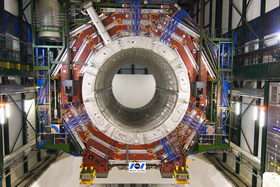
At 5:00 am GMT this morning (28th February 2007) the heaviest piece of the Compact Muon Solenoid (CMS) particle detector began a momentous journey into its experimental cavern, 100 metres underground at CERN, Geneva.

At 5:00 am GMT this morning the heaviest piece of the Compact Muon Solenoid (CMS) particle detector began a momentous journey into its experimental cavern, 100 metres underground at CERN, Geneva. You can watch it on the webcam link.

Physicists are preparing the CMS detector and its sister detector, ATLAS, to take data at CERN's Large Hadron Collider, where scientists predict that they will make fundamental discoveries about the universe, using very-high-energy proton collisions. Beyond revealing a new world of unknown particles, the LHC experiments could explain why those particles exist and behave as they do. They could discover the origins of mass, shed light on dark matter, uncover hidden symmetries of the universe, and possibly find extra dimensions of space.

Using a huge gantry crane, custom-built by VSL group, the pre-assembled central piece of the detector, weighing as much as five Jumbo jets (1920 tonnes) is being gently lowered into place. "This is a challenging feat of engineering, as there are just 20 cm of leeway between the detector and the walls of the shaft," said Austin Ball, Technical Coordinator of CMS. "The detector is supported by four massive cables, each with 55 strands and attached to a step-by-step hydraulic jacking system, with sophisticated monitoring and control to ensure the object does not sway or tilt." The entire process is expected to take about ten hours to complete.

The first seven of 15 pieces of the CMS detector have already been lowered, with the first piece arriving in the experimental cavern on 30 November 2006. The giant element being lowered today, which is 16 m tall, 17 m wide and 13 m long, marks the halfway point in the lowering process with the last piece scheduled to make its descent in summer 2007.

Professor Keith Mason, CEO of the Particle Physics and Astronomy Council (PPARC), which pays the UK subscription to CERN, said "The lowering of the largest piece of CMS today marks a major engineering milestone towards the switch on of the Large Hadron Collider (LHC) later this year. It is somewhat of a paradox that the largest, heaviest detectors ever built will be used to study the smallest scientific events."

The construction of CMS is a unique experience for the high-energy physics collaboration, as typically such experiments are built underground – without the need for moving and lowering large pieces. CMS has broken with tradition in order to start assembly before completion of the underground cavern, taking advantage of a spacious surface assembly hall to pre-assemble and pre-test the solenoid magnet and the various detectors used to measure particles resulting from collisions.

CMS is a general purpose experiment being prepared to take data at CERN's LHC which will be the world's largest and most complex scientific instrument when it switches on in November 2007.

Experiments at the LHC will allow physicists to complete a journey that started with Newton's description of gravity. Gravity acts on mass, but so far science is unable to explain why the fundamental particles have the masses they have. Experiments such as CMS may provide the answer. LHC experiments will also probe the mysterious missing mass and dark energy of the universe – visible matter seems to account for just 4% of what must exist. They will investigate the reason for nature's preference for matter over antimatter, and will probe matter as it existed at the very beginning of time.

"This is a very exciting time for physics," said CMS spokesman Jim Virdee from Imperial College London, "the LHC is poised to take us to a new level of understanding of our Universe."

Dr Helen Heath, a CMS collaboration member from the University of Bristol said, "This is a very exciting time as the experiment many of us have worked on for over 10 years begins to come together."

Source: Particle Physics & Astronomy Research Council


print this article email this article download pdf blog this article bookmark this article     Digg this Stumble it share on Facebook share on Reddit add to delicious save to Yahoo! bookmarks
4.3/5 after 35 votes


February 28th, 2007 all stories
Physics / General Physics

Comments: 0
Rank: 4.3/5 after 35 votes

  • Stumble this up

  • Digg this

  • Share it:
  • share on Facebook
  • share on MySpace
  • share on Slashdot
  • rss-newsfeed
  • share on Google
  • share on Reddit
  • add to delicious
  • save to Yahoo! bookmarks
  • share on Windows Live
  • Add to Mixx!
Rating: 4.3/5 after 35 votes

  • Related Stories

  • Michigan integral to world's largest physics experiment
    created Sep 05, 2008 | popularity not rated yet | comments 0
  • The hunt for the Higgs steps up a gear
    created Aug 28, 2008 | popularity not rated yet | comments 0
  • Large Hadron Collider set to unveil a new world of particle physics
    created Aug 19, 2008 | popularity not rated yet | comments 0
  • A front-row seat at this summer's physics extravaganza
    created Jul 02, 2008 | popularity not rated yet | comments 0
  • CMS celebrates the lowering of its final detector element
    created Jan 22, 2008 | popularity not rated yet | comments 0

Tags


  • Physicists Demonstrate Quantum Memory with Matter Qubits
    Physicists Demonstrate Quantum Memory with Matter Qubits
    Physics / General Physics
    created Jul 03, 2009 | popularity 4.4 / 5 (16) | comments 1
  • 'Holey' Nanosheets for Wastewater Dye Removal
    Nanotechnology / Nanomaterials
    created Jul 01, 2009 | popularity 5 / 5 (5) | comments 1
  • Jellyfish Robot Swims Like its Biological Counterpart
    Jellyfish Robot Swims Like its Biological Counterpart
    Electronics / Robotics
    created Jun 26, 2009 | popularity 4.4 / 5 (8) | comments 1
  • Could Maxwell's Demon Exist in Nanoscale Systems?
    Could Maxwell's Demon Exist in Nanoscale Systems?
    Physics / General Physics
    created Jun 24, 2009 | popularity 4.4 / 5 (18) | comments 29
  • Living Safely with Robots, Beyond Asimov's Laws
    Living Safely with Robots, Beyond Asimov's Laws
    Electronics / Robotics
    created Jun 22, 2009 | popularity 4.6 / 5 (52) | comments 40
  • Other News

    Science journals

    How to Spot an Influential Paper Based on its Citations

    Physics / General Physics

    created 18 hours ago | popularity 4.1 / 5 (8) | comments 5

    (PhysOrg.com) -- At first it may seem that the number of citations received by a published scientific paper is directly related to that paper's quality of content. The higher the quality, the more people read ...


    Scientists create first electronic quantum processor

    Scientists create first electronic quantum processor

    Physics / General Physics

    created Jun 28, 2009 | popularity 4.8 / 5 (51) | comments 39

    A team led by Yale University researchers has created the first rudimentary solid-state quantum processor, taking another step toward the ultimate dream of building a quantum computer.


    Fermilab's CDF observes Omega-sub-b baryon

    Fermilab's CDF observes Omega-sub-b baryon

    Physics / General Physics

    created Jun 29, 2009 | popularity 4.7 / 5 (16) | comments 7

    (PhysOrg.com) -- At a recent physics seminar at the Department of Energy’s Fermi National Accelerator Laboratory, Fermilab physicist Pat Lukens of the CDF experiment announced the observation of a new particle, ...


    New insights, and a new angle, on high-temperature superconductivity

    New insights, and a new angle, on high-temperature superconductivity

    Physics / Superconductivity

    created Jun 29, 2009 | popularity 4.8 / 5 (13) | comments 6

    (PhysOrg.com) -- A Princeton-led research team has revealed surprising information about how electron behavior influences the conduction of electricity in a class of high-temperature superconductors. An increased ...


    The art of invisibility and the perfect cat's eye

    The art of invisibility and the perfect cat's eye

    Physics / Optics & Photonics

    created Jun 30, 2009 | popularity 4 / 5 (8) | comments 6

    (PhysOrg.com) -- In recent years scientists have explored the impossible by developing invisibility or 'cloaking' devices, but can the same technology also help make things more visible?