Physicists pioneer new super-thin technology (Update)
February 28, 2007 Physicists pioneer new super-thin technology (Update)

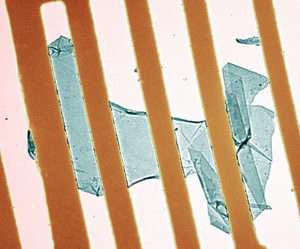
Atomic gauze hanging on a scaffold of golden wires: It is the thinnest material you will ever see. Credit: University of Manchester

Researchers have used the world's thinnest material to create a new type of technology, which could be used to make super-fast electronic components and speed up the development of drugs.

Physicists at The University of Manchester and The Max-Planck Institute in Germany have created a new kind of a membrane that is only one atom thick.
Physicists pioneer new super-thin technology

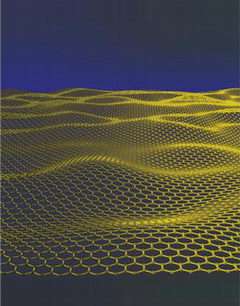
An artist´s impression of the chicken wire of carbon atoms. Credit: University of Manchester

It's believed this super-small structure can be used to sieve gases, make ultra-fast electronic switches and image individual molecules with unprecedented accuracy.

The findings of the research team is published today in the journal Nature.

Two years ago, scientists discovered a new class of materials that can be viewed as individual atomic planes pulled out of bulk crystals.

These one-atom-thick materials and in particular graphene – a gauze of carbon atoms resembling chicken wire – have rapidly become one of the hottest topics in physics.

However, it has remained doubtful whether such materials can exist in the free state, without being placed on top of other materials.

Now an international research team, led by Dr Jannik Meyer of The Max-Planck Institute in Germany and Professor Andre Geim of The University of Manchester has managed to make free-hanging graphene.

The team used a combination of microfabrication techniques used, for example, in the manufacturing of microprocessors.

A metallic scaffold was placed on top of a sheet of graphene, which was placed on a silicon chip. The chip was then dissolved in acids, leaving the graphene hanging freely in air or a vacuum from the scaffold.

The resulting membranes are the thinnest material possible and maintain a remarkably high quality.

Professor Geim – who works in the School of Physics and Astronomy at The University of Manchester – and his fellow researchers have also found the reason for the stability of such atomically-thin materials, which were previously presumed to be impossible.

They report that graphene is not perfectly flat but instead gently crumpled out of plane, which helps stabilise otherwise intrinsically unstable ultra-thin matter.

Professor Geim and his colleagues believe that the membranes they have created can be used like sieves, to filter light gases through the atomic mesh of the chicken wire structure, or to make miniature electro-mechanical switches.

It's also thought it may be possible to use them as a non-obscuring support for electron microscopy to study individual molecules.

This has significant implications for the development of medical drugs, as it will potentially allow the rapid analysis of the atomic structures of bio-active complex molecules.

"This is a completely new type of technology – even nanotechnology is not the right word to describe these new membranes," said Professor Geim.

"We have made proof-of-concept devices and believe the technology transfer to other areas should be straightforward. However, the real challenge is to make such membranes cheap and readily available for large-scale applications."

Source: University of Manchester


print this article email this article download pdf blog this article bookmark this article     Stumble it Digg this share on Facebook retweet share on Reddit add to delicious
Rate this story - 4.5 /5 (42 votes)


February 28, 2007 all stories

Comments: 0

4.5 /5 (42 votes)
  • Stumble this up

  • Digg this

  • share this

  • hide
  • Related Stories

  • 'Ultra-primitive' particles found in comet dust
    created Nov 02, 2009 | popularity not rated yet | comments 0
  • UM Professor: Consumers 'key part of solution' to global warming
    created Oct 16, 2009 | popularity not rated yet | comments 0
  • Study identifies significant savings on venous leg ulcer dressings
    created Oct 13, 2009 | popularity not rated yet | comments 0
  • Stretching opens up possibilities for graphene
    created Sep 28, 2009 | popularity not rated yet | comments 0
  • The Long and the Short of Acrylate Polymerization
    created Sep 22, 2009 | popularity not rated yet | comments 0


  • hide
  • Relevant PhysicsForums posts

  • Hi ,new here and have a question! :)
    created 59 minutes ago
  • Hydrostatic pressure in a submerged pipe
    created 2 hours ago
  • Preservation of information?
    created 3 hours ago
  • Goddard
    created 4 hours ago
  • More from Physics Forums - General Physics

Other News

Fast, easy, and highly sensitive arsenic detection with gold nanoparticles

Nanotechnology / Nanomaterials

created 38 minutes ago | popularity not rated yet | comments 0

(PhysOrg.com) -- Mention of arsenic poisoning usually brings to mind underhanded murder. However, the danger of arsenic poisoning from contaminated drinking water is far greater. Low concentrations of arsenic are found in ...


Nanotech in Space: Experiment To Weather the Trials of Orbit

Nanotech in Space: Experiment To Weather the Trials of Orbit

Nanotechnology / Nanomaterials

created 12 hours ago | popularity 4 / 5 (2) | comments 0

Novel nanomaterials developed at Rensselaer were sent into orbit on Nov. 16 aboard Space Shuttle Atlantis.


Nanoparticles used in common household items caused genetic damage in mice

Nanotechnology / Bio & Medicine

created Nov 16, 2009 | popularity 4.8 / 5 (24) | comments 11

Titanium dioxide (TiO2) nanoparticles, found in everything from cosmetics to sunscreen to paint to vitamins, caused systemic genetic damage in mice, according to a comprehensive study conducted by researchers at UCLA's Jonsson ...


Water droplets direct self-assembly process in thin-film materials

Nanotechnology / Nanomaterials

created Nov 23, 2009 | popularity 5 / 5 (4) | comments 2

You can think of it as origami - very high-tech origami. Researchers at the University of Illinois have developed a technique for fabricating three-dimensional, single-crystalline silicon structures from thin films by coupling ...


Nanotube defects equal better energy and storage systems

Nanotube defects equal better energy and storage systems

Nanotechnology / Nanomaterials

created Nov 19, 2009 | popularity 4.4 / 5 (10) | comments 2

(PhysOrg.com) -- Most people would like to be able to charge their cell phones and other personal electronics quickly and not too often. A recent discovery made by UC San Diego engineers could lead to carbon ...