Envisat still going strong after five successful years
February 28, 2007 Envisat still going strong after five successful years

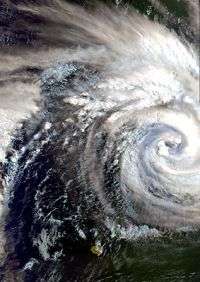
Tropical Cyclone Gamede is visible making its way across the Indian Ocean just above the islands of Mauritius and Réunion (pictured) in this image acquired on 23 February 2007 by Envisat’s Medium Resolution Imaging Spectrometer (MERIS) instrument working in Reduced Resolution mode to deliver a spatial resolution of 1200 metres. Credits: ESA

Launched from Kourou in French Guiana on the night of 28 February 2002, ESA’s Envisat spacecraft marks its fifth year in space. Having orbited Earth more than 26 000 times, the world’s largest and most complex environmental satellite ever launched has travelled a distance of more than 1 000 000 000 kilometres, nearly the equivalent of travelling to Jupiter and back.

Generating some 280 Gigabytes of data products daily, Envisat has gathered 500 Terabytes to date. The amount of data returned by Envisat’s suite of 10 instruments is providing scientists with a global picture of our environment and is helping to fulfil the initial needs of the Global Monitoring for Environment and Security (GMES) initiative until the launch of the Sentinel satellites.

Results of ongoing research projects using data from Envisat, as well as other ESA satellites, will be presented at the 2007 Envisat Symposium in Montreux, Switzerland, from 23 to 27 April. This anniversary is particularly important because it marks the end of Envisat’s nominal lifetime, as the satellite was initially only intended to stay in orbit for five years. However, given the overall excellent standing of the satellite, the ESA Member States have agreed to fund the mission operations until 2010.

Source: ESA


print this article email this article download pdf blog this article bookmark this article     Stumble it Digg this share on Facebook retweet share on Reddit add to delicious
Rate this story - 5 /5 (1 vote)


February 28, 2007 all stories

Comments: 0

5 /5 (1 vote)
  • Stumble this up

  • Digg this

  • share this

  • hide
  • Related Stories

  • Satellite data look behind the scenes of deadly earthquake
    created Oct 15, 2009 | popularity not rated yet | comments 0
  • Earth from Space: Typhoon Melor
    created Oct 09, 2009 | popularity not rated yet | comments 0
  • Satellites help locate water in Niger
    created Jan 19, 2009 | popularity not rated yet | comments 0
  • Satellites take sustainability to new heights
    created Mar 25, 2008 | popularity not rated yet | comments 0
  • Envisat captures South Korea's crude oil leak
    created Dec 11, 2007 | popularity not rated yet | comments 0


  • hide
  • Relevant PhysicsForums posts

  • Tabulation of the Standard Astronomical Filters
    created 4 hours ago
  • Sun coordinates
    created 5 hours ago
  • Huge comet seen on soho web page.
    created 6 hours ago
  • Free, downloadable solar system simluation.
    created Dec 13, 2009
  • More from Physics Forums - General Astronomy

Other News

Going vertical: Fleeing tsunamis by moving up, not out

Space & Earth / Earth Sciences

created 1hour ago | popularity not rated yet | comments 0

In the minutes after a strong earthquake struck offshore of the Indonesian city of Padang on Sept. 30, fears of a tsunami prompted hundreds of thousands of residents to evacuate the coastal city. Or try to.


Yellowstone's plumbing exposed

Yellowstone's plumbing exposed

Space & Earth / Earth Sciences

created 9 hours ago | popularity 5 / 5 (20) | comments 10

(PhysOrg.com) -- The most detailed seismic images yet published of the plumbing that feeds the Yellowstone supervolcano shows a plume of hot and molten rock rising at an angle from the northwest at a depth ...


Ethanol-powered vehicles generate more ozone than gas-powered ones

Space & Earth / Environment

created 5 hours ago | popularity 5 / 5 (3) | comments 4

Ethanol, often promoted as a clean-burning, renewable fuel that could help wean the nation from oil, would likely worsen health problems caused by ozone, compared with gasoline, especially in winter, according to a new study ...


New planet discoveries suggest low-mass planets are common around nearby stars

New planet discoveries suggest low-mass planets are common around nearby stars

Space & Earth / Astronomy

created 4 hours ago | popularity 4.7 / 5 (6) | comments 3

(PhysOrg.com) -- An international team of planet hunters has discovered as many as six low-mass planets around two nearby Sun-like stars, including two "super-Earths" with masses 5 and 7.5 times the mass of ...


California's troubled waters: Satellite-based findings reveal major groundwater loss in Central Valley

Space & Earth / Earth Sciences

created 1hour ago | popularity not rated yet | comments 0

New space observations reveal that since October 2003, the aquifers for California's primary agricultural region - the Central Valley - and its major mountain water source - the Sierra Nevada - have lost nearly enough water ...