New evidence that global warming fuels stronger Atlantic hurricanes
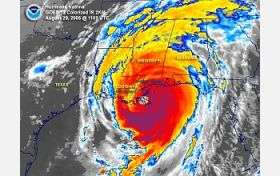
Atmospheric scientists have uncovered fresh evidence to support the hotly debated theory that global warming has contributed to the emergence of stronger hurricanes in the Atlantic Ocean.
The unsettling trend is confined to the Atlantic, however, and does not hold up in any of the world's other oceans, researchers have also found.
Scientists at the University of Wisconsin-Madison and the National Climatic Data Center (NCDC) of the National Oceanic and Atmospheric Administration reported the finding in the journal Geophysical Research Letters. The work should help resolve some of the controversy that has swirled around two prominent studies that drew connections last year between global warming and the onset of increasingly intense hurricanes.
"The debate is not about scientific methods, but instead centers around the quality of hurricane data," says lead author James Kossin, a research scientist at UW-Madison's Cooperative Institute for Meteorological Satellite Studies. "So we thought, 'Lets take the first step toward resolving this debate.'"
The inconsistent nature of hurricane data has been a sore spot within the hurricane research community for decades. Before the advent of weather satellites, scientists were forced to rely on scattered ship reports and sailor logs to stay abreast of storm conditions. The advent of weather satellites during the 1960s dramatically improved the situation, but the technology has changed so rapidly that newer satellite records are barely consistent with older ones.
Kossin and his colleagues realized they needed to smooth out the data before exploring any interplay between warmer temperatures and hurricane activity. Working with an existing NCDC archive that holds global satellite information for the years 1983 through 2005, the researchers evened out the numbers by essentially simplifying newer satellite information to align it with older records.
"This new dataset is unlike anything that's been done before," says Kossin. "It's going to serve a purpose as being the only globally consistent dataset around. The caveat of course, is that it only goes back to 1983."
Even so, it's a good start. Once the NCDC researchers recalibrated the hurricane figures, Kossin took a fresh look at how the new numbers on hurricane strength correlate with records on warming ocean temperatures, a side effect of global warming.
What he found both supported and contradicted previous findings. "The data says that the Atlantic has been trending upwards in hurricane intensity quite a bit," says Kossin. "But the trends appear to be inflated or spurious everywhere else, meaning that we still can't make any global statements."
Sea-surface temperatures may be one reason why greenhouse gases are exacting a unique toll on the Atlantic Ocean, says Kossin. Hurricanes need temperatures of around 27 degrees Celsius (81 degrees Fahrenheit) to gather steam. On average, the Atlantic's surface is slightly colder than that but other oceans, such as the Western Pacific, are naturally much warmer.
"The average conditions in the Atlantic at any given time are just on the cusp of what it takes for a hurricane to form," says Kossin. " So it might be that imposing only a small (man-made) change in conditions, creates a much better chance of having a hurricane."
The Atlantic is also unique in that all the physical variables that converge to form hurricanes - including wind speeds, wind directions and temperatures - mysteriously feed off each other in ways that only make conditions more ripe for a storm. But scientists don't really understand why, Kossin adds.
"While we can see a correlation between global warming and hurricane strength, we still need to understand exactly why the Atlantic is reacting to warmer temperatures in this way, and that is much more difficult to do," says Kossin. "We need to be creating models and simulations to understand what is really happening here. From here on, that is what we should be thinking about."
Source: University of Wisconsin-Madison


