Enter 'Junior': Stanford team's next-generation robot joins DARPA Challenge
When five autonomous vehicles, including the Stanford Racing Team's winning entry "Stanley," finished the 2005 Grand Challenge in the still Nevada desert, they passed a milestone of artificial intelligence. The robots in the 2007 Urban Challenge, however, will have to handle traffic. It is a tougher test that calls for a new generation of technology. Enter "Junior," the Stanford Racing Team's new brainchild.
"In the last Grand Challenge, it didn't really matter whether an obstacle was a rock or a bush because either way you'd just drive around it," says Sebastian Thrun, an associate professor of computer science and electrical engineering. "The current challenge is to move from just sensing the environment to understanding the environment."
That's because in the Urban Challenge, sponsored by the Defense Advanced Research Projects Agency (DARPA), the competing robots will have to accomplish missions in a simulated city environment, which includes the traffic of the other robots and traffic laws. This means that on race day, Nov. 3, the robots not only will have to avoid collisions, but also they will have to master concepts that befuddle many humans, such as right of way.
"This has a component of prediction," says Mike Montemerlo, a senior research engineer in the Stanford Artificial Intelligence Lab (SAIL). "There are other intelligent robot drivers out in the world. They are all making decisions. Predicting what they are going to do in the future is a hard problem that is important to driving. Is it my turn at the intersection? Do I have time to get across the intersection before somebody hits me?"
Racing team leaders Thrun and Montemerlo discussed Junior for the first time Feb. 17 at the annual conference of the American Association for the Advancement of Science in San Francisco. Thrun joined fellow roboticists in a panel discussion, "Robots—Our Future's Sustainable Partner." He spoke about autonomous guidance systems and machine vision. Afterward, he and Montemerlo participated in a press conference.
The racing team, based in the School of Engineering, is supported by returning industry team members Intel, MDV-Mohr Davidow Ventures, Red Bull and Volkswagen of America and joined this year by new supporters Applanix, Google and NXP Semiconductors. DARPA also has provided $1 million of funding.
Introducing Junior
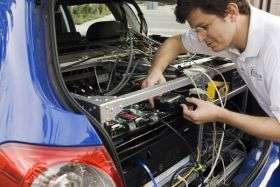
Junior is a 2006 Passat wagon whose steering, throttle and brakes all have been modified by engineers at the Volkswagen of America Electronics Research Lab in Palo Alto to be completely computer-controllable. The engineers also have created custom mountings for a bevy of sophisticated sensors.
An important difference between Junior and Stanley is that Junior must be aware of fast- moving objects all around it, while Stanley only had to grapple with still objects in front of it. Junior's sensors are therefore much more sophisticated, Thrun says. They include a range-finding laser array that spins to provide a 360-degree, three-dimensional view of the surrounding environment in near real-time. The laser array is accompanied by a device with six video cameras that "see" all around the car. Junior also uses bumper-mounted lasers, radar, Global Positioning System receivers and inertial navigation hardware to collect data about where it is and what is around.
Because Junior collects much more data than Stanley did, its computational hardware must be commensurately more powerful, says Montemerlo. Using Core 2 Duo processors—each chip includes multiple processing units—Junior's "brain" is about four times more powerful than Stanley's.
But what makes Junior truly autonomous will be its software, which is the focus of about a dozen students, faculty and researchers at SAIL. Modules for tasks such as perception, mapping and planning give Junior the machine-learning ability to improve its driving and to convert raw sensor data into a cohesive understanding of its situation.
New software development began last fall. Montemerlo has been testing some of the team's software modules in simulated traffic situations since the beginning of the year. The team expects to move into full-time testing and iterative improvement by the end of March.
Junior's name is not only an implicit homage to its predecessor, but also to Stanford University's namesake, Leland Stanford Jr. Carrying this sense of history, Junior will set out to make technology history of its own and pave the way to a future where autonomous cars can make driving safer, more accessible and more efficient. Self-driving cars could give drivers newfound free time.
"You could claim that moving from pixelated perception, where the robot looks at sensor data, to understanding and predicting the environment is a Holy Grail of artificial intelligence," says Thrun.
Source: Stanford University


