DNA nanoparticles hold promise in gene therapy for Parkinson's disease
March 1, 2007
DNA Nanoparticles

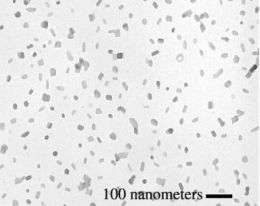
Nanoparticle Gene Therapy for Parkinson's Disease -- This electron micrograph shows the minute scale of DNA compacted into nanoparticles. After it is condensed, the DNA is delivered to the brain in an attempt to repair faulty genes in hopes of halting or preventing the neurodegenerative process. Credit: David Yurek, University of Kentucky

University of Kentucky researcher David Yurek was recently awarded $66,000 by The Michael J. Fox Foundation for Parkinson's Research under the foundation's Rapid Response Innovation Awards program. The goal of this newly launched initiative is to move quickly to support innovative research focused on the cause of and cure for Parkinson's disease (PD). In particular, MJFF seeks to fund high-risk, high-reward projects tackling critical scientific roadblocks that if successful, can open new avenues for PD therapy development.

Yurek's project, titled "Nanoparticle Gene Therapy for Parkinson's Disease," examines a relatively new gene therapy approach for treating neurodegenerative disorders. He is testing the feasibility of using a novel technology to condense DNA plasmids into nanoparticles and deliver them to the brain as a means to halt or prevent the neurodegenerative process.

The technology comes from Copernicus Therapeutics, Inc., a biotechnology company in Cleveland, Ohio. Yurek, whose laboratory is one of the first to apply this technology to central nervous system disorders, said this relatively new gene therapy strategy holds potential to help repair faulty genes. It entails transduction, a technique for expressing a particular gene in a cell by delivering DNA into the cell and making the cell synthesize the protein that corresponds to that DNA.

"We plan to use this technology to transduce brain cells so that they express proteins beneficial to the cell's survival," Yurek said.

The MJFF award will allow Yurek to test the feasibility of delivering condensed DNA nanoparticles that encode for a neurotrophic factor to the brain as a means to halt or prevent the neurodegenerative process in an animal model of PD. Neurotrophic factors are capable of protecting neurons from dying, thereby rescuing essential neurons in the brain. In animal studies, neurotrophic factors have revived dormant brain cells, caused them to produce dopamine, and prompted dramatic improvement of symptoms.

PD is a chronic, progressive disorder of the central nervous system, and is the direct result of the loss of cells in a section of the brain called the substantia nigra. Those cells produce dopamine, a chemical messenger responsible for transmitting signals within the brain. Loss of dopamine causes critical nerve cells in the brain, or neurons, to fire out of control, leaving patients unable to direct or control their movement in a normal manner.

The Michael J. Fox Foundation for Parkinson's Research is dedicated to ensuring the development of a cure for PD within this decade through an aggressively funded research agenda. Enormous progress toward finding a cure has been made on many neurological fronts, and scientists' understanding of the brain and how disease affects it has increased dramatically. The foundation seeks to hasten progress further by awarding grants that help guarantee that new and innovative research avenues are thoroughly funded and explored.

The MJFF Rapid Response Innovation Awards support projects that may have little to no existing preliminary data, but that hold potential to significantly impact understanding or treatment of PD.

"Given the extremely tight budget of federal government research funding, MJFF's work in prioritizing and funding new and innovative projects is extremely valuable," Yurek said.

Source: University of Kentucky

3.9 /5 (13 votes)  

Rank 3.9 /5 (13 votes)
Tags

Relevant PhysicsForums posts

More news stories

'Dark plasmons' transmit energy

Microscopic channels of gold nanoparticles have the ability to transmit electromagnetic energy that starts as light and propagates via "dark plasmons," according to researchers at Rice University.

Nanotechnology / Nanophysics

created 4 hours ago | popularity 5 / 5 (3) | comments 0 | with audio podcast

Nanotube therapy takes aim at breast cancer stem cells

Wake Forest Baptist Medical Center researchers have again proven that injecting multiwalled carbon nanotubes (MWCNTs) into tumors and heating them with a quick, 30-second laser treatment can kill them.

Nanotechnology / Bio & Medicine

created 9 hours ago | popularity 5 / 5 (1) | comments 0 | with audio podcast

Inspired by steel, nanomanufacturing gets wear-resistant carbide tip

(PhysOrg.com) -- Scientists at the University of Pennsylvania, the University of Wisconsin-Madison and IBM Research - Zurich have fabricated an ultrasharp silicon carbide tip possessing such high strength ...

Nanotechnology / Nanophysics

created 14 hours ago | popularity 5 / 5 (2) | comments 1 | with audio podcast

New technology platform for molecule-based electronics

Researchers at the Nano-Science Center at the University of Copenhagen have developed a new nano-technology platform for the development of molecule-based electronic components using the wonder material graphene. At the same ...

Nanotechnology / Nanomaterials

created 11 hours ago | popularity 5 / 5 (2) | comments 0

Australians risking skin cancer to avoid nanoparticles

More than three in five Australians are concerned enough about the health implications of nanoparticles in sunscreens to want to know more about their impact. And while the initial scientific information released suggests ...

Nanotechnology / Bio & Medicine

created 12 hours ago | popularity 5 / 5 (1) | comments 0


Ultraviolet protection molecule in plants yields its secrets

Lying around in the sun all day is hazardous not just for humans but also for plants, which have no means of escape. Ultraviolet (UV) radiation from the sun can damage proteins and DNA inside cells, leading ...

Hydrogen from acidic water: Researchers develop potential low cost alternative to platinum for splitting water

A technique for creating a new molecule that structurally and chemically replicates the active part of the widely used industrial catalyst molybdenite has been developed by researchers with the Lawrence Berkeley ...

FDA-approved drug rapidly clears amyloid from the brain, reverses Alzheimer's symptoms in mice

Neuroscientists at Case Western Reserve University School of Medicine have made a dramatic breakthrough in their efforts to find a cure for Alzheimer's disease. The researchers' findings, published in the journal Science, show t ...

Anyone can learn to be more inventive, cognitive researcher says

There will always be a wild and unpredictable quality to creativity and invention, says Anthony McCaffrey, a cognitive psychology researcher at the University of Massachusetts Amherst, because an "Aha moment" is rare and ...

New method makes culture of complex tissue possible in any lab

Scientists at the University of California, San Diego have developed a new method for making scaffolds for culturing tissue in three-dimensional arrangements that mimic those in the body. This advance, published online in ...

Cell biologists describes mechanism by which some people may be more susceptible to colon cancer

An international research team led by cell biologists at the University of California, Riverside has uncovered a new insight into colon cancer, the third leading cause of cancer-related deaths in the United ...