Delicate Relation between Single Spins
March 1st, 2007 Delicate Relation between Single Spins

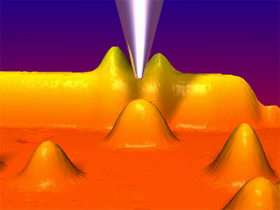
Artists view of the measurement set up with the metallic tip of the scanning tunnelling microscope on top of a chain made out of three cobalt adatoms on a copper surface. The bump to the left is a single cobalt atom. Credit: Max Planck Institute for Solid State Research

Probing the magnetic interaction between single atoms is no longer a dream. Using a scanning tunnelling microscope, the interaction of the spins of two neighbouring cobalt atoms adsorbed at a copper surface has been measured as a function of their distance with atomic precision. This development opens up new possibilities to probe the quantum nature of magnetic phenomena and to explore the physical limits of magnetic data storage.

It is a vision of information technology to store data in the smallest available units - single atoms - thus enabling the development of novel mass storage devices with huge capacities but compact dimensions. It is crucial to understand the mutual interaction and dynamics of individual spins, both for realising such a visionary device as well as to explore the limits of conventional mass storage media. New insights into these interactions can find direct application in the advancement of magnetic recording techniques as well as in the development of novel spin-based information technologies such as quantum computers.

Max-Planck researchers from Stuttgart and Halle in collaboration with colleagues from the CNRS in Grenoble have succeeded in accessing the interaction between single magnetic adatoms on a metal surface by comparing experimental results obtained with a scanning tunnelling microscope with a detailed theoretical analysis. The interaction between single magnetic adatoms has been theoretically analyzed already in the middle of last century and the predictions could now for the first time be compared with experiments on single atoms.

The metallic tip of a scanning tunnelling microscope passes over a conducting surface thereby giving access to an atomic scale height map. In order to measure the tiny magnetic effects, the researchers had to cool their microscope to low temperatures (-267°C or -448.6°F) and conduct the experiments in a vibration-isolated and sound-proof environment. The low temperature on the one hand freeze the motion of the atoms which enables the investigation of single atoms in the first place, on the other hand the spectroscopic resolution of the experiment is increased. The atomic arrangements in which the interactions have been studied were prepared by selectively dissociating single molecules containing cobalt atoms with the tip of the scanning tunnelling microscope.

As a probe for the magnetic interactions the researchers have exploited an electronic many body effect, the Kondo effect. This effect is due to the interaction of the spin of a magnetic adatom with the electrons of the metallic substrate. The effect can (at low temperatures) be detected by the scanning tunnelling microscope as resonance in the local electronic density of states. By a detailed analysis of the dependence of the Kondo resonance on the distance between two adjacent cobalt adatoms on a copper surface, the researchers were able to probe their magnetic interactions. This enabled for the first time a direct comparison of theoretical calculations for the magnetic interaction between single atoms on a metal surface with experimental data.
The researchers also observed a novel magnetic state for a chain of three cobalt adatoms, which is a correlated state of the spins of the three constituting atoms.

The results of the Max-Planck researchers are promising first steps toward developing new pathways for manipulating and engineering materials and nanostructures on the atomic scale by exploiting the quantum nature of magnetism. At the same time the results improve our understanding of the fundamental interactions between single spins.

Citation: P. Wahl, P. Simon, L. Diekhöner, V.S. Stepanyuk, P. Bruno, M.A. Schneider, and K. Kern, Exchange Interaction between Single Magnetic Adatoms, Phys. Rev. Lett. 98, 056601 (2007)

Source: Max Planck Institute for Solid State Research


print this article email this article download pdf blog this article bookmark this article     Digg this Stumble it share on Facebook share on Reddit add to delicious save to Yahoo! bookmarks
4.5/5 after 21 votes


March 1st, 2007 all stories
Physics / General Physics

Comments: 0
Rank: 4.5/5 after 21 votes

  • Stumble this up

  • Digg this

  • Share it:
  • share on Facebook
  • share on MySpace
  • share on Slashdot
  • rss-newsfeed
  • share on Google
  • share on Reddit
  • add to delicious
  • save to Yahoo! bookmarks
  • share on Windows Live
  • Add to Mixx!
Rating: 4.5/5 after 21 votes

  • Related Stories

  • Lasers can lengthen quantum bit memory by 1,000 times
    created Jun 24, 2009 | popularity not rated yet | comments 0
  • Nanoscale zipper cavity responds to single photons of light
    created Jun 04, 2009 | popularity not rated yet | comments 0
  • Going for broke
    created May 20, 2009 | popularity not rated yet | comments 0
  • New system for detection of single atoms: Records photon bursts from optical cavity
    created May 17, 2009 | popularity not rated yet | comments 0
  • Did 'Dark Gulping' Generate Black Holes in Early Universe?
    created Apr 23, 2009 | popularity not rated yet | comments 0

Tags


  • Physicists Demonstrate Quantum Memory with Matter Qubits
    Physicists Demonstrate Quantum Memory with Matter Qubits
    Physics / General Physics
    created Jul 03, 2009 | popularity 4.4 / 5 (17) | comments 1
  • 'Holey' Nanosheets for Wastewater Dye Removal
    Nanotechnology / Nanomaterials
    created Jul 01, 2009 | popularity 5 / 5 (5) | comments 1
  • Jellyfish Robot Swims Like its Biological Counterpart
    Jellyfish Robot Swims Like its Biological Counterpart
    Electronics / Robotics
    created Jun 26, 2009 | popularity 4.4 / 5 (8) | comments 1
  • Could Maxwell's Demon Exist in Nanoscale Systems?
    Could Maxwell's Demon Exist in Nanoscale Systems?
    Physics / General Physics
    created Jun 24, 2009 | popularity 4.4 / 5 (18) | comments 29
  • Living Safely with Robots, Beyond Asimov's Laws
    Living Safely with Robots, Beyond Asimov's Laws
    Electronics / Robotics
    created Jun 22, 2009 | popularity 4.6 / 5 (52) | comments 40
  • Other News

    Science journals

    How to Spot an Influential Paper Based on its Citations

    Physics / General Physics

    created 21 hours ago | popularity 4 / 5 (9) | comments 5

    (PhysOrg.com) -- At first it may seem that the number of citations received by a published scientific paper is directly related to that paper's quality of content. The higher the quality, the more people read ...


    Scientists create first electronic quantum processor

    Scientists create first electronic quantum processor

    Physics / General Physics

    created Jun 28, 2009 | popularity 4.8 / 5 (52) | comments 39

    A team led by Yale University researchers has created the first rudimentary solid-state quantum processor, taking another step toward the ultimate dream of building a quantum computer.


    Fermilab's CDF observes Omega-sub-b baryon

    Fermilab's CDF observes Omega-sub-b baryon

    Physics / General Physics

    created Jun 29, 2009 | popularity 4.7 / 5 (16) | comments 7

    (PhysOrg.com) -- At a recent physics seminar at the Department of Energy’s Fermi National Accelerator Laboratory, Fermilab physicist Pat Lukens of the CDF experiment announced the observation of a new particle, ...


    New insights, and a new angle, on high-temperature superconductivity

    New insights, and a new angle, on high-temperature superconductivity

    Physics / Superconductivity

    created Jun 29, 2009 | popularity 4.8 / 5 (13) | comments 6

    (PhysOrg.com) -- A Princeton-led research team has revealed surprising information about how electron behavior influences the conduction of electricity in a class of high-temperature superconductors. An increased ...


    The art of invisibility and the perfect cat's eye

    The art of invisibility and the perfect cat's eye

    Physics / Optics & Photonics

    created Jun 30, 2009 | popularity 4 / 5 (8) | comments 6

    (PhysOrg.com) -- In recent years scientists have explored the impossible by developing invisibility or 'cloaking' devices, but can the same technology also help make things more visible?