Digger reveals Tiga's aqua secrets
March 1, 2007 Digger reveals Tiga's aqua secrets

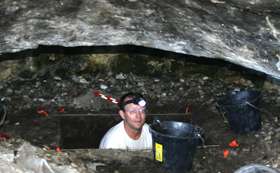
Digging deep...Associate Professor Lilley at work in one of the island`s many caves where he believes repeated cyclones and storms pushed in large amounts of sand. Photo: Ian Lilley

Being claustrophobic and allergic to wasps on an island potholed with caves and swarming with giant wasps hasn't deterred UQ archaeologist Ian Lilley from his latest dig. Associate Professor Lilley has been surveying Tiga Island, the smallest of New Caledonia's Loyalty Islands about 1500 kilometres northeast of Brisbane.

Little is known about the culture and history of the coral island, which is ten square kilometres — too small to show on most maps.

The island lacks fresh surface water but has dozens of caves and is home to giant wasps, one of the world's deadliest sea snakes and about 200 people.

Associate Professor Lilley and his French and New Caledonian colleagues have been busy trudging over the island's razor-sharp coral identifying and digging at significant sites, abseiling down cliffs and exploring the island's many caves.

So far they've uncovered burial caves, household remains including ancient pottery called Lapita, skeletons and chiefly compounds.

They have also found one mysterious clump of massive boulders that had been moved from the seashore a kilometre inland and 80 metres up a series of cliffs to the island's highest plateau.

“We've been working carefully to gain permission to work on the very abundant skeletons that are in these little caves all over the island,” Associate Professor Lilley said.

“Some of them have upwards of 40 or 50 bodies in them. They should really help us understand the region's human biological history.”

He said they also found handmade water basins to collect water drips 50 metres down in caves, as well as a hidden underground lake that early residents used as their main water supply.

“For 3000 years, people have been living perfectly successfully on this little speck of coral with no water.

“In the absence of accessible water, how did they survive there for that long, let alone build lots of large structures?”

He said he believed Tiga Island was vital to explain Pacific rim history because the island had been a regional trading hub.

“Before May last year we didn't know whether there was anything at all to look at on the island and now we've got sites coming out of our ears, revealing all kinds of things.”

Associate Professor Lilley will return to Tiga in November for a month to explore the burial caves and other sites on the rugged eastern side of the island.

His latest work is funded by a $150,000 Australian Research Council Discovery grant over three years.

He said the team was identifying and excavating ancient sites and recording local oral history to piece together how people lived, how their villages were organised and how their political system developed.

“We've found several ancient chiefly compounds so we could well have had people having fairly significant stoushes over who was who in the hierarchy and who owned what parts of the island.

“The local myths are full of legends of what sound like pretty full-on battles between people from other Loyalty Islands who moved there over the millennia.

“Many of the sites that are most important to people nowadays aren't the archaeological ones, they are places linked to these myths and the political developments they describe.”

Source: University of Queensland


print this article email this article download pdf blog this article bookmark this article     Stumble it Digg this share on Facebook retweet share on Reddit add to delicious
Rate this story - 4.3 /5 (6 votes)


March 1, 2007 all stories

Comments: 0

4.3 /5 (6 votes)
  • Stumble this up

  • Digg this

  • share this

  • hide
  • Related Stories

  • Bone parts don't add up to conclusion of Palauan dwarfs
    created Aug 27, 2008 | popularity not rated yet | comments 0
  • Cave records provide clues to climate change
    created Sep 26, 2007 | popularity not rated yet | comments 0
  • Scientists Discover Underwater Volcano
    created May 25, 2005 | popularity not rated yet | comments 0
  • Rosetta bound for outer Solar System after final Earth swingby (w/ Video)
    created Nov 13, 2009 | popularity not rated yet | comments 0
  • Ida now a coastal low assaulting the Mid-Atlantic
    created Nov 12, 2009 | popularity not rated yet | comments 0


  • hide
  • Relevant PhysicsForums posts

Other News

Maya

New insights into the life of the Maya

Other Sciences / Archaeology & Fossils

created 15 hours ago | popularity 4.4 / 5 (8) | comments 7

(PhysOrg.com) -- Ancient artifacts are almost always concerned with rich and powerful religious and political leaders, but new excavations of an ancient Maya site have unearthed a pyramid decorated with murals ...


Study Pits Man v Machine in Piecing Together 425-Million Years Old Jigsaw

Study Pits Man v Machine in Piecing Together 425-Million Years Old Jigsaw

Other Sciences / Archaeology & Fossils

created 17 hours ago | popularity 4.3 / 5 (6) | comments 0

(PhysOrg.com) -- A new study pitting academic expertise against a computer in recreating a 425 million-year old jigsaw puzzle has discovered that there is no substitute for wisdom born out of experience.


View of the Oxford American College dictionary taken in Washington

'Unfriend' is New Oxford American word of the year

Other Sciences / Other

created 7 hours ago | popularity 3 / 5 (2) | comments 0

The New Oxford American Dictionary named "unfriend" -- as in deleting someone as a friend on a social network such as Facebook -- its word of the year on Monday.


Lack of Social Engagement Is a Risk Factor for Self-Neglect in Older Adults

Other Sciences / Social Sciences

created 8 hours ago | popularity not rated yet | comments 0

Seniors who neglect themselves, risking their own health and safety, tend to be individuals with limited social networks and little social engagement, according to a study by Rush University Medical Center.


Walking hazard: Cell-phone use -- but not music -- reduces pedestrian safety

Walking hazard: Cell-phone use -- but not music -- reduces pedestrian safety

Other Sciences / Social Sciences

created 15 hours ago | popularity not rated yet | comments 0

Two new studies of pedestrian safety found that using a cell phone while hoofing it can endanger one's health. Older pedestrians, in particular, are impaired when crossing a busy (simulated) street while speaking ...