'Finger rafting:' Ice sheets that mesh when they meet
March 2, 2007 Finger Rafting

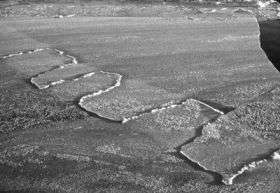
Finger rafting is the block zippered pattern that forms when thin ice sheets floating on water collide creating 'fingers' that push over and under each other alternately. This photo was taken off the Antarctic coast. Credit: W.F. Weeks

A study reported in Physical Review Letters demonstrates how ice sheets sometimes interlace when they meet, rather than riding over or under each other, and discusses the implications for other phenomena from plate tectonics of the Earth's surface to the design of self-assembling nanostructures.

"A surprising pattern, much like the meshed teeth of a zipper, is frequently seen when floating ice sheets collide," said John Wettlaufer, professor of geology & geophysics and of physics at Yale. He and his colleague Dominic Vella of Cambridge University in England demonstrated the underlying principle for the observation. Further, they suggest that the process can work for any materials that share particular physical characteristics of thickness and flexibility.

"When two elastic sheets floating on a liquid collide, intuition leads us to expect one of two results — one sheet might be 'subducted' under the other, as we observe with the earth's crust, or the two might crush each other forming a field of rubble, as we observe in thick ice floes," said Wettlaufer.

The researchers describe a third possibility in their study published in Physical Review Letters. They show that sheets of ice, or in their experiments, sheets of wax, form a series of interlocking blocks -– termed "finger rafting" — that alternately ride over and under one another. It is a curiosity that has vexed scientists for over 50 years.

The natural patterns look like meter-wide rectangular zigzags, and only occur when both sheets of ice are roughly the same thickness. Their theoretical analysis was confirmed experimentally using flexible layers of wax on water to simulate the phenomenon. They demonstrated the relationship between the width of the resulting fingers and the material's mechanical properties.

"We show that this striking observation is a general and robust mechanical phenomenon that we can reproduce in the laboratory with floating materials other than ice," he said. "Our experimental results were consistent with the field observations."

According to Wettlaufer, the findings are relevant for a host of physical systems and, "The same principles might be used for designing nanomachine gears from appropriate materials." He points out that Tuzo Wilson, one of the founders of the theory of plate tectonics, was inspired by the resemblance of structures on floating polar ice sheets to the transform faults and other features of the Earth's moving plates.

Citation: Physical Review Letters 98, 088303 (February 23, 2007) DOI: 10.1103/PhysRevLett.98.088303

Source: Yale University


print this article email this article download pdf blog this article bookmark this article     Stumble it Digg this share on Facebook retweet share on Reddit add to delicious
Rate this story - 4.5 /5 (10 votes)


March 2, 2007 all stories

Comments: 0

4.5 /5 (10 votes)
  • Stumble this up

  • Digg this

  • share this

  • hide
  • Related Stories


  • hide
  • Relevant PhysicsForums posts

  • Rocket Experiment Help
    created 10 hours ago
  • Coulomb's Law
    created 15 hours ago
  • Laser spots
    created 19 hours ago
  • Do you know elementary physics?
    created 21 hours ago
  • More from Physics Forums - General Physics

Other News

Big Bang atom smasher sends beams in 2 directions (AP)

Large Hadron Collider sends beams in 2 directions

Physics / General Physics

created 1hour ago | popularity 5 / 5 (3) | comments 1

(AP) -- The world's largest atom smasher made another leap forward Monday by circulating beams of protons in opposite directions at the same time in the $10 billion machine after more than a year of repairs, ...


Aquatic creatures mix ocean water

Physics / General Physics

created 21 hours ago | popularity 5 / 5 (3) | comments 1

Understanding mixing in the ocean is of fundamental importance to modeling climate change or predicting the effects of an El Niño on our weather. Modern ocean models primarily incorporate the effects of winds and tides. However, ...


Restored machine to explore mysteries of Big Bang (AP)

Restored machine to explore mysteries of Big Bang

Physics / General Physics

created Nov 21, 2009 | popularity 4.6 / 5 (18) | comments 23

(AP) -- Scientists are preparing the world's largest atom smasher to explore the depths of matter after successfully restarting the $10 billion machine following more than a year of repairs.


nuclear power plant

Doubts raised on nuclear industry viability

Physics / General Physics

created Nov 19, 2009 | popularity 3.1 / 5 (21) | comments 19

(PhysOrg.com) -- The investment in nuclear power has been growing around the world over the last few years, being viewed as a means for countries to control their energy security, avoid the price fluctuations ...


Researchers Find Innate Correlations Among Different Power Law Phenomena

Researchers Find Innate Correlations Among Different Power Law Phenomena

Physics / General Physics

created Nov 17, 2009 | popularity 4.3 / 5 (18) | comments 17

(PhysOrg.com) -- Studying the patterns that emerge in natural and social phenomena is a popular area of research, although usually individual phenomena are studied separately from each other. In a recent study, ...