Rosetta, New Horizons team up
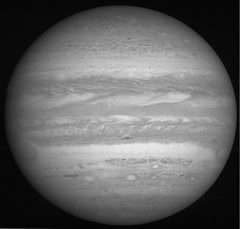
ESA and NASA are mounting a joint campaign to observe Jupiter over the next few weeks with two different spacecraft. Rosetta will watch the big picture from its current position near Mars, whilst New Horizons will take close-up data as it speeds past the largest planet in our Solar System on its journey to Pluto.
The co-ordinated observational campaign of Jupiter using Rosetta and New Horizons began this week. Jupiter remains a fascinating world of scientific mystery. "This is an excellent opportunity to test both spacecraft and to collect valuable science data," says Gerhard Schwhem, Rosetta's Mission Manager.
"We couldn't pass up this opportunity to study Jupiter's meteorology, rings, aurorae, satellites, and magnetosphere," says Alan Stern, Southwest Research Institute, Colorado, and New Horizon's Principal Investigator.
One of Rosetta's targets will be the doughnut-shaped ring of electrically charged gas that circles Jupiter. Known as the Io torus, it lies in Io's orbit and is at its most dense near the volcanic moon, Io.
The best theory for its formation is that Io's volcanoes throw sulphur and sulphur dioxide into space during their eruptions. In space, the atoms and molecules are stripped of their electrons, electrically charging them and turning them in ions. These become trapped by Jupiter's powerful magnetic field and are pulled around every ten hours by the Jupiter's rotation. The result is that the Io torus circles Jupiter at Io's orbital radius.
The idea for the joint observations came from Stern. As well as leading New Horizons, he is also the principal investigator for Rosetta's ALICE instrument.
ALICE is the ultraviolet imaging spectrometer. Designed to analyse gases being given off by Rosetta's target comet, it will allow scientists to deduce the production rates of water vapour, carbon monoxide and carbon dioxide. For the current campaign, it will be the key instrument used to observe Jupiter. Joining the observations will be VIRTIS (the Visible and Infrared Thermal Imaging Spectrometer) and OSIRIS (the Optical, Spectroscopic, and Infrared Remote Imaging System).
Rosetta will study Jupiter for between 6 and 8 days in total, spread over the next few weeks. Each time Rosetta opens its eyes to look at Jupiter, it will do so for several hours at a time, collecting as much light from the faraway planet as possible. "Rosetta will give us the big picture context in which to see the up-close data from New Horizons," says Stern. During this time, New Horizons will be riding the long tail of magnetism that stretches out behind Jupiter and funnels charged particles away.
Rosetta's ALICE was the prototype for the ultraviolet imaging instrument flying on New Horizons. At Pluto, New Horizons' ALICE will be used to study the tiny world's tenuous atmosphere.
ESA's Rosetta was launched on 2 March 2004 and is currently circling the inner solar system using close fly-bys of the Earth and Mars planets to alter its orbit and eventually swing it out towards Jupiter's orbit, where it will rendezvous with comet Churyumov-Gerasimenko in 2014.
Such ventures add value to the science that can come out of the Rosetta mission. "I am sure that this is fascinating science," says Schwhem.
Source: European Space Agency


