Atom 'noise' may help design quantum computers
March 2, 2007 Atom 'noise' may help design quantum computers

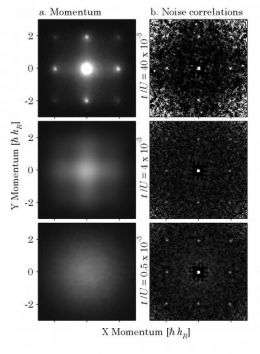
To make images of atom "noise," NIST physicists placed a Bose-Einstein condensate in an optical lattice made of intersecting laser beams, then turned the lattice off and imaged the expanding cloud of atoms. In the images on the left, lighter areas are the highest concentrations of atoms; darker areas are the lowest concentrations of atoms, dappled with noise. On the right are the processed noise images, revealing that the atoms are spaced evenly in the lattice. Credit: NIST

As if building a computer out of rubidium atoms and laser beams weren't difficult enough, scientists sometimes have to work as if blindfolded: The quirks of quantum physics can cause correlations between the atoms to fade from view at crucial times.

What to do? Focus on the noise patterns. Building on earlier work by other groups, physicists at the National Institute of Standards and Technology have found that images of "noise" in clouds of ultracold atoms trapped by lasers reveal hidden structural patterns, including spacing between atoms and cloud size.

The technique, described in the Feb. 23 issue of Physical Review Letters, was demonstrated in an experiment to partition about 170,000 atoms in an "optical lattice," produced by intersecting laser beams that are seen by the atoms as an array of energy wells arranged like an egg carton. By loading just one atom into each well, for example, scientists can create the initial state of a hypothetical quantum computer using neutral atoms to store and process information.

The atoms first are cooled to form a Bose-Einstein condensate (BEC), a unique form of matter in which all the atoms are in the same quantum state and completely indistinguishable. The optical lattice lasers then are slowly turned on and the BEC undergoes a transformation in which the atoms space out evenly in the lattice. More intense light creates deeper wells until each atom settles into its own lattice well. But during this transition, scientists lose their capability to see and measure key quantum correlations among the atoms.

Key structures are visible, however, in composite images of the noise patterns, which reveal not only atom spacing but also cloud size and how much of the BEC has undergone the transition.

In the NIST experiments, the BEC was placed in an optical lattice at various laser intensities. The lattice was turned off, and scientists took pictures of the expanding cloud of atoms after 20 to 30 milliseconds. To identify and enhance the noise signal, scientists looked for identical bumps and wiggles in the images and made composites of about 60 images by identifying and overlaying matching patterns. Lead author Ian Spielman likens the technique to listening to a noisy ballroom: While it may be impossible to hear specific conversations, correlations in noise can show where people (or atoms) are located in relation to each other, and the volume of noise can indicate the size of the ballroom (or atomic cloud), Spielman says.

Citation: I.B. Spielman, W.D. Phillips and J.V. Porto. 2007. The Mott insulator transition in a two dimensional atomic Bose gas. Physical Review Letters. Feb. 23.

Source: National Institute of Standards and Technology


print this article email this article download pdf blog this article bookmark this article     Stumble it Digg this share on Facebook retweet share on Reddit add to delicious
Rate this story - 4.2 /5 (30 votes)


March 2, 2007 all stories

Comments: 0

4.2 /5 (30 votes)
  • Stumble this up

  • Digg this

  • share this

  • hide
  • Related Stories

  • Researchers find the ties that bind electrons in high-temperature superconductivity
    created Apr 10, 2008 | popularity not rated yet | comments 0
  • IBM researchers quell nanoscale interference
    created Mar 07, 2008 | popularity not rated yet | comments 0
  • Strontium atomic clock demonstrates super-fine 'ticks'
    created Nov 30, 2006 | popularity not rated yet | comments 0
  • A new window into the deformation of nanoscale materials
    created Aug 13, 2006 | popularity not rated yet | comments 0
  • Discovering How to Focus on Tiniest of the Very Small
    created Jun 19, 2006 | popularity not rated yet | comments 0


  • hide
  • Relevant PhysicsForums posts

  • Rocket Experiment Help
    created 8 hours ago
  • Coulomb's Law
    created 12 hours ago
  • Laser spots
    created 17 hours ago
  • Do you know elementary physics?
    created 19 hours ago
  • More from Physics Forums - General Physics

Other News

Nuclear weapons: Predicting the unthinkable

Physics / General Physics

created 22 hours ago | popularity 2.6 / 5 (5) | comments 3

If a nuclear weapon were detonated in a metropolitan area, how large would the affected area be? Where should first responders first go? According to physicist Fernando Grinstein, we have some initial understanding to address ...


Generating electricity from air flow

Physics / General Physics

created 22 hours ago | popularity 3.9 / 5 (8) | comments 2

A group of researchers at the City College of New York is developing a new way to generate power for planes and automobiles based on materials known as piezoelectrics, which convert the kinetic energy of motion into electricity. ...


Aquatic creatures mix ocean water

Physics / General Physics

created 18 hours ago | popularity 5 / 5 (3) | comments 1

Understanding mixing in the ocean is of fundamental importance to modeling climate change or predicting the effects of an El Niņo on our weather. Modern ocean models primarily incorporate the effects of winds and tides. However, ...


Restored machine to explore mysteries of Big Bang (AP)

Restored machine to explore mysteries of Big Bang

Physics / General Physics

created Nov 21, 2009 | popularity 4.6 / 5 (18) | comments 21

(AP) -- Scientists are preparing the world's largest atom smasher to explore the depths of matter after successfully restarting the $10 billion machine following more than a year of repairs.


nuclear power plant

Doubts raised on nuclear industry viability

Physics / General Physics

created Nov 19, 2009 | popularity 3.1 / 5 (20) | comments 19

(PhysOrg.com) -- The investment in nuclear power has been growing around the world over the last few years, being viewed as a means for countries to control their energy security, avoid the price fluctuations ...