Frozen lightning: NIST's new nanoelectronic switch
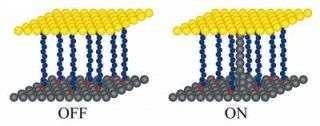
Researchers at the National Institute of Standards and Technology have demonstrated a prototype nanoscale electronic switch that works like lightning—except for the speed. Their proof-of-concept experiments reported last week demonstrate that nanoscale electrical switches can be built from self-assembled layers of organic molecules on silver wires. Potential applications range from a replacement technology for magnetic data storage to integrated circuit memory devices.
Silver would be a natural choice for nanoscale and microscale electrical contacts because of its high conductivity, but it has one notorious drawback. In an electric field, silver ions readily form silver "whiskers," tree-like branching growths of crystals that can short-out microelectronic devices.
Two NIST researchers have demonstrated that this can be a feature, not a bug, in an elegant experiment that uses this growth to make a nanoscale binary switch. In the experiment, an extremely fine silver wire is coated with a molecule that forms a self-assembled monolayer on the wire, typically some organic molecule with a sulfur group on one end to bond to the silver. An equally fine gold wire is laid crosswise to the silver wire and a small voltage is applied across the two wires.
When the voltage is increased to a critical level, silver ions form and quickly branch through the organic monolayer to the gold wire just like a lightning bolt—except solid. When a silver filament reaches the gold, it forms a short circuit, causing a dramatic change in conductance, which is easily detectable. Reversing the voltage retracts the filament and "opens" the switch.
As a candidate logic switch for nanoscale memory circuits and similar devices, the silver whisker switch has several attractive features:
-- The chemistry of the organic monolayer is not critical; the switch works with many different molecules and so can be used with many different self-assembled molecular electronics systems.
-- The crossed-wire structure is very simple to engineer and lends itself to large arrays of switches.
-- The difference between "on" and "off" is huge—electrical resistance ratios of a million or more. This makes it easier to reliably scale up the technology to very large arrays.
Problems to be overcome, according to the researchers, include volatility—the voltage has to be kept on to retain the switch state; slow switching speeds—about 10 kilohertz in the prototype; and a tendency of the switch to freeze permanently closed after a large number of cycles.
Citation: J.M. Beebe and J.G. Kushmerick. Nanoscale switch elements from self-assembled monolayers on silver. Applied Physics Letters 90, 083117 (2007). Posted online Feb. 23, 2007.
Source: National Institute of Standards and Technology


