Computer-designed molecule to clean up fluorocarbons?
March 2, 2007 Computer-designed molecule to clean up fluorocarbons?

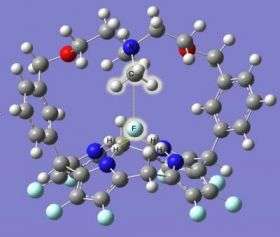
Postmortem: Computer modeling rendition of the proposed carbon-fluorine bond-breaking macrocycle after reaction with a molecule of methyl fluoride (CH3F). Highlighted in the center of the macrocycle, the CH3 fragment has attached to a nitrogen atom, separating it from the fluorine atom which has been grabbed by a group of four hydrogen atoms. The potentially toxic components of the fluorocarbon are immobilized in the macrocycle until removed by a second reaction, an important feature for possible filtering systems. Credit: NIST

The chemical bond between carbon and fluorine is one of the strongest in nature, and has been both a blessing and a curse in the complex history of fluorocarbons. Now, in a powerful demonstration of the relatively new field of "computational chemistry," researchers at the National Institute of Standards and Technology and the Interdisciplinary Network of Emerging Science and Technology group (INEST, sponsored by Philip Morris USA) have designed—in a computer—a wholly theoretical molecule to pull the fluorine out of fluorocarbons.

At sea level, the strong C-F bond makes fluorocarbons thermally and chemically stable. As a result, fluorocarbons have been used in many commercial applications including refrigerants, pesticides and non-stick coatings. In the upper atmosphere, however, high-energy photons and highly reactive ozone molecules can break apart fluorocarbons, with the well-known consequence of a depleted ozone layer and increased ultraviolet radiation at ground level.

A determined chemist can break down fluorocarbons at ground level with certain organometallic compounds, but the reactions take a long time at very high temperatures. Other known reagents are both highly toxic and inefficient, so chemists have been searching for an economical and environmentally friendly method to dispose of fluorocarbons.

Reasoning that the problem already may have been solved by nature, the NIST/Philip Morris team looked to an enzyme called fluoroacetate dehalogenase used by a South African bacterium, Burkholderia sp. The enzyme enables the bacterium to pull the fluoride ion out of sodium fluoroacetate (disrupting a poisonous compound) at room temperature and without problematic metal ions. Enzymes are giant molecules, evolved to survive and work in the complex environment of a living organism; they can be difficult and expensive to adapt to an industrial process.

Instead, the research team applied basic quantum mechanical theory of electron structures in molecules, together with the example of a known molecule that binds to and extracts chlorine ions, to calculate the make-up and geometry of the critical "active site" in the enzyme that does the work. They then designed in software a large ring-shaped molecule to hold those components in just the right orientation to break the C-F bond in methyl fluoride, a simple fluorocarbon.

Researchers at the University of Texas now are synthesizing the new molecule to test its effectiveness. If it matches theoretical predictions, it will be the first example of a simple organic molecular system able to break C-F bonds without extreme temperature and pressure conditions, and a demonstration of a novel technique for designing man-made molecules that can mimic the extraordinary selectivity and chemical activity of natural enzymes. Notes lead researcher Carlos Gonzalez, "All of these useful things are in nature, you just have to find them and make them more efficient."

Citation: F. Hæffner, M. Marquez and C. Gonzalez. Theoretical evidence for C-F bond activation by a fluoro-calix[4]pyrrole-tert-amine macrocycle. J. Phys. Chem. A 2007, 111, 268-272.

Source: National Institute of Standards and Technology


print this article email this article download pdf blog this article bookmark this article     Stumble it Digg this share on Facebook retweet share on Reddit add to delicious
Rate this story - 4.7 /5 (27 votes)


March 2, 2007 all stories

Comments: 0

4.7 /5 (27 votes)
  • Stumble this up

  • Digg this

  • share this

  • hide
  • Related Stories

  • New cancer target for non-Hodgkin's lymphoma
    created 10 hours ago | popularity not rated yet | comments 0
  • Scientists identify DNA that regulates antibody production
    created Nov 20, 2009 | popularity not rated yet | comments 0
  • PLoS Genetics 2009 maize genome collection
    created Nov 19, 2009 | popularity not rated yet | comments 0
  • Beyond genomics, biologists and engineers decode the next frontier
    created Nov 18, 2009 | popularity not rated yet | comments 0
  • Cancers' sweet tooth may be weakness
    created Nov 18, 2009 | popularity not rated yet | comments 0


Other News

New hydrogen-storage method discovered

New hydrogen-storage method discovered

Chemistry / Materials Science

created 11 hours ago | popularity 4.3 / 5 (23) | comments 5

Scientists at the Carnegie Institution have found for the first time that high pressure can be used to make a unique hydrogen-storage material. The discovery paves the way for an entirely new way to approach ...


Accidental discovery produces durable new blue pigment for multiple applications

Accidental discovery produces durable new blue pigment for multiple applications

Chemistry / Biochemistry

created Nov 16, 2009 | popularity 4.5 / 5 (32) | comments 6

An accidental discovery in a laboratory at Oregon State University has apparently solved a quest that over thousands of years has absorbed the energies of ancient Egyptians, the Han dynasty in China, Mayan ...


New on-off 'switch' triggers and reverses paralysis in animals with a beam of light

New on-off 'switch' triggers and reverses paralysis in animals with a beam of light (w/ Video)

Chemistry / Biochemistry

created Nov 18, 2009 | popularity 4.8 / 5 (5) | comments 4

In an advance with overtones of Star Trek phasers and other sci-fi ray guns, scientists in Canada are reporting development of an internal on-off "switch" that paralyzes animals when exposed to a beam of ultraviolet ...


One word: bioplastics

One word: bioplastics

Chemistry / Materials Science

created Nov 17, 2009 | popularity 4.6 / 5 (13) | comments 4

(PhysOrg.com) -- Every year, more than 250 billion pounds of plastic are produced worldwide. Much of it ends up in the world's oceans, a fact that troubles MIT biology professor Anthony Sinskey.


New research provides blueprint for molecular basis of global warming

New research provides blueprint for molecular basis of global warming

Chemistry / Materials Science

created Nov 17, 2009 | popularity 4 / 5 (4) | comments 3

A new study indicates that major chemicals most often cited as leading causes of climate change, such as carbon dioxide and methane, are outclassed in their warming potential by compounds receiving less attention.