Geologists Reveal Secrets Behind Supervolcano Eruption
March 5, 2007 Geologists Reveal Secrets Behind Supervolcano Eruption

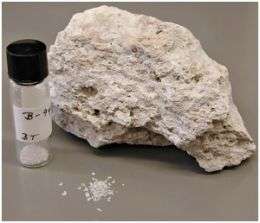
A piece of supervolcano and extracted quartz crystals analyzed for titanium. Credit: Rensselaer Polytechnic Institute/David Wark

Researchers at Rensselaer Polytechnic Institute have discovered what likely triggered the eruption of a “supervolcano” that coated much of the western half of the United States with ash fallout 760,000 years ago.

Using a new technique developed at Rensselaer, the team determined that there was a massive injection of hot magma underneath the surface of what is now the Long Valley Caldera in California some time within 100 years of the gigantic volcano’s eruption. The findings suggest that this introduction of hot melt led to the immense eruption that formed one of the world’s largest volcanic craters or calderas.

The research, which is featured in the March 2007 edition of the journal Geology, sheds light on what causes these large-scale, explosive eruptions, and it could help geologists develop methods to predict such eruptions in the future, according to David Wark, research professor of earth and environmental sciences at Rensselaer and lead author of the paper.

The 20-mile-long Long Valley Caldera was created when the supervolcano erupted. The geologists focused their efforts on Bishop Tuff, an expanse of rock that was built up as the hot ash cooled following the eruption. The researchers studied the distribution of titanium in quartz crystals in samples taken from Bishop Tuff.

A team from Rensselaer previously discovered that trace levels of titanium can be analyzed to determine the temperature at which the quartz crystallized. By monitoring titanium, Wark and his colleagues confirmed that the outer rims of the quartz had formed at a much hotter temperature than the crystal interiors. The researchers concluded that after the interiors of the quartz crystals had grown, the magma system was “recharged” with an injection of fresh, hot melt. This caused the quartz to partly dissolve, before starting to crystallize again at a much higher temperature.

Analyses of titanium also revealed that the high-temperature rim-growth must have taken place within only 100 years of the massive volcano’s eruption. This suggests that the magma recharge so affected the physical properties of the magma chamber that it caused the supervolcano to erupt and blanket thousands of square miles with searing ash.

“The Long Valley Caldera has been widely studied, but by utilizing titanium in quartz crystals as a geothermometer we were able to provide new insight into the reasons for its last huge eruption,” Wark said. “This research will help geologists understand how supervolcanoes work and what may cause them to erupt, and this in turn may someday help predict future eruptions.”

Source: Rensselaer Polytechnic Institute


print this article email this article download pdf blog this article bookmark this article     Stumble it Digg this share on Facebook retweet share on Reddit add to delicious
Rate this story - 4.4 /5 (36 votes)


March 5, 2007 all stories

Comments: 0

4.4 /5 (36 votes)
  • Stumble this up

  • Digg this

  • share this

  • hide
  • Related Stories

  • 3-D system based on optical fiber could provide new options for photovoltaics
    created Nov 02, 2009 | popularity not rated yet | comments 0
  • Russian Titanium
    created Jul 29, 2005 | popularity not rated yet | comments 0
  • Will a footprint rewrite the history books?
    created Jul 05, 2005 | popularity not rated yet | comments 0
  • Petrified Wood in Days
    created Jan 25, 2005 | popularity not rated yet | comments 0
  • Earth's early ocean cooled more than a billion years earlier than thought (w/ Video)
    created Nov 11, 2009 | popularity not rated yet | comments 0


  • hide
  • Relevant PhysicsForums posts

  • Climate Science Update
    created 2 hours ago
  • The IPCC and the term "most"
    created Nov 23, 2009
  • Is global warming a fact?
    created Nov 23, 2009
  • Random variability of wind patterns
    created Nov 23, 2009
  • More from Physics Forums - Earth

Other News

Past regional cold and warm periods linked to natural climate drivers

Space & Earth / Earth Sciences

created 21 hours ago | popularity 3.7 / 5 (13) | comments 22

Intervals of regional warmth and cold in the past are linked to the El Niño phenomenon and the so-called "North Atlantic Oscillation" in the Northern hemisphere's jet stream, according to a team of climate scientists. These ...


China is set to launch its second moon orbiter next October, state media have reported

China to launch second lunar probe: state media

Space & Earth / Space Exploration

created 4 hours ago | popularity 5 / 5 (3) | comments 0

China will launch its second moon orbiter next October, state media reported Friday, as it powers ahead with a space programme that has sparked concerns abroad.


Space shuttle Atlantis, 7 astronauts back on Earth

Space & Earth / Space Exploration

created 50 minutes ago | popularity not rated yet | comments 0

(AP) -- Space shuttle Atlantis and its seven astronauts returned to Earth with a smooth touchdown Friday to end an 11-day flight that resupplied the International Space Station.


In Greenland, warming fuels dream of hidden wealth (AP)

In Greenland, warming fuels dream of hidden wealth

Space & Earth / Environment

created 3 hours ago | popularity 3 / 5 (3) | comments 0

(AP) -- Gert Ignatiussen returns to this fjord-front Inuit town with the spoils of his hunting trip. Six seals, all killed with a single shot to the head.


New climate targets may not change daily life much (AP)

New climate targets may not change daily life much

Space & Earth / Environment

created 3 hours ago | popularity 1 / 5 (1) | comments 0

(AP) -- Americans' day-to-day lives won't change noticeably if President Barack Obama achieves his newly announced goal of slashing carbon dioxide pollution by one-sixth in the next decade, experts say.