Ship Excavation Sheds Light on Napoleon's Attack on the Holy Land
March 5, 2007 Ship Excavation Sheds Light on Napoleon's Attack on the Holy Land

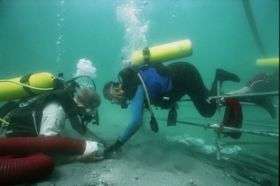
Marine archaeology excavations off the coast of Acre. Credit: Steve Breitstein

Which navy commissioned the boat that sunk off the coast of Acre 200 years ago, which battles was it involved in and how did it end up at the bottom of the sea? The recent findings of marine archaeologists at the Leon Recanati Institute for Maritime Studies of the University of Haifa may provide the answers to these questions.

The ship, which sunk off the coast of Acre during a battle between Napoleon, the British navy and possibly the defenders of Acre, 200 years ago, is under excavation and its finds are beginning to shed light on Napoleon's attempt to conquer the Holy Land.

Recent marine excavations found cannon balls, canisters of gun powder and other items that will help give evidence as to the ship's journey and answer the questions facing marine archaeologists. It is not clear if the boat was involved in battles in 1799 or 1840, if it was a French or British boat or even if the boat sunk or was sunk. "This is the only shipwreck excavated from the period of the French blockade of Acre and it can teach us a lot about the naval battles of that period," explained Dr. Ya'acov Kahanov from the Leon Recanati Institute for Maritime Studies and the Department Of Maritime Civilizations at the University of Haifa.

This large ship, 30 meters long and 9 meters wide, was discovered off the Acre coast in 1966, but systematic excavations have only just begun under the auspices of the Leon Recanati Institute for Maritime Studies of the University of Haifa in cooperation with the Nautical Archaeology Society of Great Britain and with the help of the Nautical College for Naval Officers in Acre. The fact that cannon balls, gun powder canisters, wineskins and metal buckles were found, attest to the fact that this ship was part of a naval fleet. The question of which battle it was involved in has yet to be answered, but the archaeologists do have some theories.

It seems that the story of this boat begins over 200 years ago. Researchers found a map in a British archive, drawn in 1799 by a British soldier, of the British formation off the coast of Acre, facing a blockade of Napoleon's ships. The map includes a symbol of a sunken ship, at exactly the spot where this ship was found. This map is the source of the theory that this ship was involved in the battles of 1799. In addition, one of the cannon balls was found wedged into the keel of the boat, exactly at the bottom. The location and the unique angle at which the cannon ball is positioned, has led researchers to believe that it was this cannon ball that sank the ship.

"One of the theories is that this is a "barricade ship" - a ship that the British purposely sunk at the entrance of the port in order to block smaller French ships from entering it. The leather buckles, gun power canisters and the rest of the finds need to be analyzed to verify how the ship ended up at the bottom of the sea. Once we understand these questions, we will be able to understand more about battle tactics of that period, "said Dr. Kahanov.

Source: University of Haifa


print this article email this article download pdf blog this article bookmark this article     Stumble it Digg this share on Facebook retweet share on Reddit add to delicious
Rate this story - 3.5 /5 (2 votes)


March 5, 2007 all stories

Comments: 0

3.5 /5 (2 votes)
  • Stumble this up

  • Digg this

  • share this

  • hide
  • Related Stories

  • Could cannon balls from the early 19th century sink warships?
    created Jul 15, 2009 | popularity not rated yet | comments 0
  • Beer Here
    created 21 hours ago | popularity not rated yet | comments 0
  • Design chosen for British 1,000 mph car (w/ Video)
    created Nov 25, 2009 | popularity not rated yet | comments 0
  • Alternative animal feed part of global fisheries crisis fix: study
    created Nov 17, 2009 | popularity not rated yet | comments 0
  • Russian rocket to launch from French Guiana in 2010
    created Nov 07, 2009 | popularity not rated yet | comments 0


  • hide
  • Relevant PhysicsForums posts

  • Selenocysteine in pH=7
    created 2 hours ago
  • What is the formula for calculating the speed of thought?
    created 7 hours ago
  • What does word "absorption" mean in the intestine?
    created 7 hours ago
  • What is transpulmonary pressure?
    created Nov 24, 2009
  • More from Physics Forums - Biology

Other News

Message gone viral? Blame it on altruistic, yet image-conscious Internet  'e-mavens'

Message gone viral? Blame it on altruistic, yet image-conscious Internet 'e-mavens'

Other Sciences / Economics

created 3 hours ago | popularity 2 / 5 (1) | comments 0

(PhysOrg.com) -- Why do some online ad campaigns go viral while other online marketing messages gather "cyber-dust" on the information superhighway? The key may lie in the motivation of Internet users to email ...


Study: Race, class and gender shape religion's effect on American voters

Other Sciences / Social Sciences

created 21 hours ago | popularity not rated yet | comments 0

(PhysOrg.com) -- How Americans vote is strongly linked to their religious identities, but it is not an independent influence that transcends race, socio-economic class and gender, reports a new Cornell study.


Researcher: Faint writing seen on Shroud of Turin (AP)

Researcher: Faint writing seen on Shroud of Turin (Update)

Other Sciences / Archaeology & Fossils

created Nov 20, 2009 | popularity 2.4 / 5 (30) | comments 40

(AP) -- A Vatican researcher has rekindled the age-old debate over the Shroud of Turin, saying that faint writing on the linen proves it was the burial cloth of Jesus. Experts say the historian may be reading ...


Explained: The Discrete Fourier Transform

Explained: The Discrete Fourier Transform

Other Sciences / Mathematics

created Nov 25, 2009 | popularity 4.2 / 5 (25) | comments 8

(PhysOrg.com) -- In 1811, Joseph Fourier, the 43-year-old prefect of the French district of Isčre, entered a competition in heat research sponsored by the French Academy of Sciences. The paper he submitted ...


Climate change could boost incidence of civil war in Africa

Other Sciences / Social Sciences

created Nov 23, 2009 | popularity 2.4 / 5 (16) | comments 9

Climate change could increase the likelihood of civil war in sub-Saharan Africa by over 50 percent within the next two decades, according to a new study led by a team of researchers at University of California, Berkeley, ...