Study documents evidence of 'mafia' behavior in cowbirds
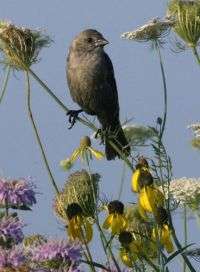
“The Sopranos” have some competition — brown-headed cowbirds. Cowbirds have long been known to lay eggs in the nests of other birds, which then raise the cowbirds’ young as their own. Sneaky, perhaps, but not Scarface.
Now, however, a University of Florida study finds that cowbirds actually ransack and destroy the nests of warblers that don’t buy into the ruse and raise their young.
Jeff Hoover, an avian ecologist at the Florida Museum of Natural History, is the lead author on the first study to document experimental evidence of this peeper payback — retaliation to encourage acceptance of parasitic eggs.
Findings will be published online in the Proceedings of the National Academy of Sciences March 5.
“It’s the female cowbirds who are running the mafia racket at our study site,” said Hoover, who has a joint appointment with the Illinois Natural History Survey. “Our study shows many of them returned and ransacked the nest when we removed the parasitic egg.”
So-called “brood parasitic birds” lay eggs in the nests of host birds that raise the parasite’s offspring, usually at the expense of some of their own. The brown-headed cowbird parasitizes more than 100 host species, including many Neotropical migratory birds such as warblers, tanagers and vireos. Prothonotary warblers were used for this study because they almost always accept cowbird eggs, Hoover said.
Hosts that use their beaks to grasp or puncture parasitic eggs and remove them from the nest are called “ejecters.” “Accepter” hosts raise parasitic eggs.
“Retaliatory mafia behavior in cowbirds makes hosts’ acceptance of cowbird eggs a better proposition than ejection,” Hoover said. “The accepting warblers in our study produced more of their own offspring, on average, than those where we ejected cowbird eggs.”
Hosts may lose some, but not all, of their biological offspring by accepting parasitism. The retaliatory behavior of ransacking nests encourages warblers to raise the cowbirds’ offspring.
“We wanted to determine if the cowbirds were responsible for nest predation after we removed cowbird eggs from parasitized warbler nests,” Hoover said. To test for this, Hoover collaborated with Scott Robinson, Florida Museum Ordway eminent scholar and natural history chair, to manipulate cowbird access to warbler nests in the Cache River watershed of southern Illinois. The researchers monitored 182 predator-proofed nests over four breeding seasons.
Hoover and Robinson found that warbler nests were ransacked 56 percent of the time when researchers experimentally removed the parasitic eggs and cowbirds were allowed nest access, versus only 6 percent when the cowbird eggs were accepted and cowbirds had nest access. No nests were ransacked when researchers removed cowbird eggs and cowbirds were denied nest access. Together, these results implicate cowbirds and provide evidence of mafia behavior.
“We also found evidence for ‘farming’ behavior,” Hoover said. “Cowbirds ‘farm’ a non-parasitized nest by destroying its contents so that the host will build another. The cowbird then syncs its egg laying with the hosts’ ‘renest’ attempt.”
Hoover found that warbler nests that were never parasitized but that cowbirds had access to, were ransacked 20 percent of the time. “Cowbirds parasitized 85 percent of the renests, which is strong supporting evidence for both farming and mafia behavior,” he said.
Hoover and Robinson’s results imply that cowbirds actively monitor nests they parasitize — which supports the idea that cowbirds continue to visit nests they have parasitized to see the results of their handiwork.
Stephen Rothstein, a zoology professor at the University of California in Santa Barbara, said other studies have shown evidence contrary to mafia and farming behaviors.
“Video surveillance would show the proportion of nest predation attributable to cowbirds,” Rothstein said. “The phenomenon may be perfectly true for these warblers, but that doesn’t mean it holds true for other species, especially those that aren’t nesting in special circumstances. Nevertheless, this new study may extend our knowledge of the extent to which parasitic cowbirds may have evolved tactics to facilitate their parasitism.”
Hoover said his future research includes video surveillance of individually banded female cowbirds and warbler nests.
Source: University of Florida


