Researchers Decipher The Buzzing Of Bees
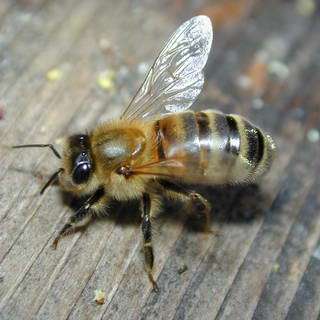
Everyone has heard of the canary in the coal mine, which sways or drops dead in the presence of poisonous gas, alerting miners to get out. Now a University of Montana research team has learned to understand the collective buzzing of bees in their hives, which can provide a similar biological alert system.
But bees evidently provide a lot more information than canaries. The researchers, who work for a UM spin-off technology company called Bee Alert Technology Inc., have found that the insects buzz differently when exposed to various poisonous chemicals.
“We found bees respond within 30 seconds or less to the presence of a toxic chemical,” said Research Professor Jerry Bromenshenk. “The military is interested in that for countering terrorism. But the real surprise was that the sounds bees produce can actually tell what chemical is hitting them.”
The insects also make different sounds when attacked by honeybee maladies such as varroa mites or foul brood. This may lead to applications that help beekeepers maintain healthy hives.
“We can tell not only whether the colony has mites or not,” Bromenshenk said, “but also the level of infestation they have. The sounds they make change with every stressor in characteristic ways.”
Scott Debnam, a Bee Alert field technician and self-described “bee whisperer,” said people have known for centuries that hives make a different sound when the queen is removed. Now modern listening equipment and computer software have revealed a secret bee vocabulary much more intricate than previously thought.
Bees lack sound-making organs, but they buzz by vibrating their wings and bodies and pushing air through spiracles -- tiny airways used for respiration. Debnam said Bee Alert discovered the unique hive sounds two years ago while studying how bees react to a poisoning event. The bees were filmed, recorded and counted, and it soon became apparent that sound was the best medium for determining if something toxic had entered the hive.
“We poisoned them with off-the-shelf stuff like acetone and malathion -- the types of poisons they might encounter in an agricultural situation,” he said. “They responded within 30 seconds, which is amazing.”
Debnam said bees recycle the air in their hives every three minutes and never sleep, so they can provide 24-hour air monitoring, seven days a week. “With some chemicals you can hear they don’t like it,” he said. “With the solvent toulene, for example, you hear their buzz go to BZZZZZZZZZZ just like that.”
For most chemical agents, however, a more exacting instrument than the human ear is needed. UM electronics technician Dave Plummer designed a listening device that’s basically a human hearing aid on a stick. However, if you leave it in a hive for an extended period, all you will hear is “crash, crash” noises as the bees try to pull the foreign object out of the hive or plug the end of the microphone. So Plummer had to create a special screen cage to protect the microphone.
The device records the same type of “.wav” audio files used for digital music. UM software engineer Larry Tarver designed a mathematical algorithm that allows a computer to analyze these files.
“Most of the time for bees their normal sound range is 200 to 400 hertz,” Tarver said. “When they get dosed with something, they really go to a high amplitude.”
He said his program creates a running average to weed out incidental noises such as doors slamming or horns honking. Bee Alert’s Colin Henderson, a faculty member at UM’s College of Technology, then examines the audio samples with statistical analysis software. The end result is an electronic signature for each type of chemical or malady affecting the honeybees.
“To be honest, when I was collecting sounds in the field, I thought, ‘Oh, this isn’t working,’” Debnam said. “But I was wrong. You just can’t hear this stuff with the human ear.”
Bee Alert uses “smart hives” filled with electronics to monitor bee colonies, and these can be adapted to monitor hive sounds. So if a hive is sprayed with chemicals or invaded by pests or diseases, the sounds can be analyzed and a signal sent immediately via satellite to a beekeeper’s computer or cell phone.
The researchers also hope to create a handheld listening device that beekeepers can use on hives to instantly tell whether the bees are healthy.
“What we are trying to do is revolutionize bee technology,” said Steve Rice, an electronics engineer and COT instructor. “Patents are pending on a lot of this.”
The new audio technology also helps distinguish different bee species. Debnam said there already is a device that can tell the difference between 100 percent European honeybees (the agricultural standard) and 100 percent African bees (also known as killer bees). However, European and African bees interbreed, and the Bee Alert audio technology seems to detect when they have intermingled.
“You don’t want Africanized bees,” Rice said. “They get angry easily.”
There also is some evidence the audio technology can differentiate between the multiple types of beneficial European honeybees used in agriculture. This can be useful to the Montana beekeeper, for example, who needs Russian honeybees instead of the Italian variety that are more susceptible to mites. A simple swipe of a handheld device and the beekeeper knows if the bees she ordered are right.
Besides doing statistical analysis to study bee noises, Bee Alert is using artificial neural networks to examine the buzzes. Information systems manager Robert Seccomb said ANN technology can recognize complex patterns on sonograms and is used a lot in voice-recognition software.
“It’s not 100 percent accurate, but it’s a lot quicker than statistical analysis,” Seccomb said. “Once we build up a sufficiently large library of recordings, I’m pretty sure ANN will give another method of analyzing the sounds.”
He said if the statistical analysis method and ANN both agree on the meaning of a buzz, “we’ll know pretty much what the answer is. If one says ‘yes’ and the other says ‘no,’ then we will say this is a questionable one, and you should check it out anyway.”
Honeybees are vitally important to the success of humanity -- not because they produce honey but because they pollinate the majority of our crops. Debnam said Albert Einstein once claimed that if all bees disappeared tomorrow, then all people would follow a scant four years later.
“We think this new technology can help bees and revolutionize beekeeping,” Debnam said. “If you took a picture of beekeeping from 1947, it would look just like a bee yard today -- with the same smoker and other tools. Our audio technology might be one of the bigger things to come along.”
Source: University of Montana


